
Product Comparison
Best Stackable Water Storage Containers
Stacking is how a small home holds a two-week supply without giving up a room. It is also how a closet floor ends up carrying five hundred pounds. Here is what two makers of stackable containers actually publish, and what a stack weighs.

The comparison
Stackable water storage containers, compared from what the makers state
Stackable water storage containers come in two very different sizes: small bricks you can lift and cross-stack, and large tanks that stack only a level or two and never move again.
Both products below are sold as stackable, and both makers publish a capacity and a material. Every other cell either quotes the maker, shows labelled arithmetic, or says plainly that the maker does not state it.
| Attribute | WaterBrick Standard | Emergency Water Tanks 55 Gallon Stackable Tank |
|---|---|---|
| Capacity | “3.5 gallon container” Stated | “55 Gallons” Stated |
| Material | “HDPE (High Density Polyethylene resin)” Stated | “rotationally-molded plastic” Stated |
| Food-contact statement | “BPA Free FDA Compliant Materials” Stated | “BPA Free: Yes.” FAQ: “food-grade materials.” Stated |
| Dimensions | “9″ Width, 18″ Length, 6″ Height” Stated | “27.75 L x 21.75 W x 29.5 H” Stated |
| Empty weight | “2.52 pounds” Stated | “22 Lbs” Stated |
| Water weight when full | About 29.2 lb Calculated | About 458 lb Calculated |
| Floor area per unit | About 1.1 sq ft Calculated | About 4.2 sq ft Calculated |
| Maximum stack height | Not stated by the manufacturer. Not stated | Not stated by the manufacturer. Not stated |
| Dispensing | Not stated by the manufacturer. Not stated | “1 x 3/4 GHT Lead Free Brass Spigot” Stated |
How this table was built. Only products whose makers state both a capacity and a material appear, and only attributes one of them publishes are columns. Anything unpublished reads “not stated by the manufacturer”; a blank would look like a “no”. Water weight is gallons × 8.329 lb. Floor area is length × width from the stated dimensions. Both makers also publish a filled weight: WaterBrick states “27 pounds” and the tank maker “490 Lbs”. The arithmetic gives about 31.7 lb and 480 lb once the stated empty weight is added, so plan with the heavier number of each pair. Scepter’s 5-gallon can, covered in the container guide, is left out because its maker does not state that it stacks. Nothing was tested.
Try it
What a stack of water storage containers weighs
A stack of water storage containers weighs gallons times 8.329 pounds, plus each container’s own weight, and all of it lands on the few square feet under the stack.
The CDC and Ready.gov both set the storage allowance at a minimum of 1 gallon per person per day, for drinking and sanitation, and the CDC suggests a 2-week supply if possible. For a household of four that is 56 gallons. Choose a container, a household and a stack height to see how many units that takes and how hard they press on the floor.
Stack weight and floor load
Every figure is arithmetic from the stated dimensions and weights above.
How this is worked out. Containers is people × days ÷ capacity, rounded up. Weight is containers × (capacity × 8.329 + stated empty weight). Floor area is the number of columns × one unit’s length × width. Load is weight ÷ floor area. The tank option stops at 2 layers.
What it will not do. Neither maker states a maximum stack height, so no height here is a recommendation. It publishes no floor rating either; a shelf, deck or upper floor is a question for its maker, a structural engineer or your building manager.
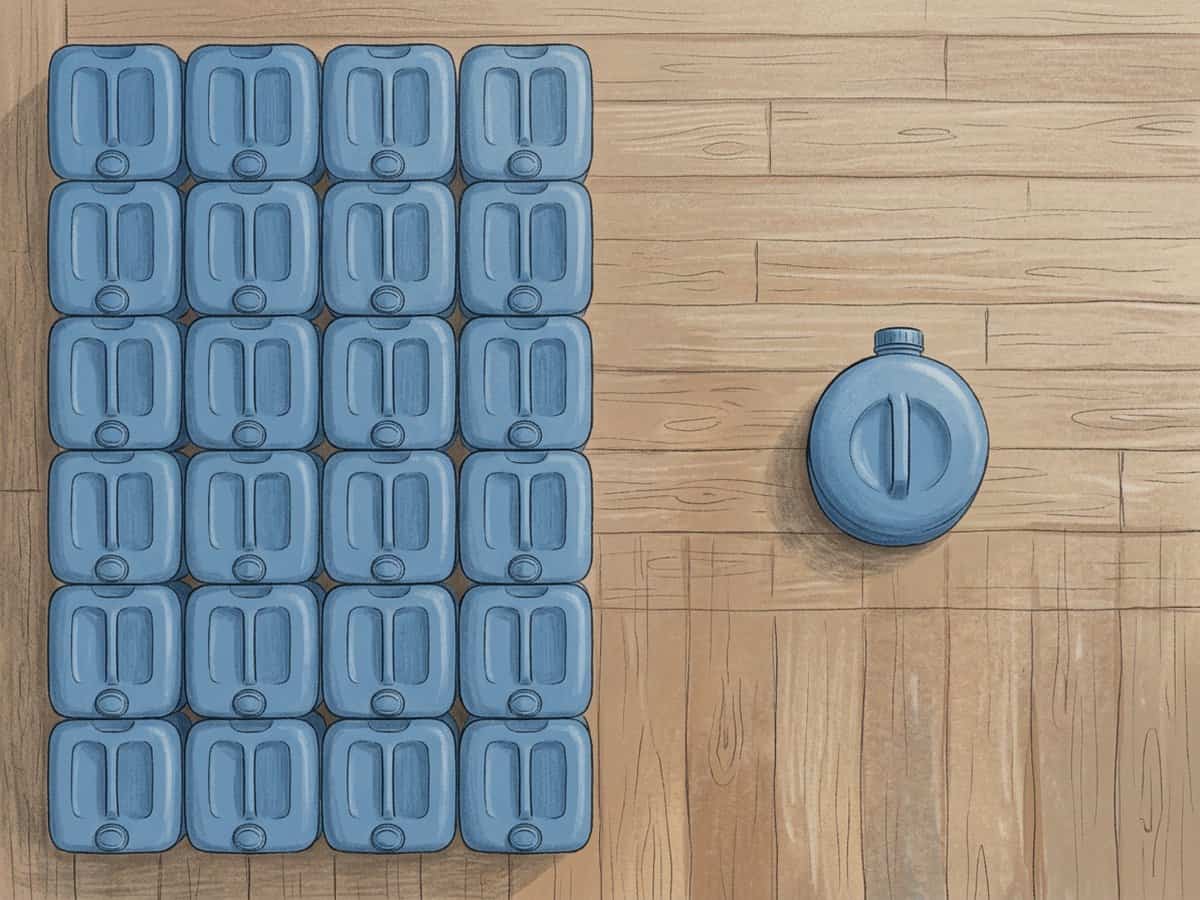
The default answer is worth reading slowly. Sixteen bricks four high put about 507 pounds on 4.5 square feet, roughly 113 pounds on every square foot (calculated). Two 55-gallon tanks stacked hold 110 gallons and weigh about 960 pounds on a little over 4 square feet. Tall stacks save floor space by concentrating weight.
What decides it
How to stack water storage containers safely
Stack water storage containers on the floor, not on shelving, keep them out of sunlight and away from chemicals, and keep a stack low enough that you can lift the top unit off.
Where a stack belongs
- WrongA tall tower on a wire shelf in a sunny window.
- RightA low, cross-stacked block on the floor, in shade, against a wall.
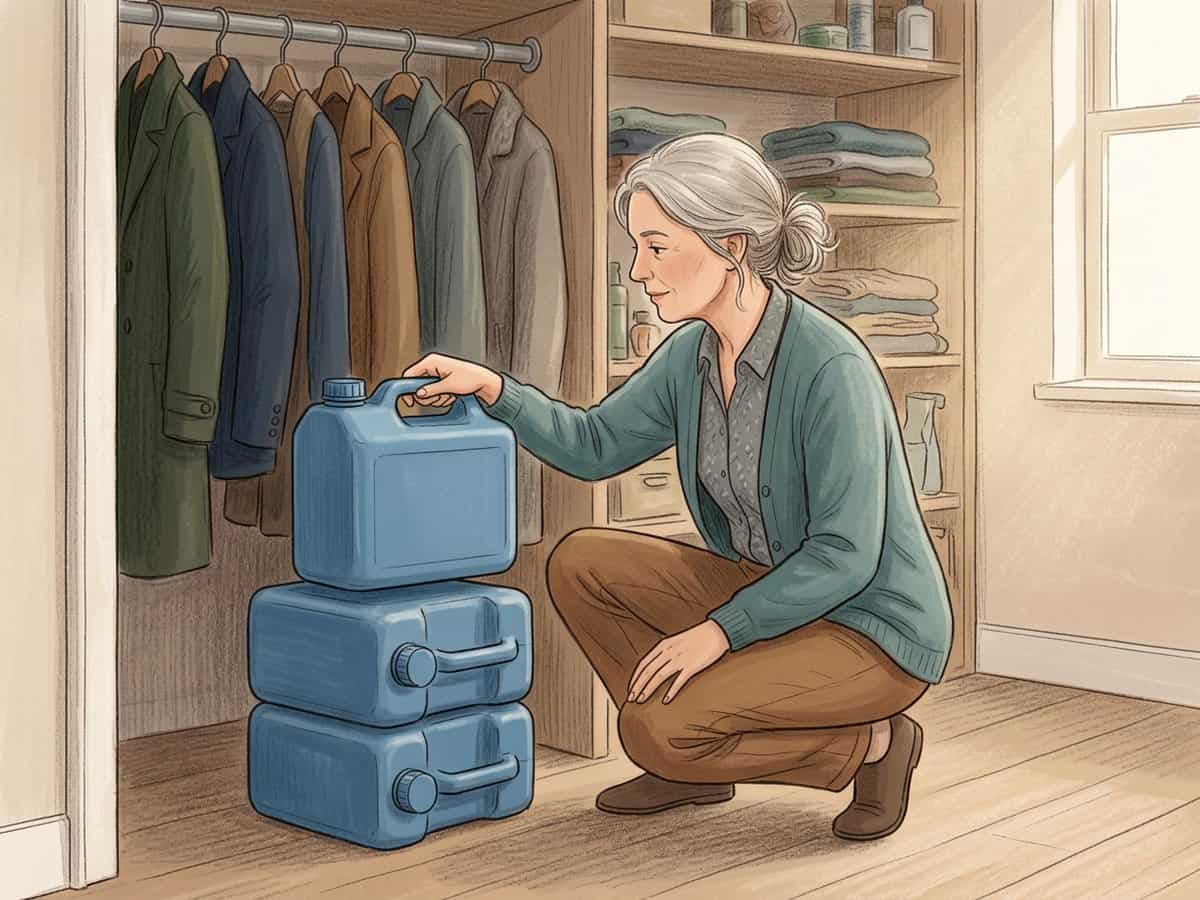
- Put it on the floor. A stack of water storage containers belongs on a floor, not a shelf. Four layers of bricks load a floor at about 113 pounds per square foot (calculated); most household shelving publishes no rating at all.
- Pick a cool, dark spot. The CDC says to store water between 50°F and 70°F, out of direct sunlight, and away from toxic substances such as gasoline and pesticides. The tank maker also excludes “tank damage from sun exposure” from its warranty.
- Fill in place. A 55-gallon tank holds about 458 pounds of water (calculated). Set it where it will live, then fill it. Bricks can be filled and carried, at about 31.7 pounds each.
- Keep the top unit liftable. A stack you cannot unstack is a stack you will not rotate. The CDC says to replace home-filled water every 6 months, which means taking the stack apart twice a year.
- Label the front. The CDC says to label containers “drinking water” with the storage date. Face the labels out so you can read them without moving anything; the rotation schedule builds the replace-by dates for you.
The products
The two stackable water storage containers checked at the manufacturer
Both containers below were checked against their makers’ own product pages in September 2026, and each card prints only what that maker states or what arithmetic shows.
Small and liftable
WaterBrick Standard, 3.5 gallons
- Capacity: “3.5 gallon container” Stated
- Material: “HDPE (High Density Polyethylene resin)” Stated
- Food contact: “The container, lid and gasket are all BPA free and FDA compliant materials in order to store water and food” Stated
- Size: 9 × 18 × 6 inches Stated
- Filled weight: about 31.7 lb (the maker states 27 pounds) Calculated
- Maximum stack height: Not stated by the manufacturer. Not stated
View WaterBrick Standard containers on Amazon
View a larger WaterBrick Standard multi-pack on Amazon
Affiliate links. Both listings are the same 3.5-gallon Standard model; pack size and colour differ between them, so check the one you choose.
Large and fixed
Emergency Water Tanks 55 Gallon Stackable Tank
- Capacity: “55 Gallons” Stated
- Construction: “rotationally-molded plastic”; “lead-free materials” Stated
- Outlet: “1 x 3/4 GHT Lead Free Brass Spigot”; lid “5″ Threaded Lid with Vent” Stated
- Warranty: “1-Year Standard”, extendable to 5 years if registered within 30 days Stated
- Water weight when full: about 458 lb Calculated
- Food-grade statement: “Food-grade materials” (maker’s FAQ); FDA or NSF certification not stated. Stated
- Maximum stack height: Not stated by the manufacturer. Not stated
View the 55-gallon stackable tank on Amazon
Affiliate link. The Amazon title calls this tank “Food Grade”; the maker’s own product page does not, so this page does not print that claim. Ask the maker to confirm in writing before you buy. The listing also offers a water preserver add-on; this site does not cover treatment products on storage pages.
Looking for a smaller stackable jug instead? Browse stackable 5-gallon containers on Amazon (affiliate link to a search, not a checked product). Keep only listings whose maker states a capacity, a material and food-grade or drinking-water use, and skip storage totes and fuel cans.
How these cards were built. WaterBrick figures come from its product specifications page; the tank figures come from its maker’s product and warranty pages. Neither listing’s price, rating or pack count is printed. Cost per usable gallon is the comparison worth making on the listing: divide the price by the gallons it holds.
The exclusions
Who stackable water storage containers are not for
Stackable water storage containers are the wrong choice for anyone who cannot lift about 32 pounds repeatedly, or who has no ground-level floor to put a stack on.
- Not for you if lifting a 31.7-pound brick off a stack isn’t safe and repeatable for you. Smaller bottles or sealed commercial water may suit you better.
- Not for you if your only space is shelving with no load rating. The weight check above shows why.
- Not for you if you rent an upper-floor unit and are considering the 55-gallon tank. Two full tanks weigh close to half a ton; ask your building manager first.
- Not for you if you move often. A tank must be drained to move, and refilling on every move quietly becomes never refilling.
- Not for you if you need a documented food-grade statement for the tank. Its maker’s page does not give one.
For the whole plan, see the emergency water storage guide. For quantities, use the emergency water storage calculator. For a single large supply with a pump-free spigot, see 55 gallon water barrel kits.
Questions
Common questions about stackable water storage containers
Short answers to what people ask before buying stackable containers.
WaterBrick’s product specifications page does not state a maximum household stack height. It gives a shipping figure, 150 cross-stacked per pallet, which is not a home limit. Keep a stack on the floor and low enough to lift the top brick off.
WaterBrick states a filled Standard brick weighs 27 pounds. The arithmetic gives more: 3.5 gallons at 8.329 pounds per gallon is about 29.2 pounds of water, plus the stated 2.52-pound empty weight, about 31.7 pounds. Plan with the heavier figure.
WaterBrick states that the container, lid and gasket are BPA free and FDA compliant materials for storing water and food, and that the container is HDPE. That is the maker’s statement; this page did not test it. The CDC recommends FDA-approved food-grade containers for stored water.
One WaterBrick holds 3.5 gallons on about 1.1 square feet, so four layers hold about 12.4 gallons per square foot of floor (calculated). One 55-gallon stackable tank holds about 13 gallons per square foot before it is stacked at all.
The CDC says to replace stored water you filled yourself every 6 months. Sealed commercial bottled water follows the date and storage instructions on the product instead.
Sources
Where these facts come from
Agency figures and manufacturer statements, each checked in September 2026.
- WaterBrick International, “Product Specifications.” waterbrick.org — 3.5 gallon container; 9″ × 18″ × 6″; empty weight 2.52 pounds; filled 27 pounds; HDPE; BPA free, FDA compliant materials; 150 cross-stacked per pallet. Checked September 2026.
- Emergency Water Tanks (a division of Hive Plastics), “55 Gallon Stackable Emergency Water Storage Tank.” emergencywatertanks.com — 55 gallons; 27.75 × 21.75 × 29.5 in; 22 lbs empty, 490 lbs full; BPA free; 5″ threaded lid with vent; 3/4 GHT lead-free brass spigot; rotationally-molded plastic. And “Warranty,” emergencywatertanks.com — 1-year standard, 5-year extended with registration; sun damage excluded. Checked September 2026.
- Centers for Disease Control and Prevention, “How to Create and Store an Emergency Water Supply” (reviewed June 27, 2025). cdc.gov — 1 gallon per person per day; 2-week supply if possible; FDA-approved food-grade containers; label and date; replace every 6 months; 50°F–70°F, out of sunlight, away from gasoline and pesticides. Checked September 2026.
- Ready.gov, “Water.” ready.gov — at least 1 gallon per person per day for drinking and sanitation. Checked September 2026.
- U.S. Geological Survey, “Water Density.” usgs.gov — 8.329 pounds per U.S. gallon at 70°F. Checked September 2026.