Emergency Water Storage
Emergency Water Storage for Pets
Most pet water numbers online have no source behind them. Here is what the agencies actually publish, the only per-animal figures that exist, and how to add your dog or cat to the household supply.
For emergency water storage for pets, Ready.gov says to store a water bowl and several days’ supply of water, and the AVMA says at least 7 days’ supply. Neither publishes a volume per animal. The only per-animal figures are veterinary normal intakes from Cornell: about 40–60 mL per kg of body weight a day for dogs and about 4 fl oz per 5 lb of lean body weight a day for cats. At those rates a 50 lb dog drinks about 1.7–2.5 gallons over 7 days (calculated), on top of the household’s gallon per person per day.
What you’ll learn
The short version
Emergency water storage for pets means adding each animal’s drinking water to the household supply, for at least the 7 days the AVMA asks for, using the only published per-animal figures.
- Ready.gov: a water bowl and several days’ supply of water. No volume.
- AVMA: at least 7 days’ supply of water. No volume.
- CDC: consider storing more than the 1-gallon-per-person baseline if you have pets.
- Cornell veterinary normal intake: dogs about 40–60 mL per kg a day; cats about 4 fl oz per 5 lb of lean weight a day.
- Those figures are drinking water for a healthy animal, not an emergency recommendation. Ask your veterinarian about your own pet.
Step 1
What the agencies actually say about pet water
The emergency agencies tell pet owners how long to store water for, not how much: no federal preparedness page publishes a water volume per animal.
Ready.gov, the federal preparedness site run by the Department of Homeland Security, has a dedicated page for pets. Its kit list says: “Water. Store a water bowl and several days’ supply of water.” Ready.gov’s general build-a-kit page lists “pet food and extra water for your pet” among the additional items to consider. The American Veterinary Medical Association (AVMA), the national professional body for veterinarians, is more specific about time: its evacuation kit calls for “at least 7 days’ supply of water.”
| Source | What it says | Volume per animal |
|---|---|---|
| Ready.gov, pets page | Store a water bowl and several days’ supply of water | None published |
| Ready.gov, water page | 1 gallon per person per day for people | None published for animals |
| CDC, emergency water | Consider storing more water than the baseline for pets | None published |
| AVMA | At least 7 days’ supply of water; a collapsible water bowl | None published |
That silence is the honest starting point: “one gallon per pet per day” is not agency guidance. The Centers for Disease Control and Prevention (CDC) comes closest, saying to consider storing more than 1 gallon per person per day for pets, without saying how much.
Step 2
The only per-animal figures are veterinary
The only published per-animal water figures come from veterinary sources describing how much a healthy dog or cat normally drinks, and they are the basis for every pet calculation on this page.
Cornell University’s College of Veterinary Medicine publishes both. For dogs, its Riney Canine Health Center says healthy dogs “drink approximately 40-60 milliliters of water for every kilogram of body weight” a day. For cats, its Feline Health Center says: “Cats need to consume about 4 ounces of water per five pounds of lean body weight per day.” Cornell also notes that cats on wet food, which can be up to 80 percent water, may drink less than cats on dry food.
What these figures are, and are not. They describe normal daily intake for a healthy animal. They are not an emergency-planning recommendation, not a care instruction and not veterinary advice for your pet. They are also drinking water only, while the human allowance of 1 gallon per person per day covers drinking and sanitation together. The two numbers are not the same unit, so this page never compares them as if they were.
Converted to U.S. units, the dog figure is about 18–27 mL per pound, or roughly 0.6–0.9 fl oz per pound of body weight a day; the cat figure is 0.8 fl oz per pound of lean weight (both calculated, using 0.4536 kg per pound and 29.57 mL per fluid ounce). Everything below is that arithmetic applied to real animals.
Step 3
Pet water by size, calculated
A pet’s emergency water need, calculated from the Cornell figures, ranges from under half a gallon for a cat to several gallons for a large dog over the AVMA’s 7-day window.
| Animal | Fl oz per day (calculated) | Gallons over 7 days (calculated) |
|---|---|---|
| Dog, 10 lb | 6.1–9.2 | 0.34–0.50 |
| Dog, 20 lb | 12.3–18.4 | 0.67–1.01 |
| Dog, 50 lb | 30.7–46.0 | 1.68–2.52 |
| Dog, 70 lb | 42.9–64.4 | 2.35–3.52 |
| Dog, 90 lb | 55.2–82.8 | 3.02–4.53 |
| Cat, 8 lb lean | 6.4 | 0.35 |
| Cat, 10 lb lean | 8.0 | 0.44 |
| Cat, 15 lb lean | 12.0 | 0.66 |
Seven days of water, in gallons
Bars scaled to one person’s 7-day allowance (7 gallons). Pet bars use the upper end of each range.
For most households, the pets’ water is a real but modest addition: a 50 lb dog and a 10 lb cat together add about 2.1–3.0 gallons over 7 days (calculated), while two people need 14. The risk is not that pets need a separate reservoir. It is that nobody remembers to count them.
Step 4
Add your pets to the household supply
Adding pets to an emergency water supply is two sums: the people at 1 gallon each per day, plus each animal’s drinking water from the Cornell figures, over the same number of days.
How much water do your people and pets need?
Enter your household, your dogs and cats, and a window. People use the 1-gallon allowance; pets use Cornell’s normal-intake figures.
How this is worked out. People: people × days × 1 gallon (CDC, Ready.gov). Dogs: dogs × weight × 0.4536 kg/lb × 40 to 60 mL × days ÷ 3,785 mL/gal, calculated from Cornell’s normal intake of 40–60 mL per kg a day, so dogs give a range. Cats: cats × lean weight × 0.8 fl oz × days ÷ 128, calculated from Cornell’s 4 fl oz per 5 lb of lean weight a day. The total adds people and pets. Weight is the upper total × 8.329 lb (USGS, water at 70°F). All of it is arithmetic.
What it will not calculate. No agency publishes an emergency water figure per animal, so the pet numbers are normal drinking intake for a healthy animal, not a recommendation. The panel adds nothing for heat, exercise, nursing, illness, bathing or cleaning, and covers no species other than dogs and cats. Your veterinarian is the right person to ask about your own animal.
The household half of the sum is explained in how much emergency water your household needs, and the emergency water calculator turns a total into containers.
Step 5
How to store your pets’ water
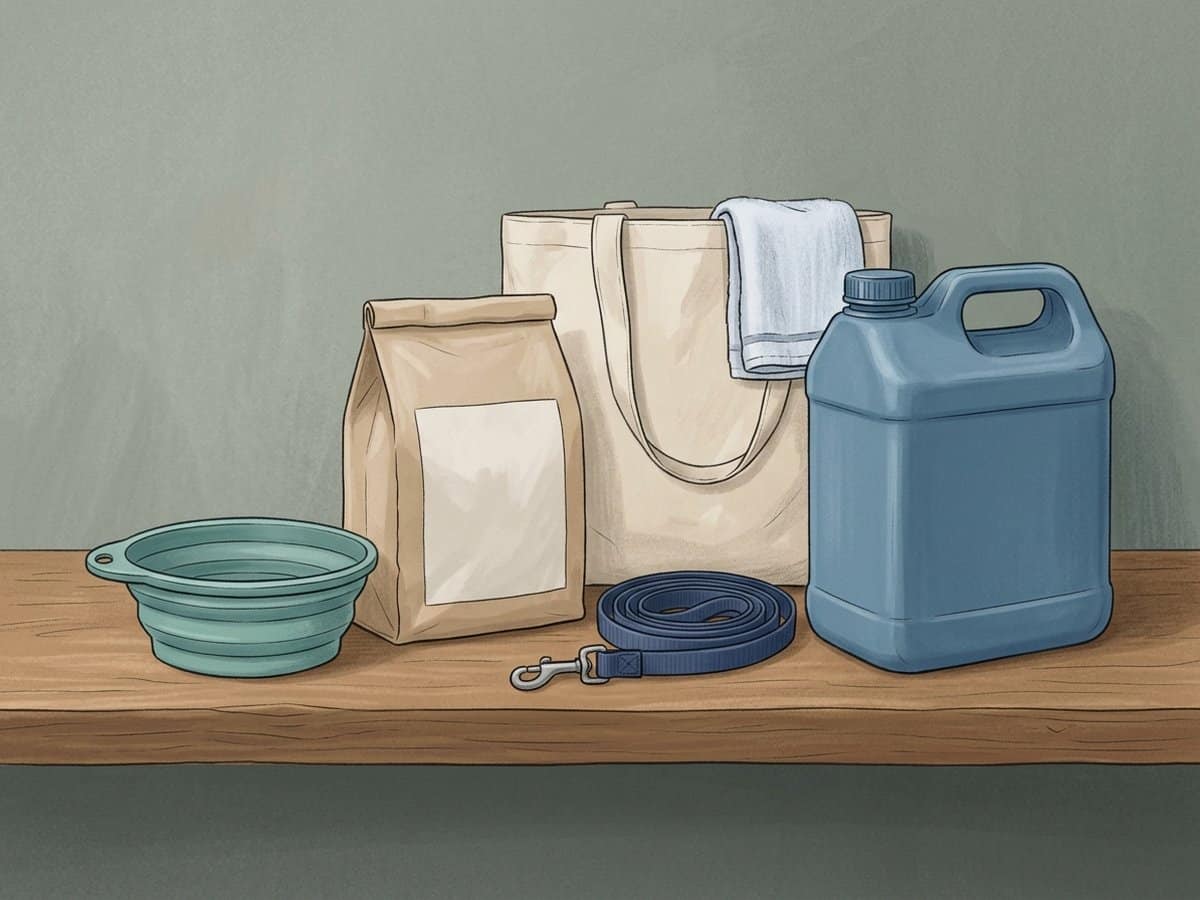
Pet emergency water is stored the same way as the family’s: in clean, closed, food-grade containers in a cool, dark place, with a bowl packed beside it.
Same containers, same rules. The CDC’s storage guidance applies: FDA-approved food-grade containers where possible, never a container that held toxic chemicals, kept between 50°F and 70°F, out of direct sunlight and away from gasoline and pesticides.
Label and rotate. The CDC says to label stored water “drinking water” with its storage date and to replace water you fill yourself every 6 months. Store-bought water follows its printed date. Pet water is no exception.
Pack the bowl with the water. Ready.gov says to store a water bowl with the supply, and the AVMA lists a collapsible feeding dish and water bowl. A gallon of water is little use to a dog without something to drink it from.
Keep it with the family supply. Adding the pets’ share to the household containers keeps one system to rotate instead of two.
The full storage setup, containers and placement are covered in how to store water long term, and the rotation dates in the water storage rotation schedule.
Step 6
Sheltering in place and evacuating with pets
Pet water planning needs two versions, according to Ready.gov: a larger supply for sheltering at home and a lighter kit you can carry if you have to leave.
Ready.gov suggests having two kits, “one larger kit if you are sheltering in place and one lightweight version for if you need to evacuate.” It also says that if local officials ask you to evacuate, your pet should evacuate too, and that many public shelters and hotels do not allow pets inside, so know a safe place to take them in advance.
Staying home
01
The larger kit
The pets’ share of the household containers, for the full window you plan for. A 70 lb dog adds about 2.4–3.5 gallons over 7 days (calculated), which fits in the same containers as the family’s water.
Leaving
02
The lightweight kit
Sealed water you can lift, a collapsible bowl, food, medicine and a leash or carrier. Water weighs about 8.3 pounds per gallon (USGS), so weight decides how much travels with you.
This week
Build the pet water kit
0 of 5 steps checked
Step 7
When a pet needs more than the figures
A pet can need more water than Cornell’s normal-intake figures, and how much more is a question for a veterinarian, not a planning table.
The Cornell figures describe a healthy animal on an ordinary day. They do not account for heat, exertion, nursing a litter, illness or medication, and this page does not estimate what any of those add. For people, Ready.gov says water needs can double in very hot temperatures; no equivalent figure for pets appears in the sources checked here, so the honest plan is extra water rather than an exact number.
Unusual thirst is a veterinary matter. Cornell describes a dog as polydipsic, meaning it drinks excessively, when its intake exceeds 100 mL per kg a day. That is a signal to call your veterinarian, not a figure to plan around. The AVMA advises contacting your veterinarian immediately if you see injuries or signs of illness after a disaster, and Ready.gov says to talk to your veterinarian about what belongs in your pet’s first aid kit.
Other animals are outside this page; none of the sources cited here publishes an emergency water figure for them. For horses, goats and other large animals, Ready.gov says to evacuate earlier where possible and make sure destinations have food, water, veterinary care and handling equipment.
A pet’s water also has to be safe. If the household supply is in doubt during an event, follow local officials and your water utility for everyone, pets included. If the water may contain fuel, chemicals, salts, or other non-microbial contamination, do not assume boiling or disinfection makes it safe. For children in the same home, see emergency water storage for families with kids, and for the whole picture, the emergency water storage guide.
Questions
Common questions about water for pets in an emergency
These are the questions pet owners most often ask when they plan emergency water for dogs and cats.
No emergency agency publishes a volume per pet. Ready.gov says to store a water bowl and several days’ supply, and the AVMA says at least 7 days’ supply. Using Cornell’s normal-intake figures, a 50 lb dog drinks about 1.7 to 2.5 gallons over 7 days and a 10 lb cat about 0.44 gallons (calculated).
Cornell’s Riney Canine Health Center says healthy dogs drink about 40 to 60 milliliters of water per kilogram of body weight a day. For a 50 lb dog that is about 31 to 46 fl oz a day (calculated). Ask your veterinarian about your own dog.
Cornell’s Feline Health Center says cats need about 4 ounces of water per 5 pounds of lean body weight a day, which is 8 fl oz for a 10 lb cat (calculated). Cats on wet food may drink less because the food contains water.
The AVMA says a pet evacuation kit should hold at least 7 days’ supply of water. Ready.gov says several days’ supply and suggests a larger kit for sheltering at home plus a lighter one for evacuating.
Yes. The CDC says to consider storing more than 1 gallon per person per day if you have pets, and Ready.gov’s kit list includes extra water for your pet. Add each animal’s drinking water to the household total for the same number of days.
No agency sets a per-dog gallon. By Cornell’s normal-intake figures, even a 90 lb dog drinks about 55 to 83 fl oz a day (calculated), well under a gallon. The human gallon also covers sanitation, so the two are not comparable.
Sources
Where these figures come from
Every figure on this page is quoted from, or calculated from, one of these sources, checked in September 2026.
- Ready.gov, “Prepare Your Pets for Disasters” (updated March 20, 2026). ready.gov — store a water bowl and several days’ supply of water; two kits, larger for sheltering and lightweight for evacuating; pets evacuate too; many shelters and hotels do not allow pets; talk to your veterinarian about a first aid kit; large animals. No per-animal volume. Checked September 2026.
- Ready.gov, “Build A Kit” (updated July 1, 2026). ready.gov — pet food and extra water for your pet. Checked September 2026.
- Ready.gov, “Water.” ready.gov — at least 1 gallon per person per day for drinking and sanitation; needs can double in very hot temperatures; no per-animal figure. Checked September 2026.
- Centers for Disease Control and Prevention, “How to Create an Emergency Water Supply” (June 27, 2025). cdc.gov — 1 gallon per person per day for 3 days; 2 weeks if possible; consider storing more for pets; food-grade containers; label and date; replace every 6 months; 50°F–70°F, away from sunlight, gasoline and pesticides. Checked September 2026.
- American Veterinary Medical Association, “Pets and disasters.” avma.org — at least 7 days’ supply of water; collapsible feeding dish and water bowl; contact your veterinarian about injuries or illness. No per-animal volume. Checked September 2026.
- Cornell University College of Veterinary Medicine, Riney Canine Health Center, “Canine Polyuria and Polydipsia” (April 26, 2024). cornell.edu — about 40–60 mL of water per kg of body weight a day; polydipsic above 100 mL per kg. Checked September 2026.
- Cornell University College of Veterinary Medicine, Feline Health Center, “Hydration.” cornell.edu — about 4 ounces of water per 5 pounds of lean body weight a day; wet food contributes water. Checked September 2026.
- U.S. Geological Survey, “Water Density.” usgs.gov — 8.329 pounds per U.S. gallon at 70°F, used for every weight on this page. Checked September 2026.