Emergency Water Storage
Emergency Water Storage for Families With Kids
Children count as full people, may need more than the baseline, and need the supply kept out of small hands. Here is what the agencies publish on each point, and where they are silent.
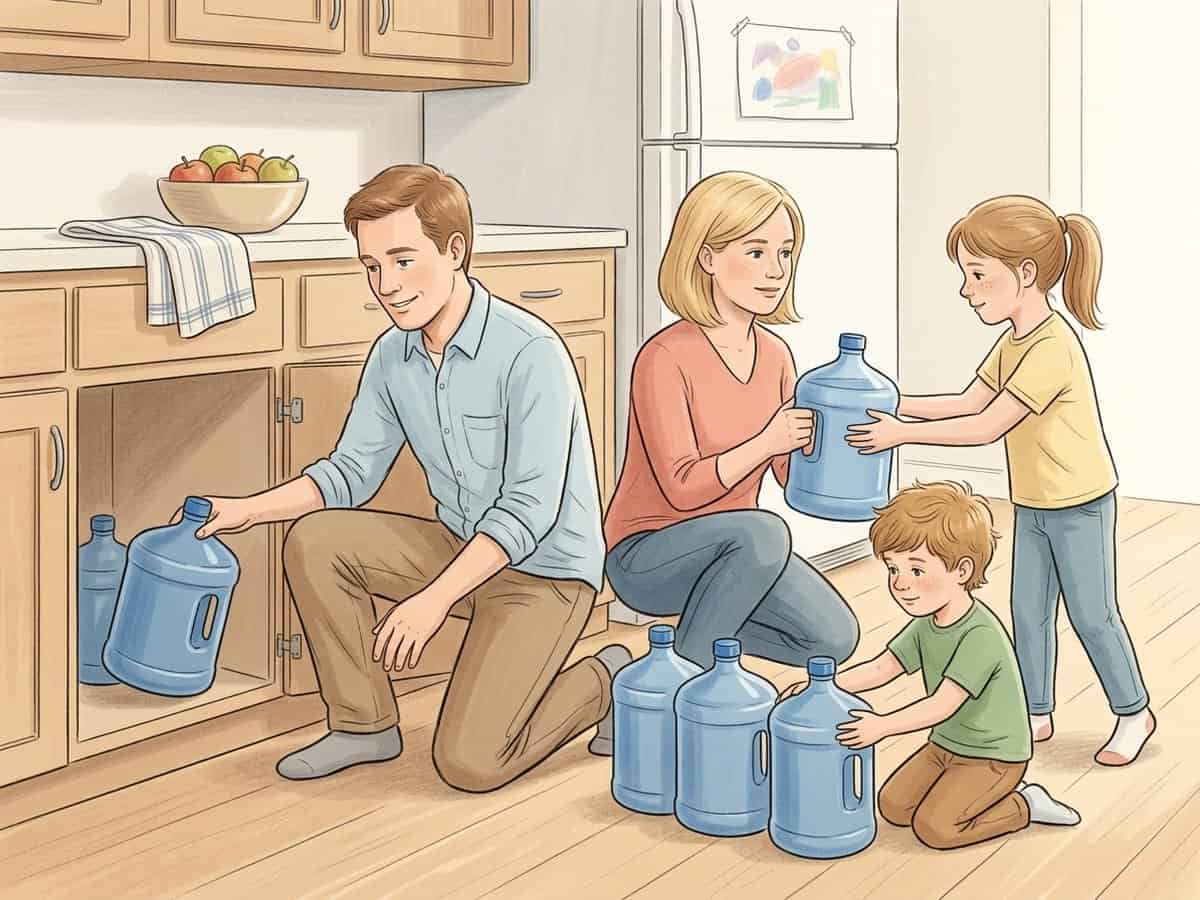
Emergency water storage for families starts with the same rule as for anyone: store at least 1 gallon per person per day, for at least 3 days, and aim for 2 weeks if you can (CDC). Every child counts as a full person. Ready.gov says children, nursing mothers and sick people may need more, with no separate figure, and needs can double in very hot weather. A family of four needs 12 gallons for 3 days and 56 for 2 weeks.
What you’ll learn
The short version
Emergency water storage for families uses the standard 1 gallon per person per day, counts every child as a full person, and adds a margin the agencies ask for but do not size.
- Store at least 1 gallon per person per day for 3 days; a 2-week supply if possible (CDC).
- Children count as full people. No agency publishes a smaller child figure.
- Children, nursing mothers and sick people may need more; heat can double needs (Ready.gov). No per-child amount is published.
- Infant formula has its own CDC guidance. Follow it and your pediatrician.
- Keep containers tightly closed; never leave open water where toddlers can reach it (CDC, CPSC).
Step 1
Every child counts as a full person
In emergency water storage for families, each child is counted at the same 1 gallon per day as each adult, because the published allowance is per person, not per adult.
The Centers for Disease Control and Prevention (CDC), the federal public-health agency, tells households to create and store a 3-day supply of water “that will meet your family’s needs,” and to store at least 1 gallon of water per person, per day. It asks you to try to store a 2-week supply if possible. Ready.gov, the federal preparedness site, gives the same allowance for drinking and sanitation.
Neither agency offers a reduced figure for a child, and this page will not print a fraction nobody published. A child still drinks, brushes teeth and washes hands, which are exactly the uses the gallon covers. Count heads, not sizes.
| Household | 3 days (CDC minimum) | 14 days (2 weeks) | Weight of the 2-week supply (calculated) |
|---|---|---|---|
| 2 adults, 1 child | 9 gallons | 42 gallons | About 350 lb |
| 2 adults, 2 children | 12 gallons | 56 gallons | About 466 lb |
| 2 adults, 3 children | 15 gallons | 70 gallons | About 583 lb |
These are floors. None of the rows adds anything for heat, illness, a nursing parent, a baby on formula or pets. The general version of this arithmetic is in how much emergency water your household needs.
Step 2
When children need more than the baseline
Children may need more water than the 1-gallon baseline, according to Ready.gov, but no U.S. agency publishes how much more, so a family plan adds a margin rather than a precise per-child number.
Ready.gov’s water page says: “Children, nursing mothers and sick people may need more water,” and that in very hot temperatures, water needs can double. The CDC says to consider storing more for pregnant women, people who are sick, pets, or if you live in a hot climate.
What is not published. Neither Ready.gov nor the CDC gives a per-child, per-infant, per-pregnancy or per-nursing-parent water figure. This page prints that silence rather than filling it. If anyone in your family has a health condition that affects drinking, ask their clinician before an emergency.
Heat is the one published multiplier. If needs double, a family of four needs 24 gallons for 3 days and 112 for 2 weeks (calculated), not 12 and 56.
Illness spreads through families. Sick people may need more water (Ready.gov), and one stomach bug rarely stays with one child.
Nursing parents. Ready.gov names nursing mothers as a group that may need more, with no amount. Add a margin on top of that parent’s gallon.
Never plan to ration. Ready.gov says: “Never ration drinking water unless ordered to do so by authorities.” A plan that needs children to drink less is too small.
Rather than an invented percentage, store toward the CDC’s 2-week figure; it leaves a buffer for a shorter emergency with higher needs.
Step 3
Work out your family’s number
Your family’s emergency water number is the count of adults and children, times the days you plan for, times 1 gallon, doubled if you plan for very hot weather.
How much water does your family need to store?
Enter adults, children and days. The panel uses the published allowance of 1 gallon per person per day for everyone.
How this is worked out. Gallons is (adults + children) × days × 1, from the CDC and Ready.gov allowance of 1 gallon per person per day. Very hot weather doubles it (Ready.gov: needs can double). The children’s share is children × days × 1, doubled in heat. Weight is gallons × 8.329 pounds (USGS, water at 70°F), before containers. All of it is arithmetic.
What it will not calculate. No smaller figure for children and no extra for babies, nursing parents, illness, formula or pets: Ready.gov says some of these needs may be higher but publishes no amount. Treat the answer as the least your family should have.
To turn the number into containers, use the emergency water calculator and compare formats in the best emergency water storage containers.
Step 4
Babies and formula: follow the official guidance
Water for a baby’s formula is covered by separate CDC infant-feeding guidance, and this page hands you to that guidance rather than giving feeding advice of its own.
Neither the CDC’s emergency water page nor Ready.gov’s water page gives a separate water figure for preparing formula. The CDC runs a dedicated infant feeding in emergencies toolkit, and its emergency list for families with infants and young children lists supplies by how a baby is fed. For formula-fed babies it includes bottled water for mixing as its own kit item.
Before an emergency, read the CDC’s guidance and talk to your pediatrician. The CDC’s infant-feeding pages explain which kind of formula it considers the safest option in an emergency and why: facts about infant feeding during emergencies. Follow that guidance, your pediatrician and any instructions from local officials. This page gives no amounts, no preparation steps and no feeding advice.
Ready.gov’s build-a-kit list also includes infant formula, bottles, diapers and wipes. So a family with a baby keeps two lists: the household supply at the gallon allowance, and the baby’s feeding kit from the CDC checklist. Keep them apart on the shelf, so nobody raids the baby’s water for a cooking pot.
Step 5
Storing water where kids cannot get into it
Kid-safe emergency water storage means tightly closed containers that small children cannot open, tip or climb, kept somewhere adults can still reach quickly.
Open water is a hazard for toddlers. The U.S. Consumer Product Safety Commission (CPSC), the federal product-safety agency, warns that “5-gallon buckets, often used for household chores, pose a serious threat to toddlers,” and that childhood drowning deaths also occur in pails, coolers and other containers with liquids. Its advice: “Be sure all containers with liquids are emptied immediately after use.”
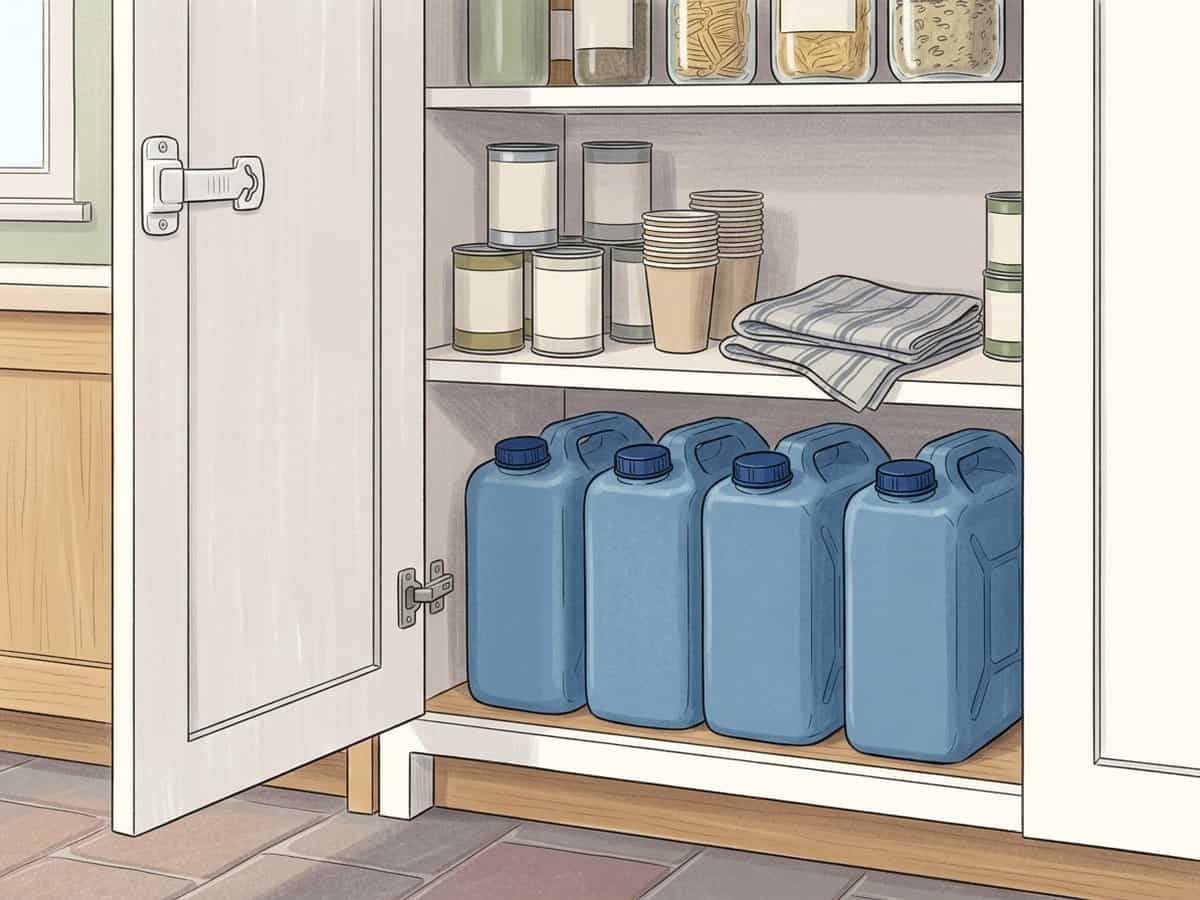
Tight caps, always. The CDC asks for a top that closes tightly and durable, unbreakable materials, not glass.
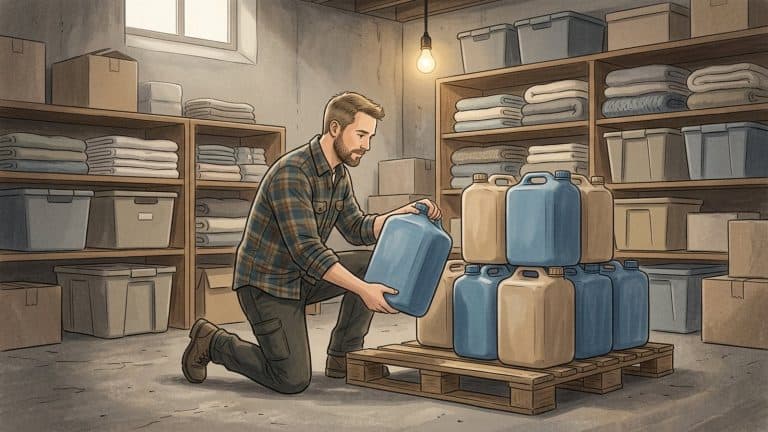
Heavy containers low. A 5-gallon container holds about 42 pounds of water (calculated, USGS). Keep it on the floor or a bottom shelf, where it cannot be pulled down onto a child.
Behind a latch, not buried. A child-proof latch keeps curious hands out while leaving the water seconds away for an adult.
No open buckets during an outage. A bucket or bathtub filled for flushing is a drowning risk for young children. Keep the door closed and empty it as soon as you can, as the CPSC advises.
Away from chemicals. The CDC says to keep stored water away from gasoline and pesticides. A shelf holding both is wrong for the water and for the children.
The CDC’s other rules still apply: 50°F to 70°F, out of direct sunlight, FDA-approved food-grade containers where possible, never a container that held toxic chemicals. The full setup is in how to store water long term; for small homes, see emergency water storage for apartments and small spaces.
Step 6
Serving stored water to children
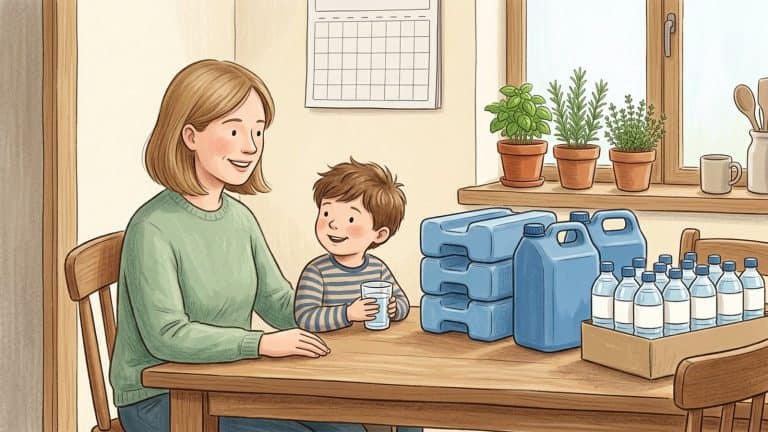
Serving stored water to children works best in small, clean portions poured by an adult, so the main container stays sealed and clean between uses.
The CDC’s rules for taking water out matter more with children around: use a clean scoop each time, do not touch the water or the inside of the container, and do not scoop water out with your hands. A child dipping a cup breaks all three.
Toddlers
01
An adult pours, every time
Keep the container out of reach and pour small amounts into a lidded cup.
School age
02
Their own cup, their own name
A named cup per child means less washing. Ready.gov’s kit list includes paper cups and plates.
Teens
03
A job, not just a ration
Older children can keep the log of what was opened and what is left.
This page gives no drinking amounts for children. The CDC says daily water intake recommendations vary by age, sex, pregnancy status, activity level and breastfeeding status. The job is to have enough stored that children can drink when thirsty.
Step 7
School, daycare and time away from home
A family emergency water plan also covers the hours children spend at school, daycare or in the car.
Ready.gov says to prepare supplies for home, work and cars, since you do not know where you will be. Its Ready Kids section offers family planning resources so that “both kids and their families can be prepared whether they’re at home, school, or anywhere else.” The Ready Kids resources include games for younger children.
Ask the school and the daycare whether they keep emergency water and how they shelter children on site. Only they can answer that.
Keep water in the car. Ready.gov suggests a car kit in case you are stranded. With children aboard, sealed water belongs in it.
Tell the children where it is. Ready.gov says all family members should know where the kit is kept.
Step 8
Make rotation a family routine
Rotating a family’s emergency water works best as a scheduled household routine that children help with, because a supply nobody checks is a supply nobody can rely on.
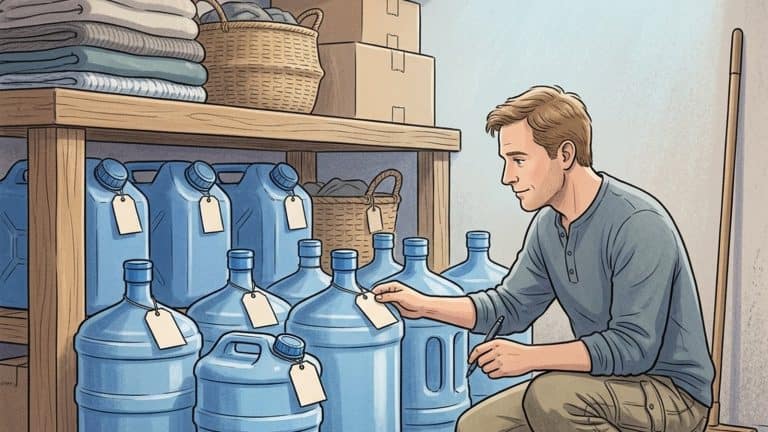
The CDC gives two rotation rules. Water you fill yourself should be replaced every 6 months, and store-bought water should be used by its printed date. The CDC also says to label each container “drinking water” with its storage date. Ready.gov adds a family-sized reminder: re-think your needs every year and update your kit as your family’s needs change.
Twice a year
A family water check the kids can help with
0 of 6 steps checked
Fixed dates help, such as the start of the school year. The rotation tool sets them: the water storage rotation schedule, and how long emergency water can be stored explains the 6-month rule. If your family includes a dog or a cat, their water is covered in emergency water storage for pets. The complete overview is the emergency water storage guide.
Questions
Common questions about family emergency water
These are the questions families most often ask when they plan emergency water storage with children in the house.
Store at least 1 gallon per person per day for at least 3 days, and try to store a 2-week supply if possible, according to the CDC. Count every child as a full person, then add a margin for heat, illness, nursing parents and pets.
A family of four needs at least 12 gallons for the CDC’s 3-day minimum and 56 gallons for 2 weeks, calculated at 1 gallon per person per day. In very hot weather, when Ready.gov says needs can double, those become 24 and 112 gallons.
Ready.gov says children, nursing mothers and sick people may need more water, and that needs can double in very hot temperatures. It does not publish a separate amount for children, and neither does the CDC. Count each child at the full gallon and add a margin.
Follow the CDC’s infant feeding in emergencies guidance and your pediatrician. The CDC’s checklist for families with infants lists bottled water for mixing as a separate kit item for families who use formula. This site does not give infant-feeding instructions or amounts.
Store it in tightly closed containers on the floor or a low shelf, behind a cupboard door a toddler cannot open, away from fuel and pesticides. The CPSC warns that buckets and other open containers of liquid are a drowning hazard for toddlers, so never leave open water where young children can reach it.
The CDC says to replace water you store yourself every 6 months and to observe the expiration date on store-bought water. Ready.gov suggests re-thinking your needs every year as your family changes.
Sources
Where these statements come from
Every figure and agency statement on this page is quoted from, or calculated from, one of these sources, checked in September 2026.
- Centers for Disease Control and Prevention, “How to Create an Emergency Water Supply” (June 27, 2025). cdc.gov — a 3-day supply that meets your family’s needs; at least 1 gallon per person per day; a 2-week supply if possible; consider more for pregnant women, people who are sick, pets or a hot climate; a tightly closing top and unbreakable materials; label “drinking water” with the date; replace every 6 months; 50°F–70°F, away from sunlight, gasoline and pesticides; clean scoops, no hands. Checked September 2026.
- Ready.gov, “Water.” ready.gov — at least 1 gallon per person per day for drinking and sanitation; children, nursing mothers and sick people may need more; needs can double in very hot temperatures; never ration drinking water unless ordered by authorities. Checked September 2026.
- Ready.gov, “Build A Kit” (updated July 1, 2026). ready.gov — infant formula, bottles and diapers as additional items; paper cups and utensils; supplies for home, work and cars; all family members know where the kit is; re-think needs every year. Checked September 2026.
- Ready.gov, “Ready Kids” and “Families.” ready.gov — family emergency planning resources for home, school or anywhere else. Checked September 2026.
- Centers for Disease Control and Prevention, “Emergency List for Families With Infants and Young Children” (August 3, 2026) and “Facts About Infant Feeding During Emergencies.” cdc.gov — cited as a handoff only; bottled water for mixing listed as a kit item. Checked September 2026.
- Centers for Disease Control and Prevention, “About Water and Healthier Drinks” (March 5, 2026). cdc.gov — water intake recommendations vary by age, sex, pregnancy status, activity level and breastfeeding status. Checked September 2026.
- U.S. Consumer Product Safety Commission, “Prevent Child In-Home Drowning Deaths.” cpsc.gov — 5-gallon buckets as a serious threat to toddlers; drownings in pails, coolers and other containers; empty containers of liquid immediately after use. Checked September 2026.
- U.S. Geological Survey, “Water Density.” usgs.gov — 8.329 pounds per U.S. gallon at 70°F, used for every weight on this page. Checked September 2026.