Daily Water Needs
How Many Bottles of Water Should You Drink a Day?
No health agency counts water in bottles, but the published reference figures convert cleanly into bottles of any size, including the bottles an emergency supply takes.
The National Academies put total water at about 91 fl oz a day for women and 125 fl oz for men, from drinks and food. About 80 percent usually comes from drinks: roughly 4.3 standard 16.9 fl oz bottles for women and 5.9 for men (calculated). Every drink counts, and thirst guides most healthy people. For an emergency, store 1 gallon per person per day, about 7.6 bottles.

What you’ll learn
The short version
How many bottles of water you should drink a day depends on the bottle size and the reference you start from, because no agency publishes a bottle count.
- Reference total water: about 91 fl oz a day for women and 125 fl oz for men, from drinks and food (National Academies, 2004).
- About 80 percent usually comes from drinks: about 73 and 100 fl oz (calculated).
- Coffee, tea, milk, juice and water-rich food all count toward the day (CDC; National Academies).
- Emergency storage is a different number: 1 gallon per person per day (CDC).
Step 1
Where a daily bottle count comes from
A daily bottle count comes from converting the National Academies’ reference water intake into bottles, because the reference itself is written in liters and ounces.
The National Academies of Sciences, Engineering, and Medicine is the body that sets the Dietary Reference Intakes used in the United States. In its 2004 report on water, it found that women who appear to be adequately hydrated consume an average of about 2.7 liters (91 ounces) of total water a day, and men about 3.7 liters (125 ounces). “Total water” means every source together: plain water, other drinks, and the water inside food.
The same release says about 80 percent of total water comes from drinking water and beverages, including caffeinated ones, and 20 percent from food. It adds that the vast majority of healthy people meet their daily hydration needs by letting thirst be their guide. The reference describes what adequately hydrated people take in; it is not a quota.
The Centers for Disease Control and Prevention (CDC), the federal public-health agency, does not publish a single daily amount either. Its page About Water and Healthier Drinks says daily water intake recommendations vary by age, sex, pregnancy status, activity level and breastfeeding status.
| Reference | Amount a day | Who says so |
|---|---|---|
| Women, total water | About 2.7 L / 91 fl oz | National Academies |
| Men, total water | About 3.7 L / 125 fl oz | National Academies |
| Women, from drinks | About 73 fl oz (calculated) | Calculated from the National Academies |
| Men, from drinks | About 100 fl oz (calculated) | Calculated from the National Academies |
| Normally active person, fluid | About ¾ gallon / 96 fl oz (calculated) | Ready.gov |
The full story behind these numbers is in the guide to how much water a person should drink a day; the metric version is how many liters of water to drink a day.
Step 2
Bottles of water per day, by bottle size
Bottles of water per day is simply the reference in fluid ounces divided by the bottle size, so a small bottle gives a big count and a large bottle a small one.
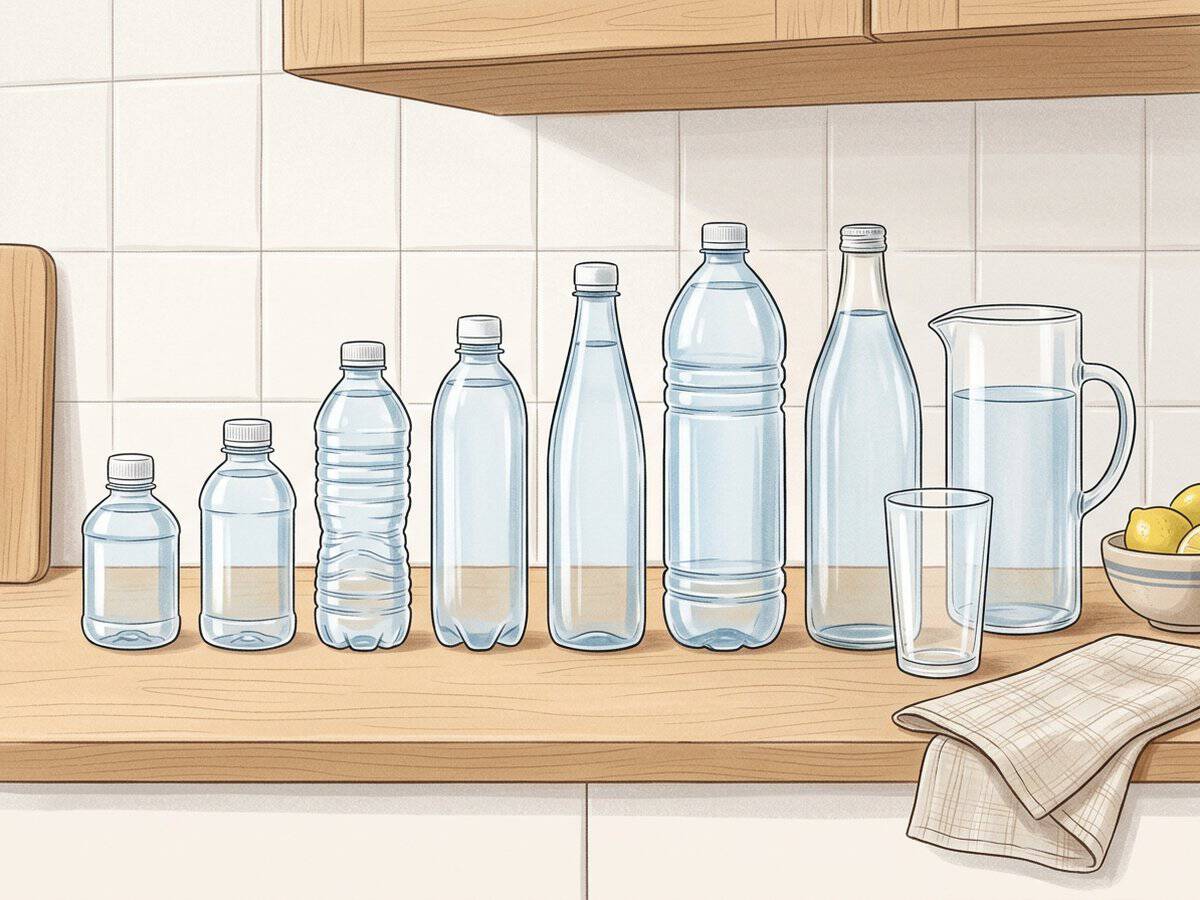
The standard single-serve bottle in the United States holds 16.9 fluid ounces, which is about 500 milliliters (16.9 × 29.573 mL, calculated from the NIST conversion). A cup is 8 fl oz.
| Bottle size | Women, total (91 oz) | Women, drinks (73 oz) | Men, total (125 oz) | Men, drinks (100 oz) | Ready.gov (96 oz) |
|---|---|---|---|---|---|
| 8 fl oz cup | 11.4 | 9.1 | 15.6 | 12.5 | 12.0 |
| 12 fl oz | 7.6 | 6.1 | 10.4 | 8.3 | 8.0 |
| 16.9 fl oz (500 mL) | 5.4 | 4.3 | 7.4 | 5.9 | 5.7 |
| 20 fl oz | 4.5 | 3.6 | 6.2 | 5.0 | 4.8 |
| 24 fl oz | 3.8 | 3.0 | 5.2 | 4.2 | 4.0 |
| 32 fl oz | 2.8 | 2.3 | 3.9 | 3.1 | 3.0 |
| 1 liter | 2.7 | 2.2 | 3.7 | 3.0 | 2.8 |
Read the columns with care. The “total” columns include water from food, and the “drinks” columns count every beverage, not only plain water. A row means “about this many bottles of all drinks combined, for a typical healthy adult,” and nothing more precise.
Step 3
Work out a bottle count for your own bottle
A bottle count for your own bottle needs only two inputs: which reference you want to see, and how much your bottle holds.
Reference water, in your bottles
A converter, not a prescription. It shows what a published reference looks like in bottles.
How this is worked out. Bottles a day is reference fl oz ÷ bottle size, to one decimal: National Academies total water (91 or 125 fl oz), 80 percent of it for drinks (72.8 or 100 fl oz), or Ready.gov’s ¾ gallon (96 fl oz). A liter is 33.814 fl oz. The emergency figure is people × 3 days × 128 fl oz ÷ bottle size, rounded up, from the CDC’s 1 gallon per person per day. All arithmetic.
What it will not calculate. No weight-based formula, and no figure for children, pregnancy, breastfeeding, illness, heat or exercise, because none of these sources publishes one. No verdict on whether a count is enough for you. If you have a fluid restriction or a medical condition, your clinician’s figure replaces these.
Step 4
What counts toward your bottles of water a day
Everything you drink counts toward your bottles of water a day, not only plain water from a bottle, and water-rich food adds to the total as well.
The CDC says daily water intake is mostly from water and other beverages, and that foods, especially those with high water content such as many fruits and vegetables, can also add to fluid intake. The National Academies go further: people also get water from juice, milk, coffee, tea, soda, fruits, vegetables and other foods and beverages, and the 80 percent drinks share explicitly includes caffeinated beverages.
That is why a bottle count taken on its own understates most people's day. The CDC's water-consumption data show U.S. adults drank an average of 44 ounces of plain water a day in 2015–2018. That is about 2.6 bottles of 16.9 fl oz (calculated). The rest of a typical adult's water comes from other drinks and from food.
Counting is not recommending. A soda counts toward the day's water in the National Academies' sense; the CDC's guidance still favours water and unsweetened drinks.
One CDC suggestion does involve a bottle directly: carry a reusable water bottle with you. A refillable bottle is also the easiest count to keep: three fills of a 24 fl oz bottle is 72 fl oz, about 2.1 liters (calculated), before anything else you drink.
Step 5
When your bottle count may need to change
Your bottle count may need to rise in heat, with physical activity, with fever or stomach illness, and during pregnancy or breastfeeding, and the agencies name these factors without giving a bottle figure for each.
Heat and activity. The CDC says your body needs more water in hot climates and when you are more physically active. The National Academies say people who are very physically active or who live in hot climates may need more water. Ready.gov adds, for emergencies, that in very hot temperatures water needs can double.
Fever, diarrhea or vomiting. The CDC lists running a fever and having diarrhea or vomiting as times the body needs more water. Follow a clinician here, not a table.
Pregnancy and breastfeeding. The CDC lists both among the factors that change daily water recommendations, and Ready.gov notes that nursing mothers may need more water.
Age. Age is on the CDC's list too, and Ready.gov says children may need more water in an emergency. Children's amounts are a question for a pediatrician, and this page does not convert them into bottles.
Some people need less, not more. Certain heart and kidney conditions and some medicines call for limits on fluid. If a clinician has given you a fluid limit, that limit is your number, and no bottle count on this or any other page overrides it.
None of the sources cited here publishes a per-factor amount, so this page does not invent one.
Step 6
Worked examples: three bottles, three counts
Worked examples show how the same reference turns into very different bottle counts depending on the bottle a person actually carries.
24 fl oz bottle
01
A woman with an office bottle
A woman with a 24 fl oz bottle sees the women's drinks share, about 73 fl oz, as about 3.0 bottles a day. Her coffee and milk are part of that 73 (calculated).
32 fl oz bottle
02
A man on a job site
A man with a 32 fl oz bottle sees the men's drinks share, about 100 fl oz, as about 3.1 bottles. On a hot day of physical work, the CDC and the National Academies both say he may need more than that (calculated).
16.9 fl oz bottles
03
The average adult
An adult drinking the CDC's average 44 fl oz of plain water drinks about 2.6 single-serve bottles. Other drinks and food supply the rest (calculated).
Step 7
How many bottles of water to store for an emergency
How many bottles of water to store for an emergency follows a separate rule: at least 1 gallon per person per day, for drinking and sanitation, which is about 7.6 bottles of 16.9 fl oz per person per day.
The CDC's page How to Create and Store an Emergency Water Supply says to store at least 1 gallon of water per person, per day, for 3 days, and to try to store a 2-week supply if possible. Ready.gov gives the same allowance and says it covers drinking and sanitation. That is why it is bigger than the ¾-gallon (96 fl oz) fluid need Ready.gov gives for a normally active person.
| Household | 3 days | 2 weeks | 3-day weight |
|---|---|---|---|
| 1 person | 3 gal · 23 bottles | 14 gal · 107 bottles | About 25 lb |
| 2 people | 6 gal · 46 bottles | 28 gal · 213 bottles | About 50 lb |
| 4 people | 12 gal · 91 bottles | 56 gal · 425 bottles | About 100 lb |
Single-serve bottles are a perfectly good way to hold a supply. The CDC calls unopened, commercially bottled water the safest and most reliable source of water in an emergency, and Ready.gov says to keep it in the sealed original container in a cool, dark place. The CDC's storage range is 50°F to 70°F, away from direct sunlight and away from gasoline and pesticides. Keep the bottles sealed until you need them, and check the date the bottler printed on each case; the guide to whether bottled water expires explains what that date means.
Ninety-one small bottles for a family's 3-day minimum is manageable; 425 for two weeks is a pallet. The emergency water calculator turns any household into gallons, containers and weight, and the guide to how much emergency water your family needs works through heat, children and other adjustments. Ready.gov says those needs can double in very hot temperatures, and never to ration drinking water unless authorities order it.
Questions
Common questions about bottles of water a day
These are the questions people most often ask when they count their water in bottles.
No agency publishes a bottle count. Converted from the National Academies reference, the drinks share of daily water is about 4.3 bottles of 16.9 fl oz for women and 5.9 for men (calculated). Every drink counts, and thirst guides most healthy people.
For a typical healthy adult, the National Academies reference works out to about 4 to 6 bottles of 16.9 fl oz a day from all drinks combined, depending on sex (calculated). It is a reference, not a target, and a clinician's advice replaces it.
Four 16.9 fl oz bottles is about 68 fl oz of plain water (calculated), more than the 44 fl oz U.S. adults drank on average in the CDC's data. Whether it is enough for you depends on your other drinks, food, heat, activity and health. The National Academies say most healthy people meet their needs by letting thirst guide them.
A U.S. gallon is 128 fl oz, so it takes about 7.6 bottles of 16.9 fl oz, 6.4 bottles of 20 fl oz, or 4 bottles of 32 fl oz to make a gallon (calculated). That gallon is the CDC's emergency storage allowance per person per day, for drinking and sanitation.
Yes. The National Academies say the drinks share of total water includes caffeinated beverages, and the CDC lists plain coffee or tea among the drinks that count toward daily fluid intake. Water-rich foods add to the day as well.
Store at least 1 gallon per person per day for at least 3 days, and a 2-week supply if possible, according to the CDC. In 16.9 fl oz bottles that is 23 bottles per person for 3 days and 107 for 2 weeks, rounded up (calculated). Keep commercially bottled water sealed, cool and dark.
Sources
Where these figures come from
Every figure on this page is quoted from, or calculated from, one of these sources, checked in September 2026.
- National Academies of Sciences, Engineering, and Medicine, news release on dietary reference intakes for water (February 11, 2004). nationalacademies.org — about 2.7 L (91 oz) of total water a day for women and 3.7 L (125 oz) for men; about 80 percent from drinking water and beverages, including caffeinated beverages, and 20 percent from food; thirst as a guide; very active people and those in hot climates may need more. Checked September 2026.
- Centers for Disease Control and Prevention, “About Water and Healthier Drinks” (reviewed March 5, 2026). cdc.gov — recommendations vary by age, sex, pregnancy status, activity level and breastfeeding status; more water in hot climates, with activity, fever, diarrhea or vomiting; drinks and water-rich foods count; carry a reusable water bottle. Checked September 2026.
- Centers for Disease Control and Prevention, “Fast Facts: Data on Water Consumption” (reviewed January 19, 2024). cdc.gov — U.S. adults drank an average of 44 ounces of plain water a day in 2015–2018. Checked September 2026.
- Ready.gov, “Water.” ready.gov — about ¾ gallon of fluid a day for a normally active person; at least 1 gallon per person per day for drinking and sanitation; needs can double in very hot temperatures; children, nursing mothers and sick people may need more; never ration drinking water unless ordered by authorities; keep commercially bottled water sealed in a cool, dark place. Checked September 2026.
- Centers for Disease Control and Prevention, “How to Create and Store an Emergency Water Supply” (reviewed June 27, 2025). cdc.gov — 1 gallon per person per day for 3 days; 2-week supply if possible; unopened commercially bottled water is the safest and most reliable source; store at 50°F–70°F away from sunlight, gasoline and pesticides. Checked September 2026.
- National Institute of Standards and Technology, Handbook 44 (2026), Appendix C, “General Tables of Units of Measurement.” nist.gov — 1 U.S. gallon = 128 fl oz = about 3.785 L; 1 fl oz = about 29.573 mL; 1 cup = 8 fl oz. Checked September 2026.
- U.S. Geological Survey, “Water Density.” usgs.gov — a gallon of water at 70°F weighs 8.329 pounds. Checked September 2026.