Daily Water Needs
How Many Gallons of Water Should You Drink a Day?
Less than one, for most people, by the published references. The gallon you keep hearing about is a different number: it is what to store per person per day for an emergency.
The National Academies put adequate total water at about 0.71 gallon a day for women (2.7 liters) and 0.98 gallon for men (3.7 liters), from all drinks and food; about 80 percent of it usually comes from drinks (gallons calculated). Ready.gov puts a normally active person at about ¾ gallon of fluid a day. No source checked here sets a gallon-a-day drinking target. The official gallon is for storage: 1 gallon per person per day, for drinking and sanitation.
What you’ll learn
The short version
How many gallons of water you should drink a day has a reference answer below one gallon for most adults: about 0.71 gallon of total water for women and 0.98 for men, including the water in food.
- From drinks alone, about 0.57 gallon for women and 0.78 for men (calculated from the National Academies’ 80 percent share).
- Ready.gov: about ¾ gallon of fluid a day for a normally active person.
- Store at least 1 gallon per person per day, for drinking and sanitation, for 3 days, and 2 weeks if possible (CDC, Ready.gov).
- A gallon of water weighs 8.329 pounds at 70°F (USGS).
Step 1
How many gallons of water women and men take in: the reference in gallons
The gallons of water women and men take in on an adequate day are about 0.71 and 0.98 of a gallon of total water, converted from the National Academies’ liter figures.
The National Academies of Sciences, Engineering, and Medicine, which sets the U.S. Dietary Reference Intakes, reported in 2004 that women who appear to be adequately hydrated consume an average of about 2.7 liters of total water a day, and men about 3.7 liters. Total water counts all beverages and foods. The panel called these adequate intake levels and said about 80 percent of total water comes from drinking water and beverages, including caffeinated ones, and 20 percent from food.
| Reference | Published | Gallons a day Calculated | From drinks, about 80% Calculated |
|---|---|---|---|
| Women, total water (National Academies) | About 2.7 L | About 0.71 gal (91 fl oz) | About 0.57 gal (73 fl oz) |
| Men, total water (National Academies) | About 3.7 L | About 0.98 gal (125 fl oz) | About 0.78 gal (100 fl oz) |
| Normally active person, fluid (Ready.gov) | About ¾ gal | 0.75 gal (96 fl oz) | Already a drinks figure |
So even the men’s total, which includes the water in food, stops just short of a gallon. The panel’s guidance on using these numbers is that “the vast majority of healthy people adequately meet their daily hydration needs by letting thirst be their guide.” For the everyday question in full, see the site’s guide to how much water a person should drink a day, and the ounce-by-ounce version in how many ounces of water to drink a day.
Step 2
Is drinking a gallon of water a day an official recommendation?
Drinking a gallon of water a day is not an official recommendation in any source checked for this page; the gallon those agencies publish is a storage allowance, not a drinking target.
Gallon-a-day drinking challenges are popular, and the number sounds official because it echoes emergency guidance. It is not the same thing. The National Academies panel chair, Lawrence Appel, said the panel offers no “rule of thumb based on how many glasses of water people should drink each day” because hydration needs can be met through many sources besides drinking water. The CDC’s guidance on water and healthier drinks sets no single amount either; it says recommendations vary by age, sex, pregnancy status, activity level and breastfeeding status.
In numbers, a gallon of plain water is 128 fl oz. That is about 28 fl oz more than the men’s drinks share and about 55 fl oz more than the women’s (calculated), before counting coffee, tea, milk or food. Some people, especially very active people or those in hot climates, may need more water, as the National Academies note. Others need less. A fixed gallon fits neither group by design.
More is not automatically better. The National Academies set no upper limit for water, but noted that some athletes in strenuous activity and some people with certain psychiatric disorders occasionally drink water in excessive amounts that can be life-threatening, while calling such cases highly unusual. If a clinician has told you to limit fluids, for a heart or kidney condition or any other reason, follow the clinician, not a challenge.
Step 3
Drinking a gallon of water versus storing a gallon of water
Storing a gallon of water per person per day is the published emergency allowance, and it covers drinking and sanitation together, so it is larger than any drinking reference.
Ready.gov separates the two numbers on one page. It says a normally active person needs about ¾ of a gallon of fluid daily, from water and other beverages, and then says to “store at least one gallon of water per person per day for several days, for drinking and sanitation.” The CDC’s emergency water page gives the same allowance, at least 1 gallon per person per day for 3 days, and says to try to store a 2-week supply if possible.
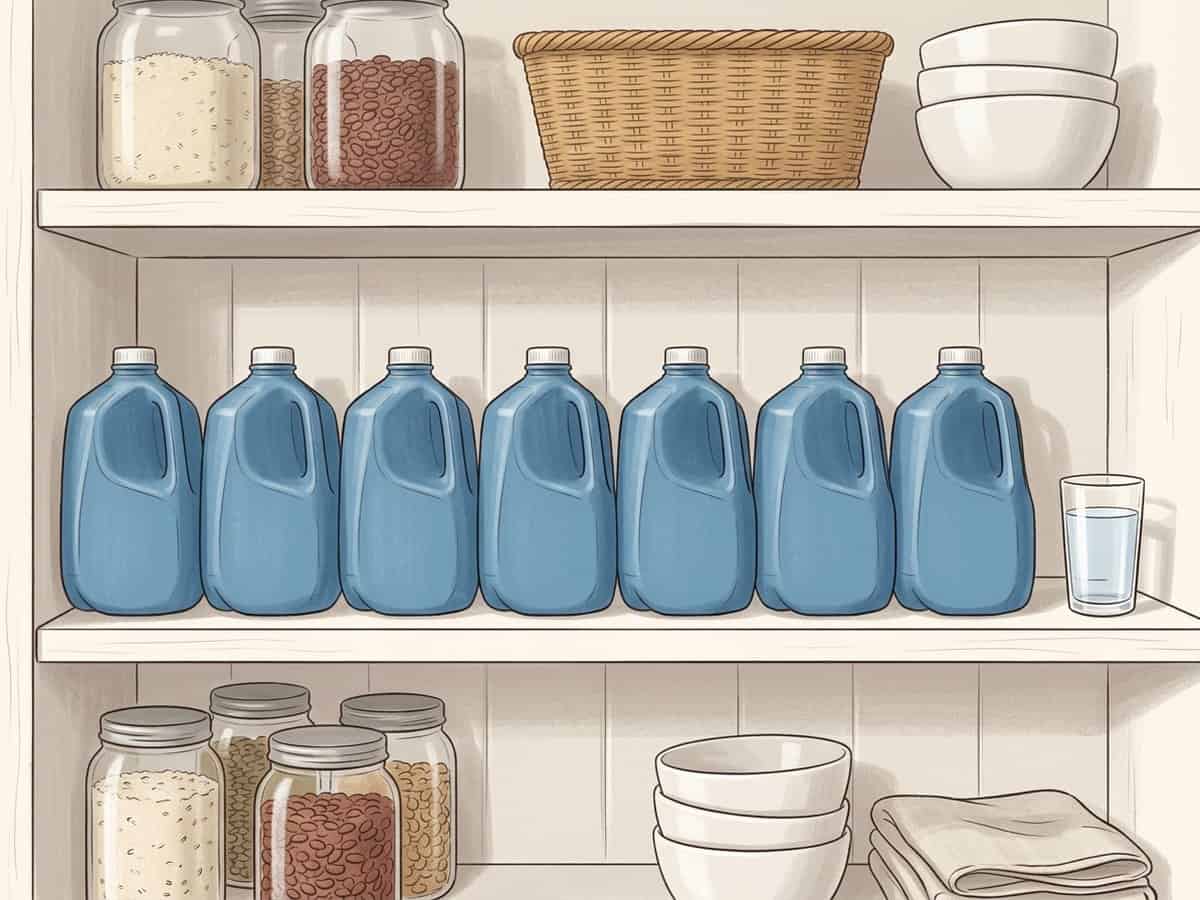
The difference between ¾ of a gallon and a full gallon is ¼ gallon, 32 fl oz (calculated). Neither agency assigns that difference to a particular task, and this page does not either. What they do say is that the stored gallon is meant to cover more than drinking, so the storage gallon should never be read as a gallon to drink. Bathing and laundry are not part of it.
Step 4
When the gallons of water you need go up
The gallons of water a person needs go up in heat, with activity and in some health situations, and Ready.gov is the one source here that sizes the change: needs can double in very hot temperatures.
The CDC lists hot climates, being more physically active, running a fever, and having diarrhea or vomiting as times the body needs more water. Ready.gov says children, nursing mothers and sick people may need more. Neither source gives a figure for any of these groups, so none is printed here.
For storage, Ready.gov’s doubling is easy to apply: 2 gallons per person per day in very hot weather instead of 1 (calculated). A family of four storing for 2 weeks in a hot climate would plan for 112 gallons rather than 56. That is arithmetic for a supply, not a drinking target.
Needs can be higher for infants, children, older adults, pregnancy, illness, pets, hot conditions, and physically demanding activity. For anyone in those groups, ask a clinician about their own needs before an emergency, not during one.
Step 5
How many gallons of water a household should store for 3 days and 2 weeks
The gallons of water a household should store are people times days times one gallon: at least 3 gallons per person for the CDC’s 3-day minimum and 14 per person for 2 weeks.
| Household | 3 days | 3-day weight | 2 weeks | 2-week weight |
|---|---|---|---|---|
| 1 person | 3 gal | About 25 lb | 14 gal | About 117 lb |
| 2 people | 6 gal | About 50 lb | 28 gal | About 233 lb |
| 3 people | 9 gal | About 75 lb | 42 gal | About 350 lb |
| 4 people | 12 gal | About 100 lb | 56 gal | About 466 lb |
| 5 people | 15 gal | About 125 lb | 70 gal | About 583 lb |
| 6 people | 18 gal | About 150 lb | 84 gal | About 700 lb |
A family of four: 3 days against 2 weeks, one jug per gallon
- 12 gallonsthe 3-day minimum, solid jugs
- 56 gallonsa 2-week supply, all jugs together
The jump from 3 days to 2 weeks is what surprises most households. Twelve gallons fits in a closet corner. Fifty-six gallons is a shelf unit, and at about 466 pounds it needs a floor that can carry it and a plan for moving it.
Step 6
Gallons to drink against gallons to store: a calculator
Gallons to drink and gallons to store sit side by side in the panel below: a published drinking reference in gallons, against the 1-gallon storage allowance multiplied out for your household.
Drink a day, store a day, store in total
Pick a reference, then enter people and days. Every number is arithmetic on a published figure.
How this is worked out. The drinking references are the National Academies’ 2.7 and 3.7 liters of total water, divided by 3.785 liters per gallon (drinks: 80 percent of those), and Ready.gov’s ¾ gallon of fluid. The supply is people × days × 1 gallon, the CDC and Ready.gov allowance, and the weight is supply × 8.329 pounds (USGS, water at 70°F). The bars share one scale in gallons, a full bar being one gallon.
What it will not calculate. No personal drinking target, no weight-based formula, and nothing for children, pregnancy, breastfeeding, illness, heat or pets, because none of these sources publishes a figure for them. Treat the supply as the least to store, and add a margin for anyone who needs more.
Step 7
What a gallon of water weighs, and where the gallons go next
A gallon of water weighs 8.329 pounds at 70°F, according to the U.S. Geological Survey, and that weight is what turns a gallon count into a storage plan.
The USGS Water Science School gives 8.329 pounds for a U.S. gallon of water at 70°F. Multiplied out, a common 5-gallon container holds about 41.6 pounds of water and a 55-gallon barrel about 458 pounds, before the container itself is weighed (both calculated). Those figures decide who can lift a container, which shelf can hold it, and whether a supply belongs on a ground floor.
Count the gallons. People × days × 1 gallon, and double it for very hot weather, following Ready.gov.
Choose containers you can move. Use only clean, food-grade containers intended for drinking water. The CDC says not to use containers that previously held toxic chemicals, such as bleach or pesticides.
Store and date it. The CDC says to keep containers somewhere cool, 50°F to 70°F, out of direct sunlight and away from gasoline and pesticides, and to replace water you fill yourself every 6 months.
Ready.gov also says never to ration drinking water unless ordered to do so by authorities. Drink what you need, and let the stored supply do its job. To turn this into a plan, the guide to how much emergency water your family needs works through the household numbers, and the emergency water storage calculator sizes the gallons, containers and weight for you.
Questions
Common questions about gallons of water a day
These are the questions people most often ask about daily water in gallons.
The National Academies put adequate total water at about 0.71 gallon a day for women and 0.98 for men, from all drinks and food, with roughly 0.57 and 0.78 gallon from drinks (calculated). Ready.gov gives about three-fourths of a gallon of fluid for a normally active person. Thirst guides most healthy people.
No source checked here recommends drinking a gallon a day. A gallon is more than the National Academies drinks shares for women and men. The panel set no upper limit, calling dangerous overdrinking highly unusual, but anyone told to limit fluids should follow their clinician.
Half a gallon is 64 ounces, the same as eight 8-ounce glasses. It is below the National Academies drinks shares, but coffee, tea, milk and food also count, and needs vary with age, sex, pregnancy, activity and breastfeeding, so a plain-water total alone does not answer the question.
Store at least 1 gallon per person per day, for drinking and sanitation, for at least 3 days, and a 2-week supply if possible, according to the CDC and Ready.gov. That is 3 gallons per person for 3 days and 14 gallons for 2 weeks (calculated).
The U.S. Geological Survey gives 8.329 pounds for a U.S. gallon of water at 70°F. A 5-gallon container of water is about 41.6 pounds and a 55-gallon barrel about 458 pounds, not counting the container (calculated).
No. Ready.gov says to store at least one gallon per person per day for drinking and sanitation. That is why it is larger than the roughly three-fourths of a gallon of fluid Ready.gov gives as a normally active person's daily need.
Sources
Where these figures come from
Every figure on this page is quoted from, or calculated from, one of these sources, checked in September 2026.
- National Academies of Sciences, Engineering, and Medicine, news release on dietary reference intakes for water, salt and potassium (February 11, 2004). nationalacademies.org — about 2.7 L of total water a day for women and 3.7 L for men, from all beverages and foods; about 80 percent from drinks, including caffeinated ones; thirst as a guide; no glass-count rule of thumb; very active people and those in hot climates may need more; no upper limit set, with excessive drinking described as highly unusual but potentially life-threatening. Checked September 2026.
- Centers for Disease Control and Prevention, “About Water and Healthier Drinks” (updated March 5, 2026). cdc.gov — recommendations vary by age, sex, pregnancy status, activity level and breastfeeding status; more water needed in hot climates, with more activity, fever, diarrhea or vomiting. Checked September 2026.
- Ready.gov, “Water.” ready.gov — about ¾ gallon of fluid daily for a normally active person; at least 1 gallon per person per day for drinking and sanitation; needs can double in very hot temperatures; children, nursing mothers and sick people may need more; never ration drinking water unless ordered to. Checked September 2026.
- Centers for Disease Control and Prevention, “How to Create and Store an Emergency Water Supply” (reviewed June 27, 2025). cdc.gov — at least 1 gallon per person per day for 3 days; a 2-week supply if possible; food-grade containers; 50°F–70°F storage away from gasoline and pesticides; replace home-filled water every 6 months. Checked September 2026.
- U.S. Geological Survey, “Water Density.” usgs.gov — 8.329 pounds per U.S. gallon of water at 70°F, used for every weight on this page. Checked September 2026.