Buying and Setup Guide
55 Gallon Water Barrel Kits: What to Buy and How to Set Up
A 55 gallon water barrel is the cheapest floor space per gallon you can buy, and the least forgiving container you will ever own. Once it is full it holds about 458 pounds of water and it does not move again. Choose the spot first, the barrel second.
The comparison
What a complete 55 gallon water barrel kit needs
A complete 55 gallon water barrel kit is a food-grade container, a way to open it, a way to get water out without tipping it, and a floor that can carry about 458 pounds.
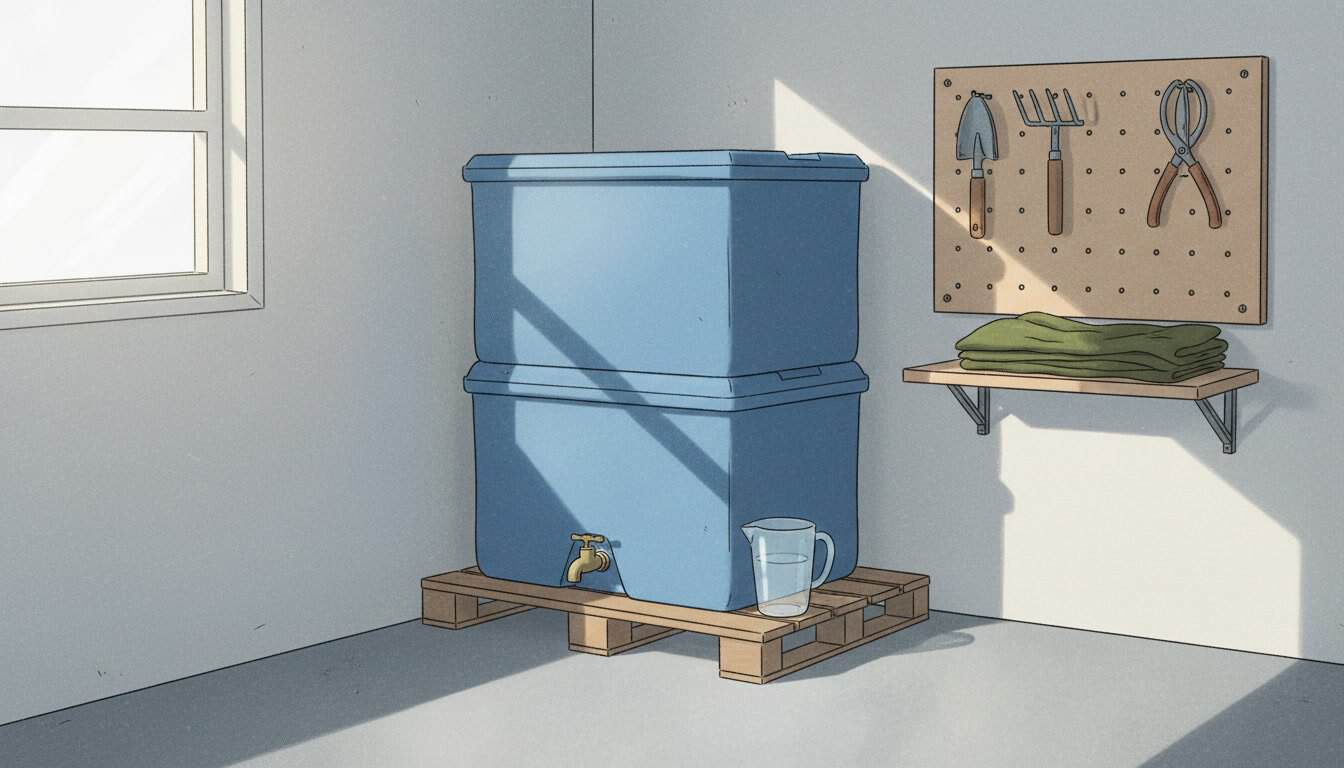
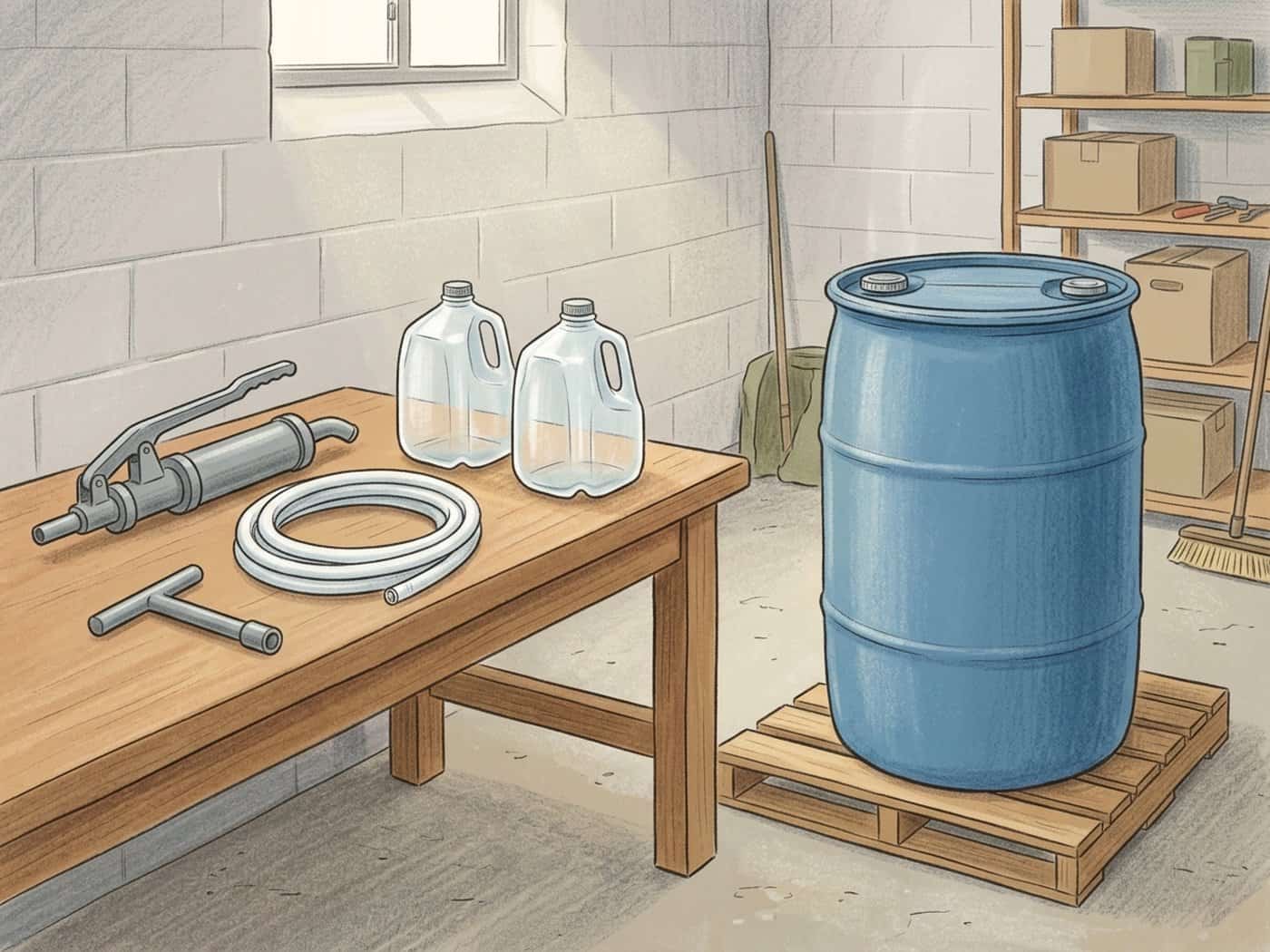
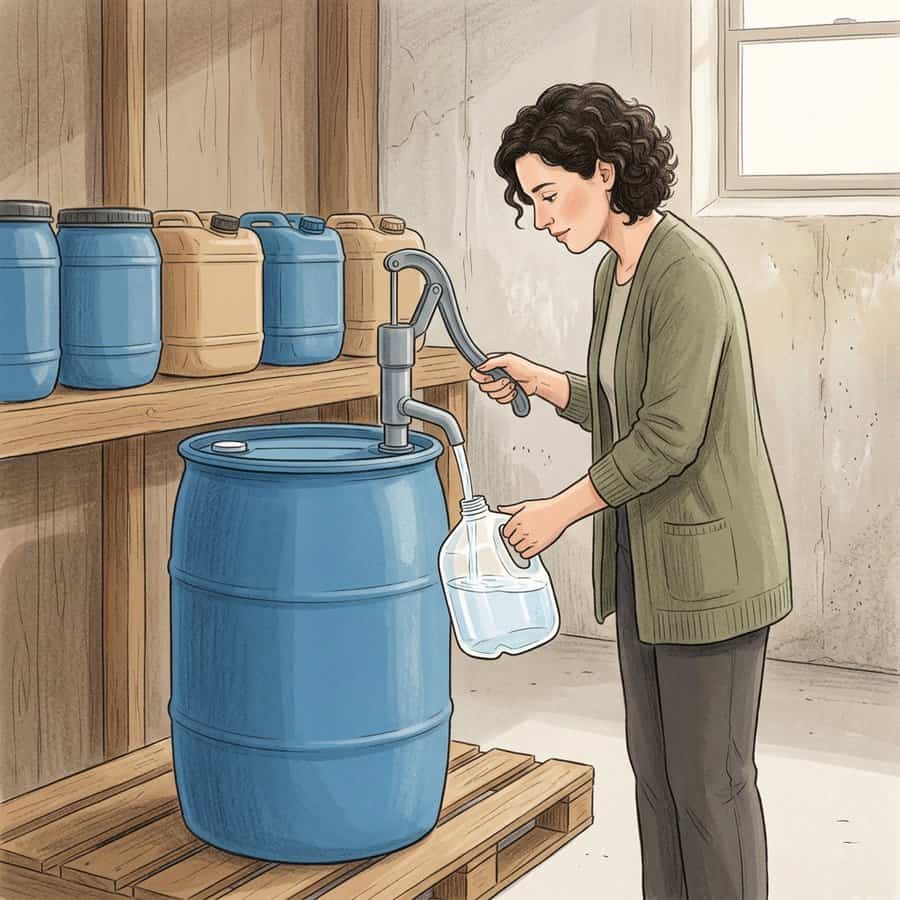
There are two ways to get there. A traditional drum has two small threaded openings, called bungs, and needs a bung wrench to open them and a pump or siphon to draw water. A stackable tank with a built-in spigot needs neither.
| What the setup needs | Traditional drum with bung caps | Stackable tank with a spigot |
|---|---|---|
| Capacity | 55 gallons | 55 gallons |
| Water weight when full (calculated) | About 458 lb | About 458 lb |
| Opening it | A bung wrench | A wide screw lid, by hand |
| Getting water out | A drum pump or siphon, bought separately | The built-in spigot |
| Filling | Through a 2-inch opening | Through the lid or opening |
| Stacking | Not designed to stack | Designed to stack |
| Weak spot | Two extra tools to buy and keep with it | A spigot is one more fitting to check for drips |
How this table was built. It compares setups, not brands, so capacities are the category size rather than manufacturer claims, and each weight is arithmetic: 55 × 8.329 = 458.1 lb of water. The one product this page links is checked at its maker below. Nothing was tested, and no price, rating or stock claim appears.
Try it
Check a 55 gallon water barrel setup before you buy
Whether a 55 gallon water barrel works for you comes down to three numbers: how many gallons you need, how many barrels that takes, and what the floor under them has to carry.
The CDC and Ready.gov put the storage allowance at a minimum of 1 gallon per person per day for drinking and sanitation, for at least 3 days, and the CDC suggests 2 weeks if possible. A household of four needs 12 gallons for 3 days and 56 for 2 weeks. One barrel covers the first with room to spare and falls a gallon short of the second.
Barrel setup check
Gallons and weights are arithmetic; the placement verdict comes from the CDC storage guidance.
Fits the guidance: Cool, dark and at ground level, away from gasoline and pesticides: this matches the CDC storage guidance, and the floor is not carrying the weight on joists.
How this is worked out. Gallons is people × days × 1. Barrels is gallons ÷ 55, rounded up. Weight is barrels × 55 × 8.329 lb (USGS), water only. The replace-by month is the fill month plus 6, from the CDC’s rule for water you store yourself.
What it will not do. It gives no floor rating and adds nothing for heat, infants, illness or pets; Ready.gov says needs can be higher for some people and can double in very hot temperatures, without publishing a per-person figure.
Step by step
How to set up a 55 gallon water barrel
Set up a 55 gallon water barrel by choosing a cool, dark, ground-level spot first, placing the empty barrel there, and only then filling, labelling and dating it.
Where a barrel lives
- WrongA full barrel on a wood deck, in direct sun.
- RightIndoors on a ground-level slab, in shade, with the spigot clear.
- Pick the spot. The CDC says to store water between 50°F and 70°F, out of direct sunlight, and away from toxic substances such as gasoline and pesticides. A basement or garage slab is the usual answer; the garage only if nothing chemical is stored near the barrel.
- Place it empty. About 458 pounds of water (calculated) cannot be walked across a room. Put the empty barrel where it will stay, raised enough that a pitcher or bucket fits under the spigot or pump outlet.
- Start with a clean, food-grade container. The CDC recommends FDA-approved food-grade containers and rules out any container that previously held toxic chemicals. A used drum is covered in used 55 gallon barrels for water storage.
- Fill from a safe supply. Fill from your usual tap with a clean hose or clean containers. If your water utility or local officials give storage or treatment instructions, follow theirs; this page gives no ratios, no measures and no timings for treatment.
- Label and date it. The CDC says to label containers “drinking water” with the date stored and to replace water you stored yourself every 6 months. The rotation schedule turns the fill date into calendar reminders.
- Keep the tools with it. A drum’s bung wrench and pump are useless in a drawer across town. Store them on or beside the barrel.
What to buy
The 55 gallon water barrel option checked at the manufacturer
One 55-gallon container on this page has been checked against its maker’s own documentation: a stackable tank whose spigot makes it a complete kit without a pump.
Complete without a pump
Emergency Water Tanks 55 Gallon Stackable Tank
- Capacity: “55 Gallons” Stated
- Size: “27.75 L x 21.75 W x 29.5 H” Stated
- Empty weight: “22 Lbs” Stated
- Outlet: “1 x 3/4 GHT Lead Free Brass Spigot” Stated
- Lid: “5″ Threaded Lid with Vent” Stated
- BPA: “BPA Free: Yes” Stated
- Warranty: 1 year standard, 5 years if registered within 30 days; excludes “tank damage from sun exposure” Stated
- Full weight: about 480 lb with the tank (the maker states 490 Lbs) Calculated
- Food-grade statement: “All of our water tanks are made from BPA-free, food-grade materials” (maker’s FAQ). FDA or NSF certification is not stated by the manufacturer. Stated
View the 55-gallon stackable tank on Amazon
Affiliate link. The Amazon title calls this tank “Food Grade”; the maker’s product page does not, so ask the maker to confirm in writing before buying. This site does not link the water preserver the listing offers alongside it.
If you choose a traditional drum
The two tools a bung-cap drum needs
- A bung wrench to open the threaded caps. Check that it fits your drum’s cap size before you buy.
- A pump or siphon made for drinking water. This page has not checked a specific pump at its maker, so it names none. When you browse, keep only listings whose maker states drinking-water or food-grade use, and skip pumps sold for fuel, oil or chemicals.
- Optionally, a spigot. Choose one whose maker states it is lead-free and suitable for drinking water, and check that it fits your drum’s opening.
- A food-grade drum. One widely listed drum was considered and left out: its own listing describes an industrial drum for chemicals and oils and states no food-grade use. When you browse, keep only new drums whose maker states food-grade use, and skip any sold for chemicals, oils or fuel.
Browse bung wrenches on Amazon
Browse barrel spigots on Amazon
Browse food-grade 55-gallon drums on Amazon
Affiliate links to Amazon searches, not to checked products; no specification is printed for them. Search results mix drinking-water and industrial items, so use the checks above.
How these cards were built. The tank figures come from its maker’s product and warranty pages, checked September 2026. Anything the maker does not state is printed as “not stated by the manufacturer.” Cost per usable gallon is the comparison worth making on any listing: divide the price by 55, then add the price of whatever else the kit needs.
The exclusions
Who a 55 gallon water barrel is not for
A 55 gallon water barrel is the wrong choice for anyone without a ground-level floor, anyone who moves often, and anyone who needs to carry their water.
- Not for you if your only space is an upper-floor apartment. About 458 pounds of water on a few square feet is a question for your building manager, not a shopping decision.
- Not for you if you move often. A barrel must be drained to move, and refilling after every move tends not to happen.
- Not for you if you may need to leave with your water. A barrel stays; carry-size containers and sealed bottles go with you.
- Not for you if you cannot confirm a used drum’s history. Walk away from it.
- Not for you if your household needs are small. Four people need 12 gallons for 3 days; a barrel is a lot of water to rotate every 6 months for that.
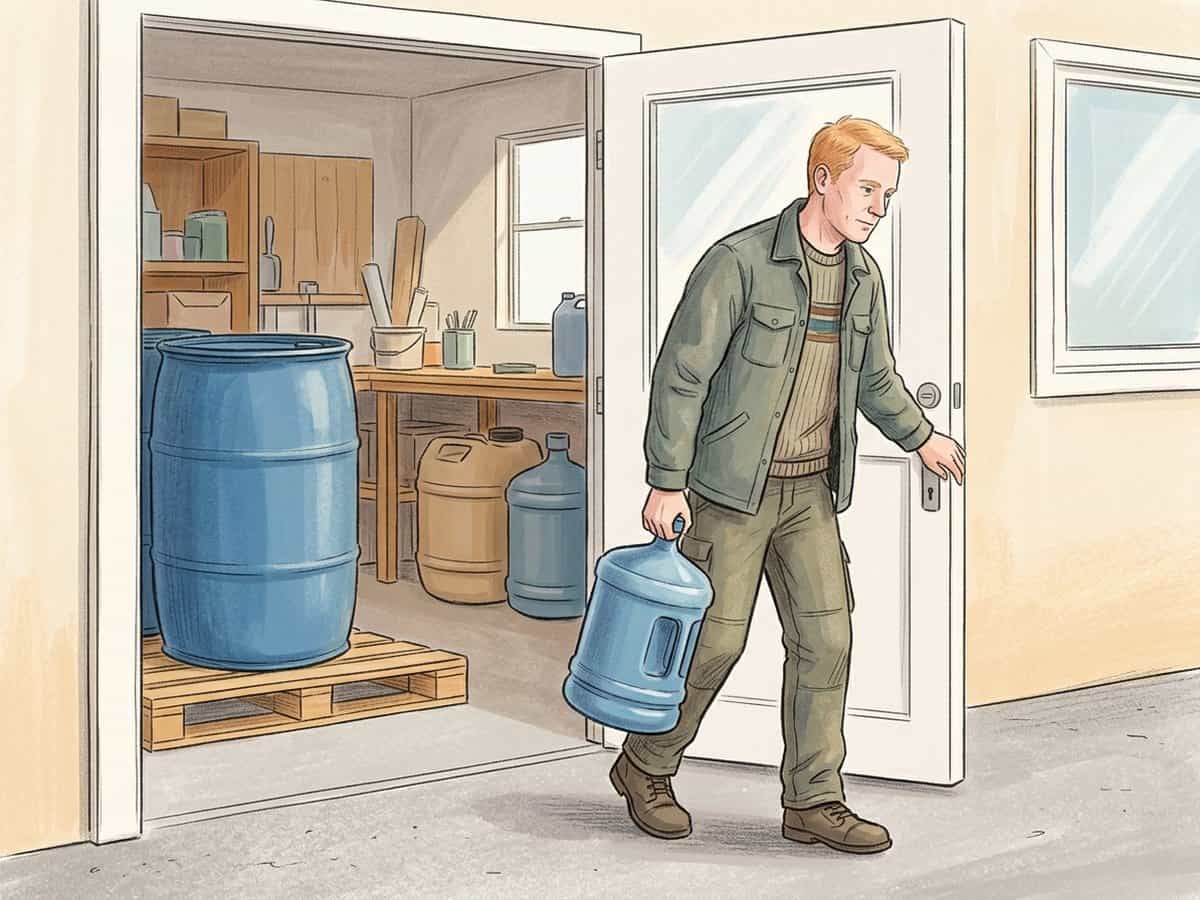
For smaller formats, compare the best emergency water storage containers or the best stackable water storage containers. To size the whole supply, use the emergency water storage calculator.
Questions
Common questions about 55 gallon water barrels
Short answers to what people ask before buying a water barrel.
The water alone weighs about 458 pounds: 55 gallons at 8.329 pounds per gallon, the USGS figure for water at 70°F. The container adds its own weight; the tank on this page states 22 pounds empty.
The CDC says to replace water you store yourself every 6 months. The CDC does not set a longer period for barrels, so this page uses the same 6 months for a 55-gallon barrel you fill yourself.
A traditional drum with bung caps needs a pump or siphon, because it is too heavy to tip when full. A tank with a built-in spigot, like the one on this page, does not.
The CDC says to store water between 50°F and 70°F, out of direct sunlight, and away from toxic substances such as gasoline and pesticides. Because a full barrel holds about 458 pounds of water, a ground-level floor is the practical choice.
Only if you can confirm it never held a toxic chemical. The CDC says not to use containers that previously held toxic chemicals and recommends FDA-approved food-grade containers. If the history is unknown, do not use it.
Sources
Where these facts come from
Agency figures and manufacturer statements, each checked in September 2026.
- Centers for Disease Control and Prevention, “How to Create and Store an Emergency Water Supply” (reviewed June 27, 2025). cdc.gov — 1 gallon per person per day for 3 days; 2 weeks if possible; FDA-approved food-grade containers; no containers that held toxic chemicals; label and date; replace every 6 months; 50°F–70°F, out of sunlight, away from gasoline and pesticides. Checked September 2026.
- Ready.gov, “Water.” ready.gov — at least 1 gallon per person per day for drinking and sanitation; needs can double in very hot temperatures; some people need more. Checked September 2026.
- U.S. Geological Survey, “Water Density.” usgs.gov — 8.329 pounds per U.S. gallon at 70°F. Checked September 2026.
- Emergency Water Tanks (a division of Hive Plastics), “55 Gallon Stackable Emergency Water Storage Tank.” emergencywatertanks.com — specifications. And “Warranty,” emergencywatertanks.com. Checked September 2026.