Buying Guide
Bathtub Emergency Water Storage: How Tub Bladders Work
Filling the bathtub before a storm is old advice, and the agencies disagree on what that water is for. A tub bladder changes the picture: a sealed liner and a pump instead of an open basin. Here is what the agencies actually say, how a bladder works and how long one tub lasts a household.
The guidance
What the agencies say about bathtub emergency water storage
Bathtub emergency water storage in an open tub is, in the current agency wording checked for this page, water for washing, cleaning and flushing, not a drinking supply.
| Source | What it says about the bathtub | Date |
|---|---|---|
| CDC, Preparing for Hurricanes | “Fill clean water containers with drinking water” and “You can also fill up your sinks and bathtubs with water for washing.” | Page dated May 28, 2026 |
| National Weather Service, Hurricane Safety brochure | “Fill bathtub and large containers with water in case tap water is unavailable. Use water in bathtubs for cleaning and flushing only. Do NOT drink it.” | File dated 2010 |
| FEMA, Are You Ready? hurricane guide | “Store drinking water in clean bathtubs, sinks and jugs, in case the local water supply becomes contaminated.” | Spring 2008 |
| Ready.gov, Water and Hurricanes | Silent. Neither page mentions a bathtub. | Checked September 2026 |
| EPA, Hurricanes | Silent on bathtubs. It says to keep “at least a 3-day water supply per person and for pets, too.” | Checked September 2026 |
How this table was built. Each row quotes the source directly. The sources disagree: the 2008 FEMA guide calls tub water drinking water, while the newer CDC page names washing and the National Weather Service brochure says not to drink it. This page follows the more recent and more cautious wording. No agency page checked here addresses sealed tub bladders at all.
The practical reading is simple. Water standing in an open tub is exposed to the tub surface, the drain area, the room and whatever falls in. It is useful for flushing a toilet and for washing when the taps stop. Your drinking supply should come from sealed commercial water or clean, food-grade containers, which is what the CDC’s emergency water supply page describes: at least 1 gallon per person per day for 3 days, and a 2-week supply if possible.
How it works
How a bathtub water bladder works
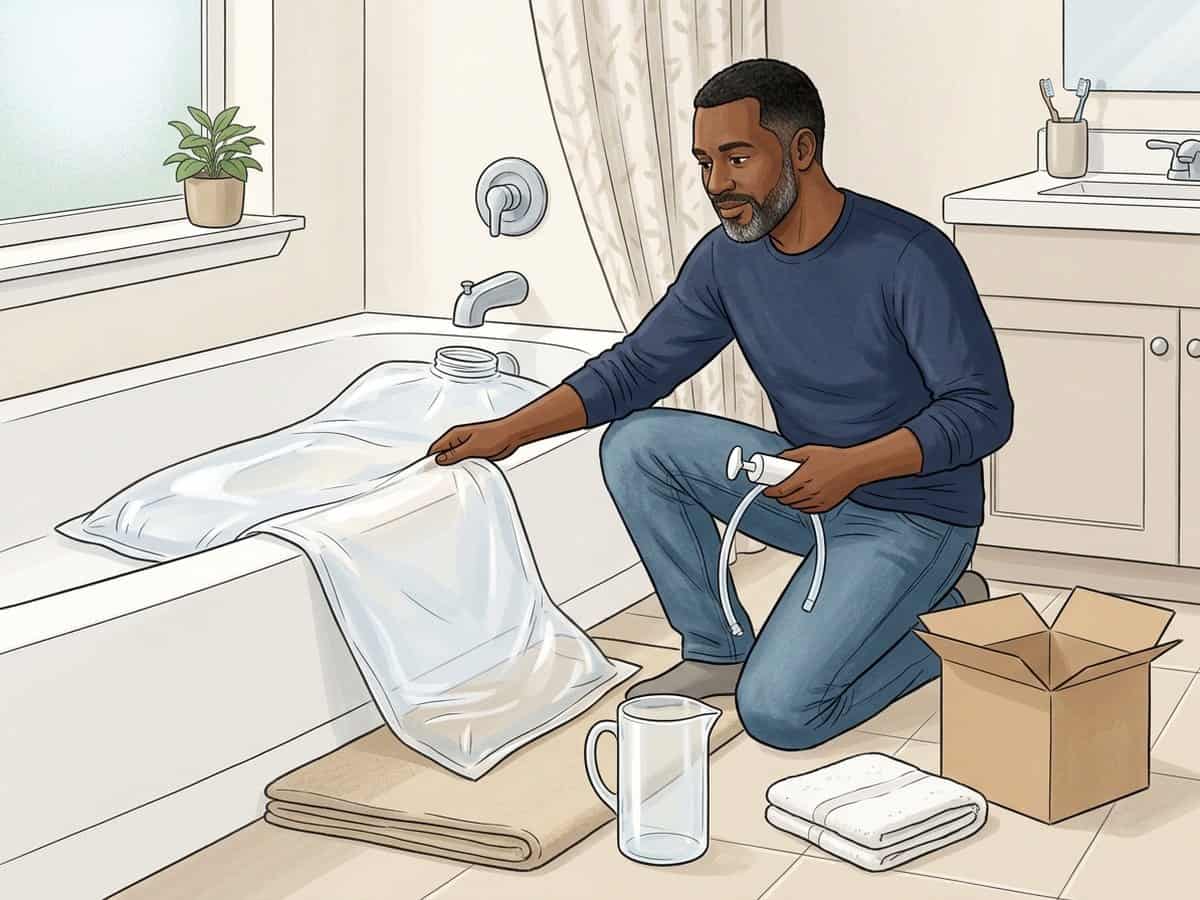
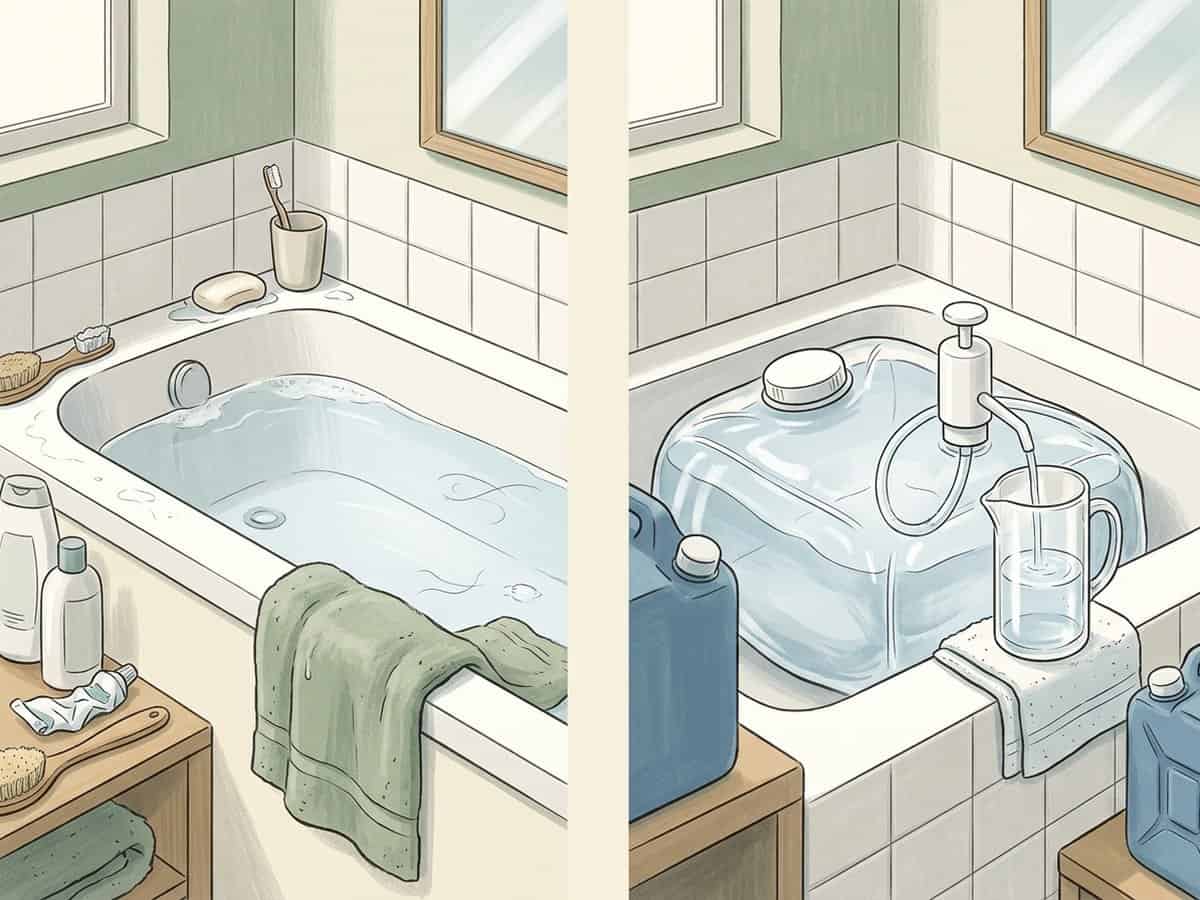
A bathtub water bladder is a large, closed plastic liner that lies in the tub, fills from the tub faucet, seals with a cap and empties through a small hand pump, so the water never sits open in the basin.
The idea is separation. The tub becomes a support that carries the weight, while the liner keeps the water away from the tub surface, the drain and the air of the room. Nothing is dipped in to get water out: the pump pushes it into a pitcher or jug. Tub bladders are often searched by the brand name WaterBOB; this page has not checked any bladder maker’s documentation, so it prints no brand’s capacity, material or hold time.
A tub bladder, from filling to pouring
- Fillfrom the faucet into a capped opening, before the event
- Pourwith the pump into a clean container; nothing is dipped in
- Check the tub. It needs to be sound, built in and free of cracks or chips that could damage a liner.
- Clean the tub first. The liner rests on it. Follow the maker’s instructions for placing it.
- Fill from the cold tap while the water is still safe. That means before the storm, not after. If your utility has already issued a boil-water or do-not-drink advisory, follow its instructions instead of treating the tap as a drinking source.
- Close it and keep the pump with it. A bladder without its pump or siphon is water you cannot easily reach.
- Pour, do not dip. Pump into a clean pitcher or jug, and keep the fill cap closed between uses.
- Empty it on the maker’s schedule. No agency page checked here publishes a hold time for tub bladders. The CDC’s 6-month rotation applies to water you store in containers, and a bladder is a short-notice fill, not a container you keep full.
Try it
How many days bathtub emergency water storage covers
The days a filled tub or tub bladder covers is its gallons divided by the household’s daily need, at 1 gallon per person per day.
How much a tub holds for your household
Enter the capacity printed on your bladder’s packaging. The starting figure of 50 gallons is an example, not a measurement.
How this is worked out. Household need is people × 1 gallon, the CDC and Ready.gov allowance for drinking and sanitation, doubled if you tick very hot weather because Ready.gov says needs can double. Days is gallons ÷ household need, rounded down. Weight is gallons × 8.329 pounds (USGS), all calculated.
What it will not do. It does not know your tub. No agency publishes a typical capacity for a standard alcove tub; EPA WaterSense says only that a bath “takes up to 70 gallons,” and a liner usually holds less than the tub around it. It adds nothing for children, nursing mothers, illness or pets, which Ready.gov says may need more without giving a figure.
At the example of 50 gallons, a household of four covers 12 full days at the allowance, and six at the doubled figure for very hot weather (calculated). That water weighs about 416 pounds, which is why a bladder is filled where it will be used and never moved full.
Buying
What to check before buying a bathtub water bladder
A bathtub water bladder is worth buying only when its maker states, on the maker’s own packaging or website, that it is made for drinking water, and states its capacity.
- A drinking-water or food-grade statement from the maker. The CDC’s container rule is food-grade, for drinking water. A retailer’s title is not the maker’s statement.
- A stated capacity. It is the number the calculator above needs.
- A pump or siphon in the box. Without one, the only way out is dipping.
- The maker’s tub-fit statement. Check it against your tub’s type and size.
- The maker’s instructions on how long water may stay in it, and whether it is single-use. This page prints none, because no bladder maker’s documentation has been checked.
Browse bathtub water bladders on Amazon
Affiliate link to a search, not to one product. The results have not been checked. Keep only listings whose maker states drinking-water or food-grade use, a capacity and an included pump.
The exclusions
Who a bathtub water bladder is not for
A bathtub water bladder is a short-notice fill for a warning you can see coming, so it is the wrong tool for long-term storage or for a tub that cannot safely hold it.
- Not for you if you want long-term storage. The CDC’s long-term guidance is clean, food-grade containers, rotated every 6 months if you fill them yourself.
- Not for you if your tub is a clawfoot or other freestanding tub, or is cracked or chipped. This page does not recommend a bladder for those tubs; check the maker’s tub-fit statement.
- Not for you if no one in the home can dispense without a pump, or the pump is missing. Dipping cups into the liner defeats the seal.
- Not for you if it would be your only drinking water. Keep a sealed or container supply as the base, and treat the tub as the extra.
For that base supply, start with the complete emergency water storage guide and the best emergency water storage containers. Sealed options you never fill yourself are compared in emergency drinking water: canned, boxed and pouched options.
Questions
Common questions about bathtub emergency water storage
Short answers to what people ask before filling a tub or buying a tub bladder.
People fill the tub so there is water for washing and flushing if the taps stop working. The CDC’s hurricane page says you can fill sinks and bathtubs with water for washing, and the National Weather Service brochure says to use bathtub water for cleaning and flushing only.
The current agency wording checked here does not treat open tub water as drinking water. The National Weather Service brochure says “Do NOT drink it,” and the CDC names washing. An older 2008 FEMA guide said otherwise. Drink from sealed or stored containers instead.
EPA WaterSense says a bath takes up to 70 gallons. No agency publishes a typical figure for a standard tub, and a bladder holds less than the tub around it, so use the capacity the bladder’s maker states.
No agency page checked here gives a hold time for water in a tub bladder. Follow the maker’s own instructions. A bladder is a short-notice fill; the CDC’s 6-month rotation applies to water you store in containers.
Tub bladders are designed to be emptied with a small hand pump or siphon into a clean pitcher or jug. Check that one is included before buying, and keep it with the bladder.
At the CDC allowance of 1 gallon per person per day, 50 gallons covers a family of four for 12 full days, calculated. In very hot weather Ready.gov says needs can double, which halves that.
Sources
Where these facts come from
Agency wording and figures, each checked in September 2026.
- Centers for Disease Control and Prevention, “Preparing for Hurricanes or Other Tropical Storms” (dated May 28, 2026). cdc.gov — fill clean water containers with drinking water; fill sinks and bathtubs with water for washing. Checked September 2026.
- National Weather Service, “Hurricane Safety” brochure (file dated 2010). weather.gov — fill bathtub and large containers; use water in bathtubs for cleaning and flushing only; do not drink it. Checked September 2026.
- Federal Emergency Management Agency, “Are You Ready? A Preparedness Guide for Hurricanes” (Spring 2008). fema.gov — store drinking water in clean bathtubs, sinks and jugs. Checked September 2026.
- Centers for Disease Control and Prevention, “How to Create and Store an Emergency Water Supply” (reviewed June 27, 2025). cdc.gov — 1 gallon per person per day for 3 days; a 2-week supply if possible; food-grade containers; replace self-filled water every 6 months. Checked September 2026.
- Ready.gov, “Water” and “Hurricanes.” ready.gov/water, ready.gov/hurricanes — 1 gallon per person per day; needs can double in very hot temperatures; children, nursing mothers and sick people may need more; neither page mentions bathtubs. Checked September 2026.
- U.S. Environmental Protection Agency, “Hurricanes.” epa.gov — keep at least a 3-day water supply per person and for pets; no mention of bathtubs. And EPA WaterSense, “WaterSense for Kids” (updated April 21, 2026), epa.gov — a bath takes up to 70 gallons. Checked September 2026.
- U.S. Geological Survey, “Water Density.” usgs.gov — 8.329 lb per gallon. Checked September 2026.