Daily Water Needs
How Much Water Does the Average Household Use a Day?
The EPA’s figure for an average American family is more than 300 gallons a day at home. Here it is per day, per month and per year, where it goes, how to read it on your bill, and how small an emergency supply looks beside it.
The EPA says the average American family uses more than 300 gallons of water a day at home, roughly 70 percent of it indoors. Per person, the EPA gives about 82 gallons a day, which it says comes to around 10,000 gallons in 30 days for a family of four. An emergency supply is far smaller: the CDC says to store at least 1 gallon per person per day, so 12 gallons covers a family of four for 3 days.
What you’ll learn
The short version
How much water the average household uses has a published answer from the EPA: more than 300 gallons a day at home for the average American family, with roughly 70 percent used indoors.
- Family total: more than 300 gallons a day at home, about 70 percent indoors and 30 percent outdoors nationally (EPA WaterSense).
- Per person: about 82 gallons a day at home (EPA, citing USGS 2015 estimates); the USGS separately estimates 80 to 100 gallons a day for indoor uses.
- Per month: around 10,000 gallons in 30 days for a family of four, in the EPA’s own example.
- Leaks alone can waste 180 gallons a week in the average family, about 9,400 gallons a year (EPA).
- Emergency storage: at least 1 gallon per person per day for 3 days, and a 2-week supply if possible (CDC). For a family of four that is 12 to 56 gallons.
Step 1
How much water the average household uses per day
How much water the average household uses per day, in the EPA’s national figure, is more than 300 gallons for the average American family at home, with roughly 70 percent of that used indoors.
The U.S. Environmental Protection Agency runs WaterSense, its program for water-efficient products and homes. Its page on how we use water, updated in August 2026, says: “The average American family uses more than 300 gallons of water per day at home. Roughly 70 percent of this use occurs indoors.” The same page says outdoor use accounts for 30 percent of household use nationally, and can be much higher in drier parts of the country.
Applied to the 300-gallon floor, those shares come to about 210 gallons indoors and 90 gallons outdoors each day (calculated). Because the EPA’s figure is “more than” 300 gallons, both numbers are lower bounds, not exact amounts for any one home.
The per-person view gives a similar picture. The EPA’s WaterSense statistics page says “each American uses an average of 82 gallons of water a day at home,” citing the U.S. Geological Survey’s estimate of water use in 2015. The USGS Water Science School, in a separate answer from 2019, says that “estimates vary, but, on average, each person uses about 80-100 gallons of water per day, for indoor home uses.” These are different estimates with different scopes, so this page prints both rather than blending them. For the single-person version of this question, see the guide to how much water the average person uses a day.
| Measure and source | Published figure | Scope |
|---|---|---|
| Average American family (EPA WaterSense) | More than 300 gal a day | All use at home |
| Indoor share (EPA WaterSense) | Roughly 70 percent, about 210 gal or more Calculated | Toilets, showers, faucets, laundry and other indoor uses |
| Outdoor share (EPA WaterSense) | 30 percent nationally, about 90 gal or more Calculated | Mainly landscape watering; much higher in dry regions |
| Each American (EPA, citing USGS 2015) | About 82 gal a day | All use at home |
| Each person (USGS Water Science School, 2019) | About 80 to 100 gal a day | Indoor home uses only |
Step 2
How much water the average household uses per month and per year
How much water the average household uses per month is around 10,000 gallons for a family of four, in the EPA’s own worked example based on 82 gallons per person per day over a 30-day period.
The EPA’s guide to understanding your water bill puts it plainly: “The average American uses around 82 gallons per day per person in the household. That means a family of four would use around 10,000 gallons in a 30-day period.” The exact arithmetic is 82 × 4 × 30 = 9,840 gallons, which the EPA rounds to 10,000.
The table below applies the same 82-gallon figure to other household sizes. Every number in it is arithmetic on the EPA’s per-person average, so it describes an average household of that size, not yours. The EPA adds that usage “varies a great deal across the country, mostly because of differences in weather patterns,” with higher use where homes rely on irrigation.
| Household | Per day Calculated | Per 30 days Calculated | Per year Calculated |
|---|---|---|---|
| 1 person | 82 gal | 2,460 gal | 29,930 gal |
| 2 people | 164 gal | 4,920 gal | 59,860 gal |
| 3 people | 246 gal | 7,380 gal | 89,790 gal |
| 4 people | 328 gal | 9,840 gal (EPA: “around 10,000”) | 119,720 gal |
| 5 people | 410 gal | 12,300 gal | 149,650 gal |
The family-level figure gives a similar yearly scale from a different starting point. More than 300 gallons a day for 365 days is more than 109,500 gallons a year (calculated). Neither source publishes a monthly figure for any specific region, house size or season, and this page does not estimate one.
Step 3
Where the average household’s water goes
The average household’s water goes mostly to indoor uses, about 70 percent nationally, with flushing toilets the largest single indoor use and showers and baths next, according to the EPA and USGS.
The USGS answer on home water use names the order directly: “the largest use of household water is to flush the toilet, and after that, to take showers and baths.” It explains that this is why newer toilets, showers and faucets are built to use less, with many faucet heads stamped with a maximum flow such as 1.0 gallons per minute. The pages checked for this guide rank the uses but give no percentage split for each fixture, so none is printed here.
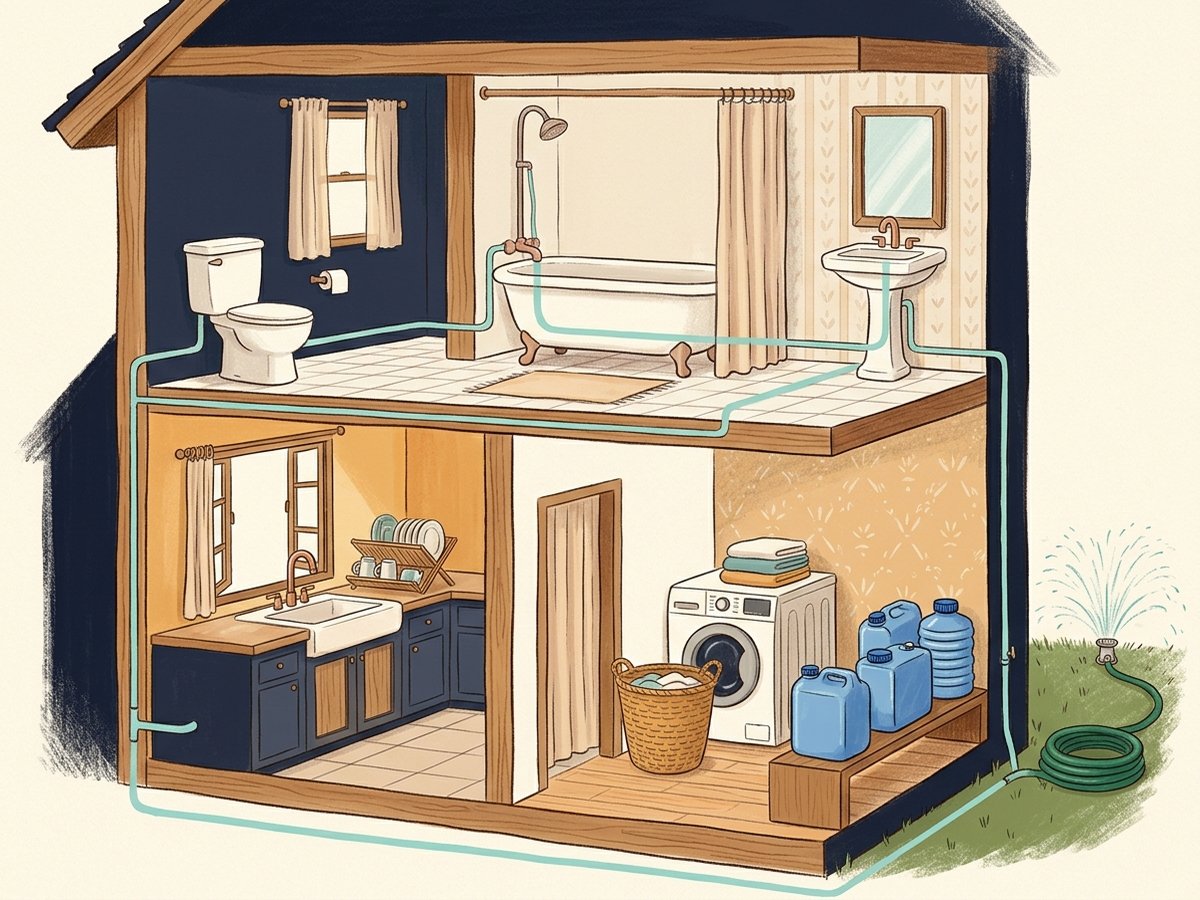
Outdoors, the share depends heavily on climate. The EPA’s statistics page says outdoor water use “accounts for more than 30 percent of total household water use, on average, but can be as much as 60 percent of total household water use in arid regions.” Its outdoor water page adds that “the average U.S. household uses more water outdoors than for showering and washing clothes combined,” mainly for landscape irrigation.
Small daily habits are part of the total too. The EPA says turning off the tap while brushing teeth can save 8 gallons of water a day, and that letting a faucet run for five minutes while washing dishes can waste 10 gallons. Those are the agency’s own illustrations of how individual habits add up across a household.
Step 4
How to find your own household water use on your bill
Your own household water use is printed on your water bill, usually in gallons or in CCF, a unit of one hundred cubic feet that the EPA says equals 748 gallons.
The EPA’s water bill guide calls the bill “the best place to find this information” and explains the two common units. One CCF, also written HCF, is 100 cubic feet of water, and “one CCF is equal to 748 gallons.” To compare your bill with the averages on this page, convert the billed usage to gallons, then divide by the number of days in the billing period and by the number of people in your home.
| Example billed use | In gallons Calculated | Per day over 30 days Calculated | Per person per day, 4 people Calculated |
|---|---|---|---|
| 8 CCF | 5,984 gal | About 199 gal | About 50 gal |
| 13 CCF | 9,724 gal | About 324 gal | About 81 gal |
| 20 CCF | 14,960 gal | About 499 gal | About 125 gal |
Some utilities bill every two or three months, so check the dates printed on the bill before dividing. The EPA notes that some utilities also print a graph of use over the year, which it describes as a helpful way of seeing when your own water use reaches its highest levels.
Step 5
How much water household leaks waste
Household leaks waste a measurable share of average use: the EPA says the average family can waste 180 gallons a week, or 9,400 gallons a year, from leaks in the home.
The EPA’s statistics page compares those 9,400 gallons to “the amount of water needed to wash more than 300 loads of laundry,” and says household leaks nationwide can waste nearly 900 billion gallons a year. Spread evenly over a week, 180 gallons is about 26 gallons a day (calculated), close to a tenth of the family’s 300-gallon daily total (calculated).
The EPA’s leak figures are national averages, and the sources checked here give no way to estimate the leaks in any one home; the water bill and its usage history are the place to look. Fixing a known leak is one of the few household water changes that saves water every day without changing anyone’s habits.
Step 6
How much water a household needs when the tap stops
How much water a household needs when the tap stops is far less than it normally uses: the CDC says to store at least 1 gallon per person per day for 3 days, and a 2-week supply if possible, for drinking, cooking and hygiene.
The CDC’s emergency water page says: “Store at least 1 gallon of water per person, per day for 3 days. You can use this water during an emergency for drinking, cooking, brushing teeth, and other uses. Try to store a 2-week supply if possible.” Ready.gov gives the same gallon for drinking and sanitation, adds that “in very hot temperatures, water needs can double,” and says never to ration drinking water unless authorities order it.
A family of four: normal daily use beside stored emergency water, in gallons
Bars scaled to 330 gallons. Emergency amounts are 1 gallon per person per day (CDC) multiplied out; the 82-gallon row is EPA’s per-person figure times four. Both are calculated.
Set side by side, the difference is stark. A full 2-week emergency supply for a family of four, 56 gallons, is less than one-fifth of the 300-plus gallons the same family uses at home on an ordinary day (calculated). The 3-day minimum, 12 gallons, is about 4 percent of one ordinary day (calculated). That is why an outage changes how a household uses water, not just how much it has: no lawn watering, no laundry, short washes and careful flushing, with the stored gallon reserved first for drinking and food.
| Household | 3 days | 2 weeks | 2 weeks, very hot weather | 2-week weight, normal |
|---|---|---|---|---|
| 2 people | 6 gal | 28 gal | 56 gal | About 233 lb |
| 4 people | 12 gal | 56 gal | 112 gal | About 466 lb |
| 5 people | 15 gal | 70 gal | 140 gal | About 583 lb |
The CDC also says to replace water you fill and store yourself every 6 months, and to observe the expiration date on store-bought water. To size a supply for your household, the emergency water storage calculator works out gallons and weight, the guide to how much water per person per day to store explains what the gallon covers, and our comparison of water storage containers sets out capacities from the makers’ own specifications. Use only clean, food-grade containers intended for drinking water, kept cool, dark and away from fuel and pesticides. For the drinking side of the same picture, see how much water the average person drinks a day.
Questions
Common questions about how much water a household uses
These are the questions people most often ask about household water use.
The EPA says the average American family uses more than 300 gallons of water a day at home, roughly 70 percent of it indoors. Per person, the EPA gives about 82 gallons a day at home.
In the EPA’s own example, a family of four using about 82 gallons per person per day uses around 10,000 gallons in a 30-day period. The exact arithmetic is 9,840 gallons.
Indoors, the USGS says flushing the toilet is the largest use, followed by showers and baths. Outdoors, the EPA says the average household uses more water than for showering and washing clothes combined, mainly on landscape watering.
Multiply by 748. The EPA says one CCF, a hundred cubic feet of water, equals 748 gallons. Divide the result by the days in the billing period and the people in your home to compare with the averages.
The CDC says at least 1 gallon per person per day for 3 days, and a 2-week supply if possible. For a family of four that is 12 gallons for 3 days or 56 gallons for 2 weeks; Ready.gov says needs can double in very hot weather.
Sources
Where these figures come from
Every figure on this page is quoted from, or calculated from, one of these sources, checked in October 2026.
- U.S. Environmental Protection Agency, WaterSense, “How We Use Water” (last updated August 4, 2026). epa.gov — the average American family uses more than 300 gallons of water per day at home; roughly 70 percent indoors; outdoor use 30 percent nationally, higher in drier regions. Checked October 2026.
- U.S. Environmental Protection Agency, WaterSense, “Statistics and Facts” (last updated March 11, 2026). epa.gov — each American uses an average of 82 gallons a day at home (citing USGS estimates for 2015); leaks can waste 180 gallons a week or 9,400 gallons a year per family, and nearly 900 billion gallons a year nationwide; outdoor use more than 30 percent on average and up to 60 percent in arid regions; tap-off and running-faucet examples. Checked October 2026.
- U.S. Environmental Protection Agency, WaterSense, “Understanding Your Water Bill” (last updated March 4, 2026). epa.gov — around 82 gallons per person per day; a family of four around 10,000 gallons in 30 days; one CCF equals 748 gallons; use varies with weather. Checked October 2026.
- U.S. Environmental Protection Agency, WaterSense, “Outdoors” (last updated July 20, 2026). epa.gov — the average U.S. household uses more water outdoors than for showering and washing clothes combined. Checked October 2026.
- U.S. Geological Survey, Water Science School, “How much water do I use at home each day?” (June 20, 2019). usgs.gov — about 80 to 100 gallons per person per day for indoor home uses; toilet flushing the largest use, then showers and baths. Checked October 2026.
- Centers for Disease Control and Prevention, “How to Create an Emergency Water Supply.” cdc.gov — at least 1 gallon per person per day for 3 days; a 2-week supply if possible; replace home-filled water every 6 months; observe expiration dates on store-bought water. Checked October 2026.
- Ready.gov, “Water.” ready.gov — at least 1 gallon per person per day for drinking and sanitation; needs can double in very hot temperatures; never ration drinking water unless ordered to. Checked October 2026.
- U.S. Geological Survey, “Water Density.” usgs.gov — water at 70°F weighs 62.300 pounds per cubic foot; converted to about 8.33 pounds per U.S. gallon (calculated) for every weight on this page. Checked October 2026.