Daily Water Needs
How Many Ounces of Water Should You Drink a Day?
The published answer is a reference in liters, not a rule in ounces. Here it is in fluid ounces, cups, bottles and gallons, with every conversion shown.
The National Academies put adequate total water at about 91 fl oz a day for women (2.7 liters) and 125 fl oz for men (3.7 liters), from all drinks and food. About 80 percent usually comes from drinks: roughly 73 oz and 100 oz (calculated). These are references, not targets; thirst guides most healthy people. For an emergency supply, store 128 fl oz (1 gallon) per person per day for drinking and sanitation.
What you’ll learn
The short version
How many ounces of water you should drink a day has a reference answer, not a personal rule: about 91 fl oz of total water for women and 125 fl oz for men, including food.
- Women about 2.7 L, men about 3.7 L of total water (National Academies); about 73 and 100 oz of it from drinks (calculated).
- The National Academies offer no glass-count rule of thumb.
- Emergency storage: at least 128 fl oz, one gallon, per person per day for drinking and sanitation (Ready.gov, CDC).
Step 1
How many ounces of water women and men take in: the reference figures
The ounces of water women and men take in on an adequate day are about 91 fl oz and 125 fl oz of total water, converted from the National Academies’ liter figures.
The National Academies of Sciences, Engineering, and Medicine, which sets the U.S. Dietary Reference Intakes, found in its 2004 water report that women who appear to be adequately hydrated consume an average of about 2.7 liters (91 ounces) of total water a day, and men about 3.7 liters (125 ounces). Total water means every source: plain water, other beverages, and the moisture in food. The panel called these values adequate intake levels, which describe healthy populations rather than a quota for any one person.
The same release says about 80 percent of people’s total water comes from drinking water and beverages, including caffeinated ones, and the other 20 percent comes from food.
| Reference group | Total water, published | Total, in fl oz Calculated | From drinks, about 80% Calculated | From food, about 20% Calculated |
|---|---|---|---|---|
| Women | About 2.7 L | About 91 fl oz | About 73 fl oz | About 18 fl oz |
| Men | About 3.7 L | About 125 fl oz | About 100 fl oz | About 25 fl oz |
The panel’s summary: “The vast majority of healthy people adequately meet their daily hydration needs by letting thirst be their guide.” For the full everyday question, see how much water a person should drink a day.
Step 2
How many oz of water should a person drink, compared with what people actually drink
How many oz of water a person should drink is easier to picture beside real intake: U.S. adults drank an average of 44 ounces of plain water a day in 2015–2018, according to the CDC.
The Centers for Disease Control and Prevention (CDC), the federal public-health agency, reports in its water consumption fast facts that U.S. adults drank an average of 44 ounces of plain water daily in 2015–2018. That counts plain water only, so it is not directly comparable with the reference totals.
Daily water figures, in fluid ounces
Bars scaled to one U.S. gallon, 128 fl oz. Ounces converted from liters are calculated.
Ready.gov adds a third reference. It says a normally active person needs about ¾ of a gallon of fluid daily, from water and other beverages, which is 96 fl oz (calculated). It sits between the two drinks shares.
Everything else a person drinks fills the gap between 44 oz of plain water and the drinks shares. The CDC says daily intake is mostly from water and other beverages, and that water-rich foods such as many fruits and vegetables add to it. Coffee and tea count too: the National Academies panel concluded that caffeinated beverages “can contribute as much as noncaffeinated options” to daily hydration.
Step 3
Is 64 ounces of water a day right? The eight-glass idea
Sixty-four ounces of water a day, the familiar eight 8-ounce glasses, is a memorable habit rather than a published recommendation from any source checked for this page.
The eight-by-eight idea adds up to 64 fl oz of plain water, about 1.9 liters (calculated). The National Academies panel chair, Lawrence Appel, said in 2004: “We don’t offer any rule of thumb based on how many glasses of water people should drink each day because our hydration needs can be met through a variety of sources in addition to drinking water.”
The CDC does not set a glass count either. Its guidance on water and healthier drinks says daily water intake recommendations vary by age, sex, pregnancy status, activity level and breastfeeding status. None of the agency pages cited here documents where the eight-glass idea came from, so this page does not guess.
So 64 ounces is neither a minimum nor a finish line; many people reach the reference through other drinks and food without counting a glass.
Eight glasses shows up in one official place. One gallon is 128 fl oz, which is about eight 16-ounce glasses. That gallon is the emergency storage allowance per person per day, and it covers drinking and sanitation together. It is not eight glasses to drink.
Step 4
Ounces of water in heat, activity and other situations
The ounces of water a person needs go up in heat and with activity, but the only published multiplier in the sources checked here is Ready.gov’s statement that water needs can double in very hot temperatures.
The National Academies say very active people and those in hot climates may need more water; the CDC adds fever, diarrhea and vomiting. Neither gives an amount. Ready.gov, writing for emergencies, is the one source that puts a size on it: “In very hot temperatures, water needs can double.”
Applied as plain arithmetic, doubling Ready.gov’s own 96 fl oz fluid figure gives 192 fl oz, and doubling the 128 fl oz storage gallon gives 256 fl oz per person per day (both calculated). Those are planning numbers for a hot-weather emergency supply, not drinking targets.
Ready.gov also says children, nursing mothers and sick people may need more water. No per-group ounce figure is published in these sources, so none is printed here.
Follow your clinician first. If a clinician has told you to limit fluids, for a heart or kidney condition or any other reason, reference figures do not apply to you. For pregnancy, breastfeeding and children, ask the clinician who knows the person.
Step 5
Ounces of water converted to cups, bottles, liters and gallons
Ounces of water convert to other units with fixed arithmetic: 8 fl oz to a cup, 16.9 fl oz to a standard single-serve bottle, about 33.8 fl oz to a liter and 128 fl oz to a U.S. gallon.
A U.S. gallon is 128 fluid ounces and 3.785 liters, so one fluid ounce is about 0.0296 liters. The bottle column uses 16.9 fl oz, a common single-serve size; check your own labels.
| Amount and source | Fluid ounces | 8-oz cups | 16.9-oz bottles | Liters | Gallons |
|---|---|---|---|---|---|
| Average plain water, U.S. adults (CDC) | 44 | 5.5 | 2.6 | 1.3 | 0.34 |
| Eight 8-oz glasses (habit, not guidance) | 64 | 8 | 3.8 | 1.9 | 0.5 |
| Women, from drinks (National Academies) | 73 | 9.1 | 4.3 | 2.2 | 0.57 |
| Women, total water (National Academies) | 91 | 11.4 | 5.4 | 2.7 | 0.71 |
| Fluid, normally active person (Ready.gov) | 96 | 12 | 5.7 | 2.8 | 0.75 |
| Men, from drinks (National Academies) | 100 | 12.5 | 5.9 | 3.0 | 0.78 |
| Men, total water (National Academies) | 125 | 15.6 | 7.4 | 3.7 | 0.98 |
| Stored per person per day (CDC, Ready.gov) | 128 | 16 | 7.6 | 3.8 | 1 |
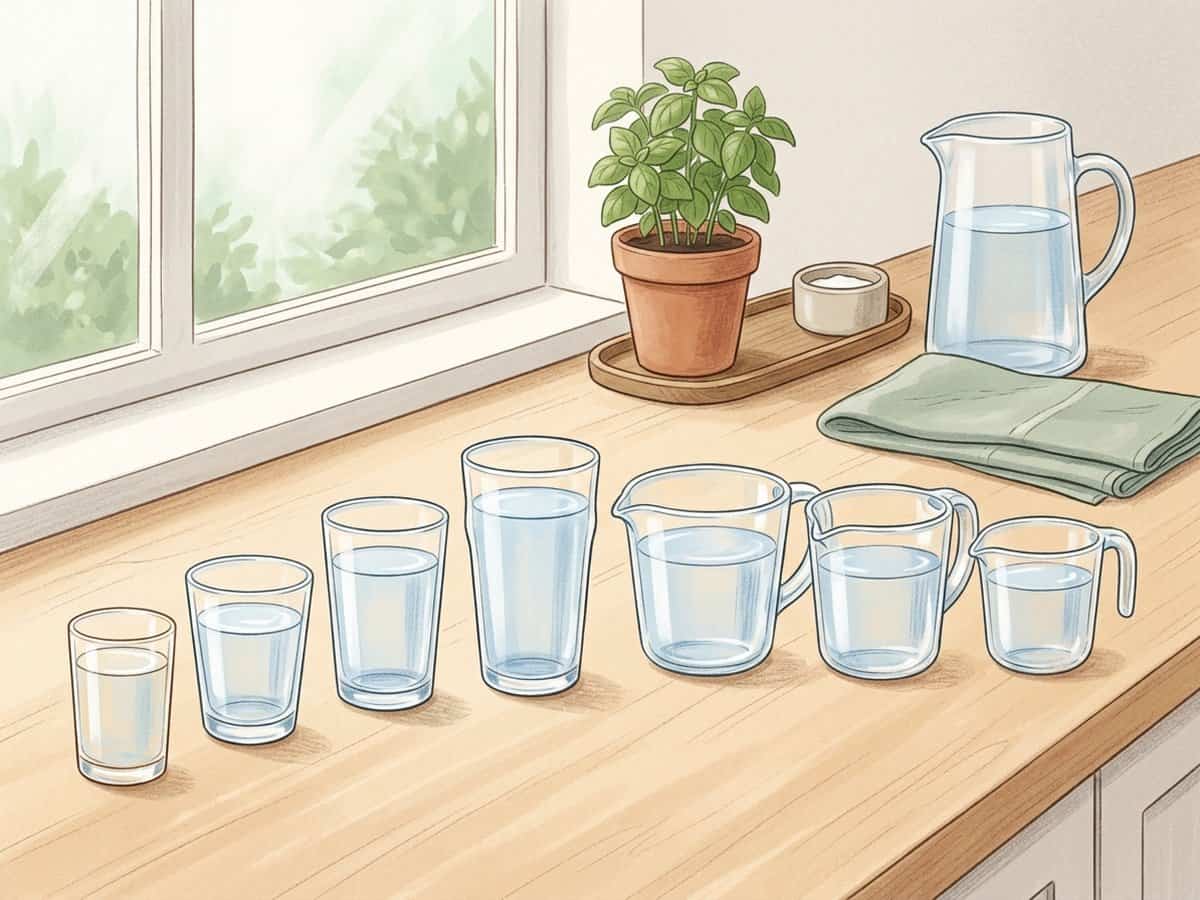
The men’s total, 125 fl oz, is just under a gallon, but it includes food, so it does not mean a man should drink a gallon. Only the storage row covers hygiene as well as drinking. Separate guides on this site will cover how many bottles of water a day, how many liters of water a day and how many gallons of water a day in more detail.
Step 6
Spreading daily ounces of water across a waking day
Spreading daily ounces of water across a waking day is simple division: the reference in fluid ounces, divided by the hours you are awake or by the size of the glass you use.
The panel below does that division for any published reference, then the separate storage arithmetic for your household. It is a converter, not a schedule.
Reference ounces, per hour and per glass
Pick a published reference and a glass size. The storage line uses the 1-gallon allowance for people and days.
How this is worked out. References are the National Academies’ 2.7 and 3.7 liters at 33.814 fl oz per liter (drinks: 80 percent of those), and Ready.gov’s ¾ gallon, 96 fl oz. Per waking hour is reference ÷ hours, and glasses is reference ÷ glass size. Storage is people × days × 128 fl oz, the CDC and Ready.gov allowance of 1 gallon per person per day. All of it is arithmetic.
What it will not calculate. No weight-based formula, and no figure for children, pregnancy, breastfeeding, illness, heat or exercise, because none of the sources used here publishes one. The storage line adds nothing for pets or heat. The per-hour figure does not apply to anyone told by a clinician to limit fluids.
Step 7
How many ounces of emergency water to store per person
The ounces of emergency water to store per person are at least 128 fl oz, one gallon, per day, covering drinking and sanitation, for at least 3 days and ideally 2 weeks.
Ready.gov says to “store at least one gallon of water per person per day for several days, for drinking and sanitation.” The CDC's emergency water page says to store at least 1 gallon per person, per day, for 3 days, and to try to store a 2-week supply if possible. That is why it is larger than the drinking references: a stored gallon also covers basic hygiene.
| Household | 3 days | 2 weeks | 2-week weight |
|---|---|---|---|
| 1 person | 384 fl oz (3 gal) | 1,792 fl oz (14 gal) | About 117 lb |
| 2 people | 768 fl oz (6 gal) | 3,584 fl oz (28 gal) | About 233 lb |
| 4 people | 1,536 fl oz (12 gal) | 7,168 fl oz (56 gal) | About 466 lb |
The U.S. Geological Survey gives a gallon of water at 70°F as 8.329 pounds, so a family of four's 2-week supply is close to 466 pounds before any container is counted. Ready.gov adds: never ration drinking water unless ordered to do so by authorities.
To size a supply, the emergency water storage calculator works out gallons, containers and weight for your household, and the guide to how much emergency water your family needs walks through the planning. Use only clean, food-grade containers intended for drinking water, and keep them somewhere cool, dark and away from fuel and pesticides.
Questions
Common questions about ounces of water a day
These are the questions people most often ask about daily water in ounces.
The National Academies put adequate total water at about 91 fluid ounces a day for women and 125 for men, from drinks and food, with roughly 73 and 100 ounces from drinks (calculated). Most healthy people meet their needs by letting thirst guide them.
Sixty-four ounces is eight 8-ounce glasses, a habit rather than an agency rule. Other drinks and food also count, so a plain-water total alone does not show whether someone is getting enough.
None of the agency sources used on this page publishes a body-weight formula for water. For a personal figure that accounts for your body and health, ask a clinician.
For reference, 100 ounces is about the drinks share of the National Academies figure for men. The panel set no upper limit for water, noting that dangerously excessive drinking is highly unusual. Anyone told to limit fluids for a medical reason should follow their clinician, not a reference figure.
Store at least 128 fluid ounces, one gallon, per person per day for drinking and sanitation, for at least 3 days, and a 2-week supply if possible, according to the CDC and Ready.gov. That is 384 ounces per person for 3 days and 1,792 ounces for 2 weeks (calculated).
Sources
Where these figures come from
Every figure on this page is quoted from, or calculated from, one of these sources, checked in September 2026.
- National Academies of Sciences, Engineering, and Medicine, news release on dietary reference intakes for water, salt and potassium (February 11, 2004). nationalacademies.org — about 2.7 L (91 oz) of total water a day for women and 3.7 L (125 oz) for men, from all beverages and foods; about 80 percent from drinking water and beverages, including caffeinated ones; thirst as a guide; no glass-count rule of thumb; very active people and those in hot climates may need more; no upper limit set. Checked September 2026.
- Centers for Disease Control and Prevention, “About Water and Healthier Drinks” (updated March 5, 2026). cdc.gov — recommendations vary by age, sex, pregnancy status, activity level and breastfeeding status; intake mostly from water and other beverages, with water-rich foods adding; more water needed in hot climates, with more activity, fever, diarrhea or vomiting. Checked September 2026.
- Centers for Disease Control and Prevention, “Fast Facts: Data on Water Consumption” (reviewed January 19, 2024). cdc.gov — U.S. adults drank an average of 44 ounces of plain water daily in 2015–2018. Checked September 2026.
- Ready.gov, “Water.” ready.gov — about ¾ gallon of fluid daily for a normally active person; at least 1 gallon per person per day for drinking and sanitation; needs can double in very hot temperatures; children, nursing mothers and sick people may need more; never ration drinking water unless ordered to. Checked September 2026.
- Centers for Disease Control and Prevention, “How to Create and Store an Emergency Water Supply” (reviewed June 27, 2025). cdc.gov — at least 1 gallon per person per day for 3 days; a 2-week supply if possible. Checked September 2026.
- U.S. Geological Survey, “Water Density.” usgs.gov — 8.329 pounds per U.S. gallon of water at 70°F, used for every weight on this page. Checked September 2026.