Daily Water Needs
How Much Water Does the Average Person Use per Day?
The everyday answer is measured in dozens of gallons. The emergency answer is one. Seeing the two side by side is the quickest way to understand what a stored supply is really for.
The U.S. Geological Survey estimates that each person uses about 80 to 100 gallons of water per day for indoor home uses. The EPA’s WaterSense program says the average American family uses more than 300 gallons a day at home, roughly 70 percent of it indoors. For an emergency, the CDC and Ready.gov allowance is 1 gallon per person per day, which is about 1 percent of ordinary indoor use (calculated).
Per person
How much water the average person uses per day
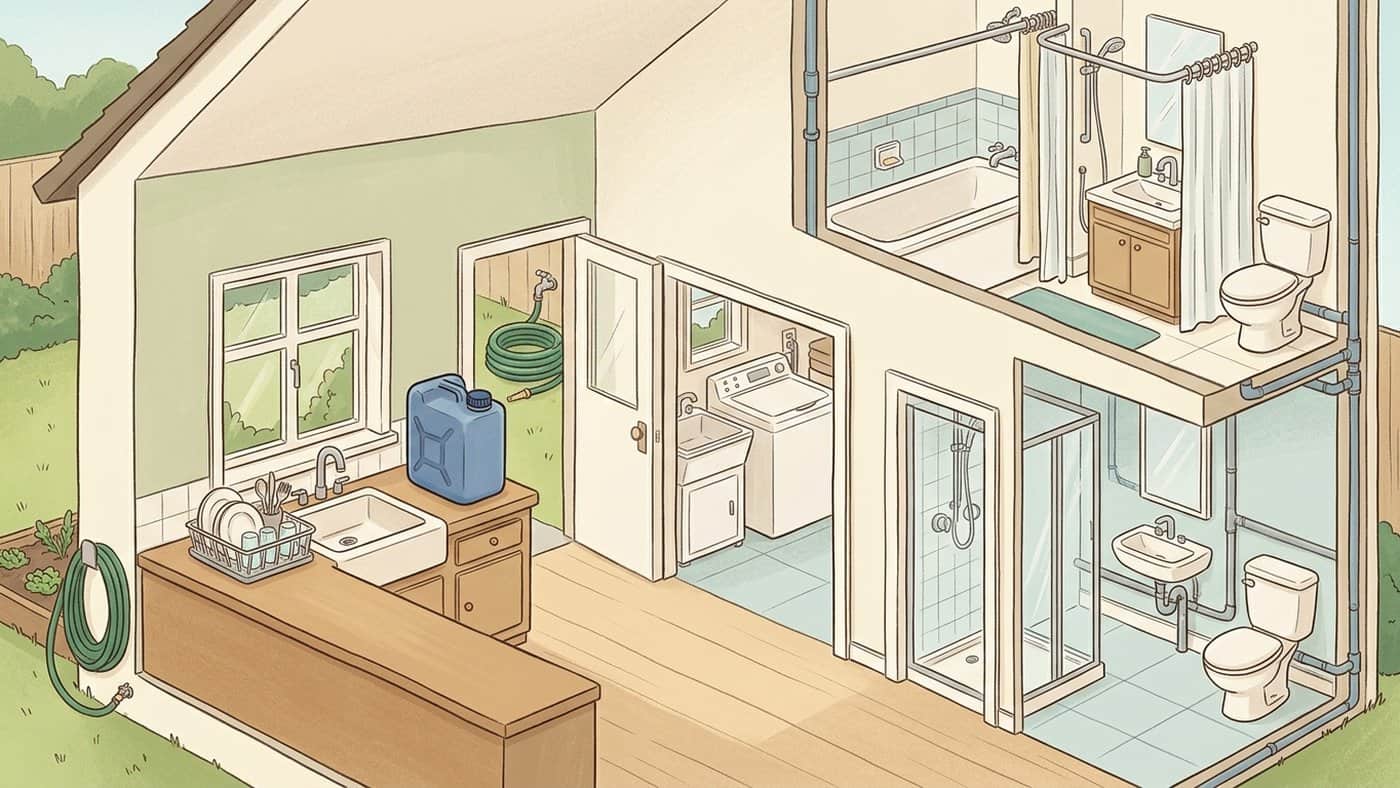
The average person uses about 80 to 100 gallons of water per day for indoor home uses, according to the U.S. Geological Survey.
The USGS gives that figure as a range and says plainly that estimates vary. It covers indoor uses at home: the water that runs through taps, toilets, showers, baths, dishwashers and washing machines. It does not include water used outdoors, and it is not a measurement of any particular household.
For comparison, the amount a person drinks is small. The National Academies report that adequately hydrated women take in about 2.7 liters and men about 3.7 liters of total water a day, including water from food. That is well under 1 gallon, against 80 to 100 gallons of indoor use (both calculated from the published figures).
One person, one day, in gallons
Bars scaled to 100 gallons. The USGS figure is a range; the bar shows its top.
Per household
How much water the average household uses
The average American family uses more than 300 gallons of water per day at home, according to the EPA’s WaterSense program, and roughly 70 percent of that use happens indoors.
The EPA figure is for a family rather than a person, so it does not line up exactly with the USGS per-person range. Since 70 percent of 300 gallons is 210 gallons (calculated), an average family uses more than 210 gallons a day indoors, with the rest going to outdoor uses such as watering. The EPA does not say how many people its average family contains, so this page does not divide the figure into a per-person number.
The household figure is where people searching for how much water a family uses per day usually land. It is also a useful reality check for emergency planning: a family’s ordinary day at home uses more water than most households could ever store.
Per month and year
How much water a person uses per month and per year
At 80 to 100 gallons a day, one person’s indoor use comes to about 2,400 to 3,000 gallons a month and about 29,200 to 36,500 gallons a year, all calculated from the USGS range.
| Period | Low estimate | High estimate | Emergency allowance, same period |
|---|---|---|---|
| One day | 80 gallons | 100 gallons | 1 gallon |
| One week | 560 gallons | 700 gallons | 7 gallons |
| One month | 2,400 gallons | 3,000 gallons | 30 gallons |
| One year | 29,200 gallons | 36,500 gallons | 365 gallons |
These totals are arithmetic on a published range, not measurements. Your water bill is the only source for your own household’s figure; many utilities show usage per billing period.
The comparison
A normal day versus an emergency day
An emergency water supply covers about 1 percent of a normal day’s indoor use per person, so it is a plan for drinking and basic sanitation, not for ordinary life.
Your normal day against your emergency day
Enter the people in your home. The panel compares the USGS indoor-use range with the emergency allowance of 1 gallon per person per day.
How this is worked out. Normal day is people × 80 to people × 100 gallons, from the USGS indoor-use range. Emergency day is people × 1 gallon, the CDC and Ready.gov allowance. The 2-week supply is people × 14 gallons; as a share of one normal day it is 14 ÷ 100 to 14 ÷ 80, or about 14 to 18 percent, whatever the household size. All of it is arithmetic.
What it will not do. It does not estimate your own usage; only your water bill can. It adds nothing for heat, illness, infants or pets, whose needs Ready.gov says may be higher without publishing a figure.
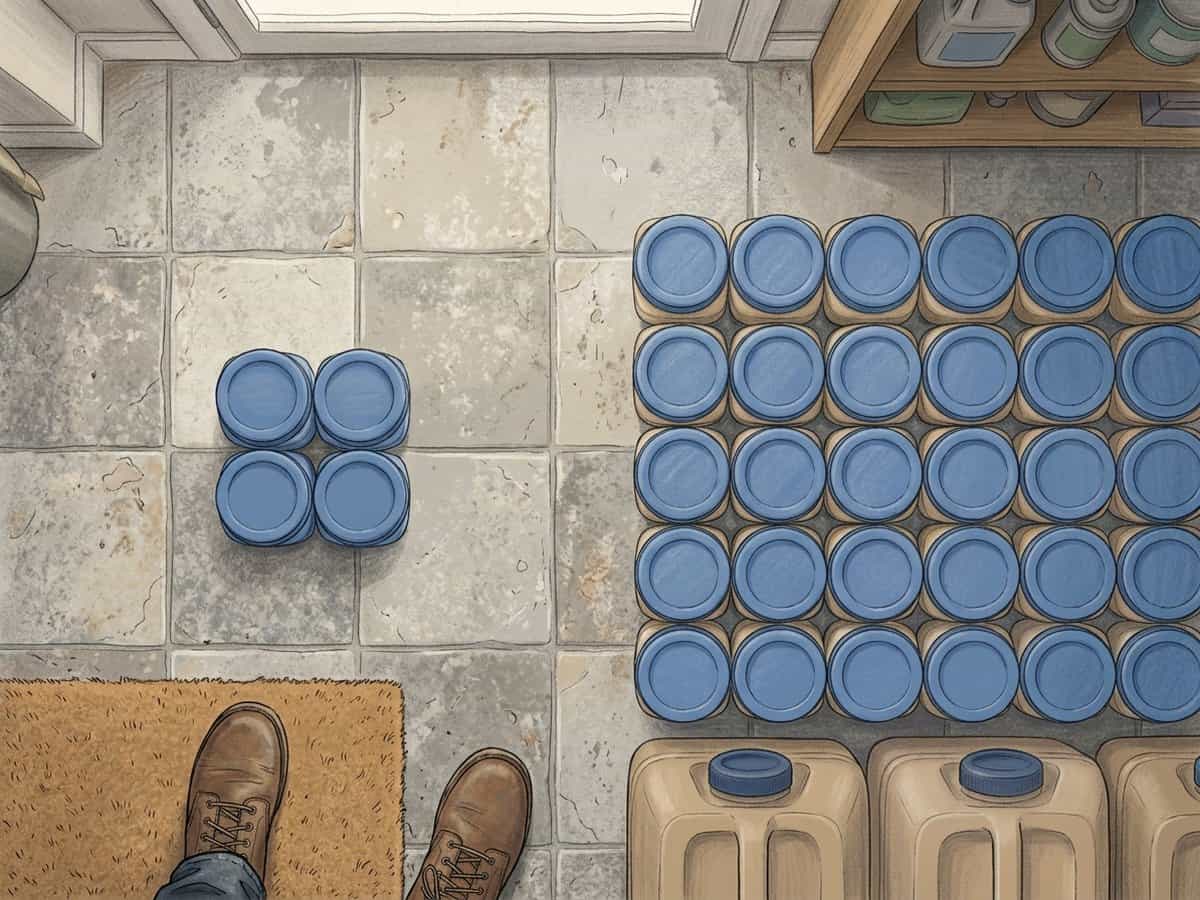
One person's normal day, drawn in gallon jugs
- 100 jugsa normal day at the top of the USGS range, indoors
- 1 jugthe emergency allowance for drinking and sanitation
The comparison explains what emergency water is for. With 1 gallon per person per day, the priorities are drinking and basic sanitation, which is how Ready.gov describes the allowance. Showers, laundry and the rest of an ordinary day's use are not part of it.
To turn the allowance into your household's number, use the calculator, or read how much water a person needs per day in an emergency: emergency water storage calculator and how much water you need per day to survive.
Context
Why household water use estimates vary
Household water use estimates vary because homes, fixtures, climates and habits vary, and the agencies publish ranges and averages rather than a single rule.
The USGS introduces its per-person range by noting that estimates vary. The EPA's household figure is an average across families, and roughly 30 percent of it is outdoor use, which swings with climate and season. Neither figure tells you what your own home uses.
For emergency planning, that variation does not change the answer. The published storage allowance is the same for every household: at least 1 gallon per person per day, for at least 3 days, and a 2-week supply if possible. Needs can be higher for infants, children, older adults, pregnancy, illness, pets, hot conditions, and physically demanding activity.
Questions
Common questions about household water use
These are the questions people most often ask about how much water they use.
The U.S. Geological Survey estimates that each person uses about 80 to 100 gallons of water per day for indoor home uses, and notes that estimates vary. Outdoor use, such as watering, is on top of that.
The EPA's WaterSense program says the average American family uses more than 300 gallons of water per day at home, and that roughly 70 percent of that use occurs indoors.
At the USGS estimate of 80 to 100 gallons a day indoors, one person uses about 2,400 to 3,000 gallons over a 30-day month. That is arithmetic on a published range; your water bill shows your own household's figure.
The EPA puts the average American family at more than 300 gallons a day at home. At the USGS per-person range, a household of four uses about 320 to 400 gallons a day indoors, calculated. Actual use varies widely by home and season.
Store at least one gallon per person per day for at least three days, and two weeks if possible, according to the CDC. That is about 1 percent of ordinary indoor use per person, so an emergency supply covers drinking and basic sanitation rather than normal household use.
Keep going
Where to go next
These pages turn the comparison into a plan.
Sources
Where these figures come from
Every figure on this page is quoted from, or calculated from, one of these sources, checked in September 2026.
- U.S. Geological Survey, “Water Q&A: How much water do I use at home each day?” (June 20, 2019). usgs.gov — each person uses about 80–100 gallons per day for indoor home uses; estimates vary. Checked September 2026.
- U.S. Environmental Protection Agency, WaterSense, “How We Use Water” (updated August 4, 2026). epa.gov — the average American family uses more than 300 gallons per day at home; roughly 70 percent indoors. Checked September 2026.
- Centers for Disease Control and Prevention, “How to Create and Store an Emergency Water Supply” (reviewed June 27, 2025). cdc.gov — 1 gallon per person per day for 3 days; 2 weeks if possible. Checked September 2026.
- Ready.gov, “Water.” ready.gov — at least 1 gallon per person per day for drinking and sanitation; higher needs for some groups. Checked September 2026.
- National Academies of Sciences, Engineering, and Medicine, water intake news release (February 11, 2004). nationalacademies.org — about 2.7 L (women) and 3.7 L (men) of total water a day. Checked September 2026.