Emergency Water Storage
How Long Can You Store Water? Tap, Bottled and Home-Filled
There are two different answers, and mixing them up is why so much stored water gets thrown away early — or kept far too long.
Water you filled yourself should be replaced every 6 months. Commercially bottled water has no agency-set shelf life — keep it sealed in its original container and follow the date the manufacturer printed on it. Neither number is a food-safety expiry date, and that distinction changes how you should manage your supply.
What you’ll learn
The short version
Stored water does not spoil on a schedule like food, so the numbers you see are rotation intervals rather than expiry dates.
- Home-filled water: replace every 6 months.
- Store-bought bottled: follow the printed date.
- Storage conditions matter more than time.
- No agency publishes a “discard after” rule.
Step 1
There are two answers, not one
How long emergency water lasts depends entirely on whether you filled the container yourself or bought it sealed from a manufacturer.
Almost every argument about water storage life comes from two people answering different questions. One says water keeps indefinitely; the other says six months. Both are repeating real guidance about different water.
The distinction is not about the water itself. It is about who controlled the conditions when the container was sealed, and whether anyone can verify that. A commercial bottler fills and seals under food-safety rules; you fill at a kitchen tap into a container you cleaned yourself. Different levels of certainty, so different handling advice.
| Type | Published interval | Who says so | What it actually means |
|---|---|---|---|
| Water you filled yourself | Replace every 6 months | CDC; Ready.gov | A rotation schedule. It assumes nothing about whether the water has gone bad, only that six months is a sensible refresh point. |
| Commercially bottled, unopened | Observe the manufacturer’s date | CDC | No agency sets a shelf life. The date belongs to the bottler, and neither the CDC nor Ready.gov states that sealed bottled water must be replaced on a schedule. |
Ready.gov puts the first row plainly: “Water that has not been commercially bottled should be replaced every six months.” The CDC’s emergency water page gives the same interval, and adds a separate instruction for the second row: “Observe the expiration date for store-bought water.”
Notice what neither agency says. There is no published statement that sealed bottled water becomes unsafe after a set period, and no rule telling you to throw out stored water on a particular date. That gap is real, and the rest of this page is about managing it honestly rather than filling it with a number nobody sourced.
If your question is specifically whether sealed bottled water expires, what its printed date means, or what to do once a bottle is opened, the dedicated guide covers it: does bottled water expire.
Step 2
Why six months, and what the number is not
Six months is a maintenance interval chosen to keep your supply fresh and your habits regular, not a measured point at which water becomes unsafe.
You filled it
Every 6 months
Empty it, refill it, re-date it. Both the CDC and Ready.gov give this interval.
They sealed it
The printed date
No agency sets a shelf life. Keep it sealed in its original container.
This matters more than it sounds. If you read six months as an expiry date, two unhelpful things follow. You panic when you find a container that is eight months old, and you relax completely the day after you refill — as though the clock, not the container, was doing the work.
Read as a rotation interval instead, it does something more useful. It puts you in front of your water supply twice a year. You notice the lid that never sealed properly, the container that has drifted into a sunny corner, the shelf that turned out to be holding more weight than you thought. Those checks catch problems the calendar never would.
There is a practical reason the interval is not longer. Home-filled water sits in a container you cleaned, sealed with household equipment, in a space that is not climate controlled. None of that is necessarily a problem, but nobody has verified it.
A useful reframe: the six-month mark is a reminder to look at your water, not a verdict on it. The most common real-world failure is not old water. It is water that was never checked once after the day it was stored.
Step 3
What the date on a water bottle actually tells you
The date printed on bottled water is the manufacturer’s own quality date, and the CDC’s instruction is simply to observe it.
Bottled water dates are not set by a public-health agency and do not all mean the same thing. Some concern taste; some relate to the plastic rather than the water. Only the bottler can say what their date represents.
This is why the guidance is worded the way it is. The CDC does not print a shelf life for bottled water, because there is no single shelf life to print. It tells you to observe the date on the container in front of you, which is the only date that applies to that product.
Two conditions come attached, and they matter as much as the date. Ready.gov’s instruction is to “buy commercially bottled water and store it in the sealed original container in cool, dark place.” Sealed and original are doing real work in that sentence. Once you open a bottle, or decant it into something else, you have taken over responsibility for the conditions and it is no longer commercially bottled water in any meaningful sense — it is water you filled yourself, on the six-month schedule.
Step 4
What actually shortens storage life
Temperature, light, container choice, and what sits nearby affect stored water more reliably than the number of months on the calendar.
The CDC’s storage instructions are specific about the environment, and they are the closest thing to a lever you actually control. Each of the following comes directly from that guidance.
The pattern here is worth naming. Four of the five have nothing to do with time. A container stored well for a year is in better shape than one stored beside a fuel can for two months, and no schedule reflects that. If you only change one thing after reading this page, change where your water lives rather than how often you replace it.
A limit worth stating plainly. This page is about water that was already safe when you stored it. If water may contain fuel, chemicals, salts, or other non-microbial contamination, do not assume boiling or disinfection makes it safe. If you are under a boil-water notice or any active advisory, follow your local officials and water utility rather than a general guide. Treatment and disinfection are their own subject, and the EPA’s emergency disinfection guidance is the current source for it.
Step 5
How to decide when to replace a container
Neither the CDC nor Ready.gov publishes criteria for discarding stored water, so any list of warning signs is practical judgment rather than official guidance.
We should be straight about this, because many sites are not. Search for signs your stored water has gone bad and you will find confident lists of colours, smells and cloudiness thresholds attributed to agencies that never published them. We checked both pages directly. Neither gives discard criteria.
What follows is therefore labelled for what it is: ordinary caution, not a public-health standard.
Replace it if the seal failed. A lid that has loosened, a container that has been knocked over and reseated, or any sign the closure was compromised means you no longer know what got in. This is the clearest case.
Replace it if the container is damaged. Cracks, deep scuffs, warping from heat, or a container that has bulged or collapsed have all changed in a way you cannot inspect from outside.
Replace it if storage conditions were violated for a long stretch. A summer in a hot garage or a winter beside a fuel can is a reason to start over, regardless of how recently you filled it.
Replace it if you cannot remember filling it. Undated water is the most common problem in a real household. If the history is unknown, the decision is easy and cheap.
Replace it on schedule anyway. For home-filled water, six months arrives often enough that most of the above never comes up.
Which clock is this container on?
Pick the kind of water and the month it went into storage. The panel produces a date only where an agency has published an interval.
How this is worked out. For water you filled yourself the panel adds six months to the month entered, because the CDC instruction for home-filled stored water is to replace it every six months. The whole calculation is month plus six. It is not a judgement about whether a given container is still good.
Why it goes quiet on bottled water. Choose the sealed commercial option and the panel stops producing a date, because there is none to produce. The CDC publishes no shelf life for bottled water; it says to observe the date on the container. Those dates are set by each bottler and do not all mean the same thing, so the only one that applies is printed on your bottle.
Notice that four of those five are about the container, not the water. In household storage, the container is the part that fails first and the part you can actually inspect.
Step 6
Three households, three rotation habits
The right rotation routine depends less on how much water you store than on how often you are realistically willing to handle it.
Mostly bottled
01
The set-and-check household
Supply is sealed store-bought water. There is no six-month clock, so the routine is a twice-yearly look: dates still ahead, seals intact, storage spot still cool and dark.
Mostly home-filled
02
The six-month rotator
Supply is tap water in food-grade containers. Two dates a year, tied to something already in the calendar — clock changes work well — and every container gets emptied and refilled.
Both
03
The mixed supply
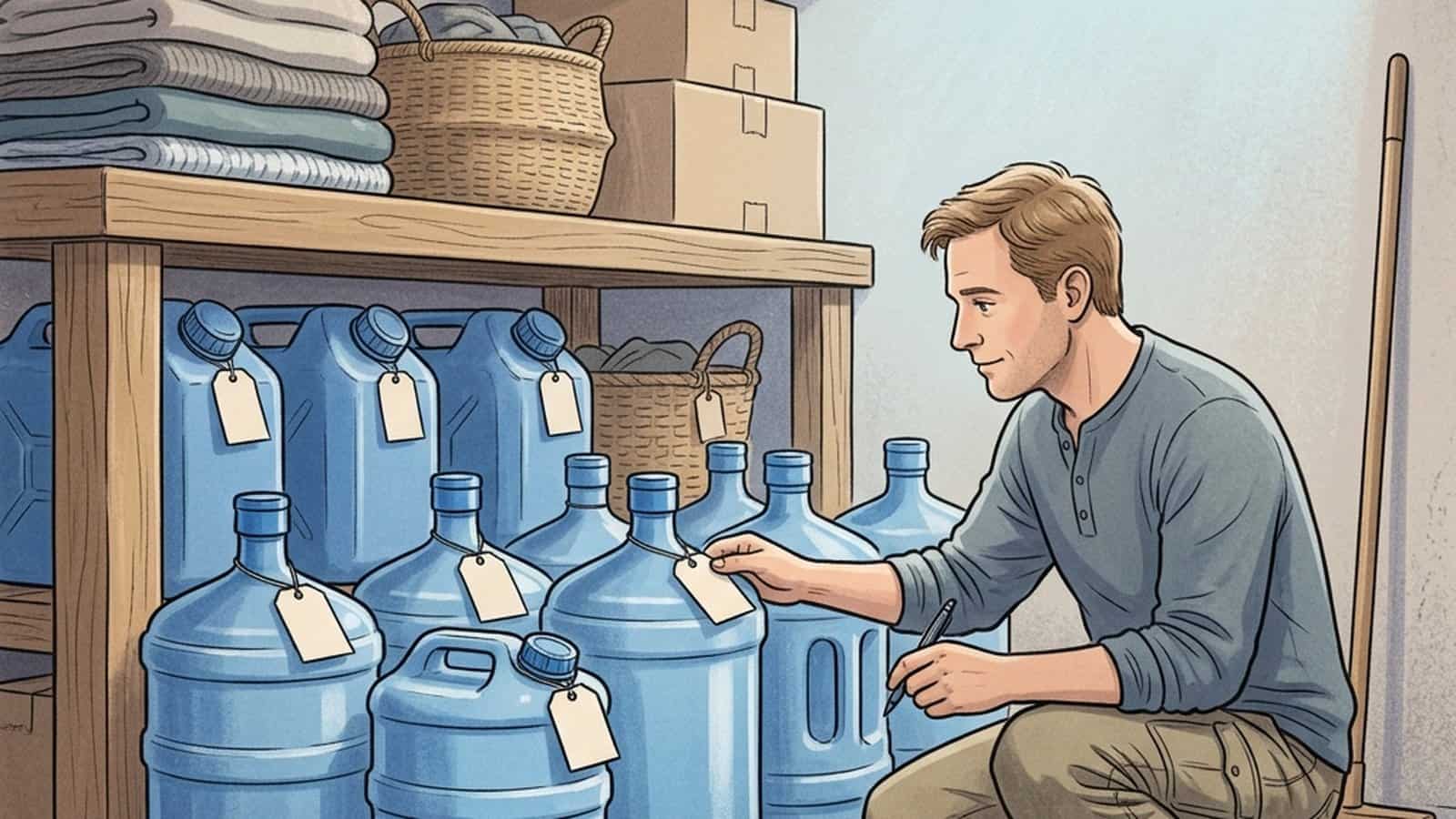
The common real-world case, and the one that goes wrong most often. Two types on one shelf, two different rules, and no way to tell them apart six months later unless they were separated and marked at the start.
If you keep both types, store them apart. The mixed shelf is where the six-month rule quietly gets applied to bottled water that did not need it, or skipped on home-filled water that did.
Step 7
A rotation routine that survives contact with real life
A twice-yearly check of five things is enough to keep a household supply in the condition the guidance assumes.
Storage advice tends to assume a diligence nobody sustains. The version below is deliberately short, because a five-item check you perform beats a thorough one you abandon.
Twice a year
The five-minute water check
0 of 5 steps checked
That last item is the one people skip, and it is the one that keeps the whole exercise honest. A supply that was right for a two-person household is not right after a third person moves in, and the CDC's planning baseline of at least one gallon per person per day for three days is a floor rather than a target. Needs run higher for infants, children, older adults, pregnancy, illness, and pets — and Ready.gov notes that in very hot temperatures, water needs can double.
Next step
Not sure your total is right?
Rotation only helps if the amount is correct to begin with. Work out your household's figure first, then set the schedule around it.
Calculate how much water your household needsQuestions
Common questions about water storage life
These are the questions readers ask most often once they understand the difference between the two storage rules.
No U.S. public-health agency publishes a shelf life for sealed commercially bottled water. The CDC's instruction is to observe the expiration date printed by the manufacturer, and to keep the water sealed in its original container. The date belongs to the bottler, so it is the only one that applies to that specific product.
Six months is a rotation interval rather than a measured point of spoilage. Water you filled yourself was sealed under conditions nobody verified, so the guidance keeps the supply fresh and brings you back to inspect your containers twice a year. Both the CDC and Ready.gov give the same interval.
Neither the CDC nor Ready.gov publishes criteria for judging stored water by appearance or smell, so any such list you find is practical judgment rather than official guidance. The dependable approach is to replace water whenever the seal failed, the container is damaged, storage conditions were violated for a long period, or you cannot remember when you filled it.
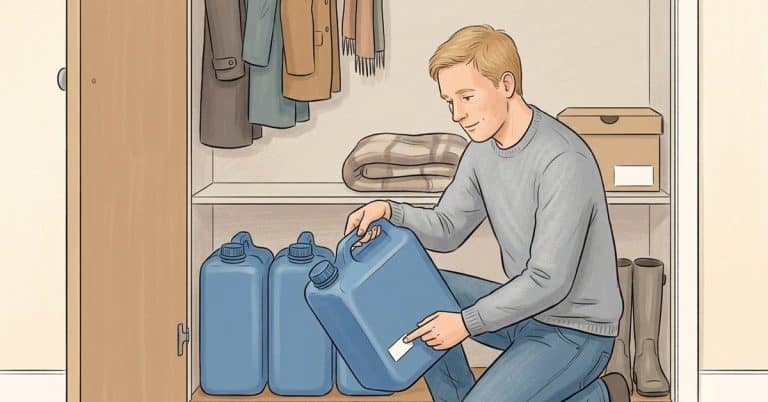
No. The CDC's guidance is to keep containers in a place with a cool temperature of 50°F to 70°F, away from direct sunlight and away from toxic substances such as gasoline or pesticides. An interior closet or a cool basement usually meets that. An uninsulated garage or attic often does not.
The CDC advises using food-grade water storage containers with a tightly closable top, made of durable unbreakable material rather than glass. Containers that previously held toxic chemicals must never be reused for drinking water. Food containers are a separate question of practicality, since thin jugs are difficult to clean thoroughly and prone to failing at the seams over time.
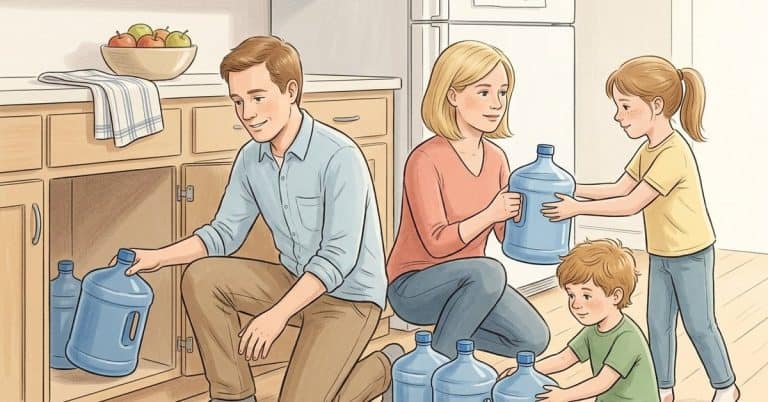
The CDC's baseline is to store at least one gallon of water per person per day for three days. Treat that as a floor rather than a target. Needs run higher for infants, children, older adults, pregnancy, illness and pets, and Ready.gov notes that in very hot temperatures water needs can double.
Keep going
Where to go next
Storage life is one piece of a household water plan, and these two pages cover the parts most people need before it.
Sources
Where these figures come from
Every interval and storage condition on this page is quoted from one of the following, checked in August 2026.
- Centers for Disease Control and Prevention, "How to Create and Store an Emergency Water Supply." cdc.gov — six-month replacement, 50°F–70°F storage, expiration date for store-bought water, container guidance. Checked August 2026.
- Ready.gov, "Water." ready.gov — six-month replacement for water that has not been commercially bottled, sealed original container in a cool dark place, increased needs in hot temperatures. Checked August 2026.
- U.S. Environmental Protection Agency, "Emergency Disinfection of Drinking Water." epa.gov — referenced for treatment, which is outside the scope of this page. Checked August 2026.