Emergency water planning
How Much Water per Person per Day? Planning Your Family’s Emergency Supply
Most households guess. The math is simple once you use the official rule: count the people, choose the number of days, and multiply. This page does it for you.
Quick answer: Store at least 1 gallon per person per day. That is 12 gallons for a family of four for 3 days, and 56 gallons for 2 weeks. Three days is the minimum; two weeks is the goal to build toward when you have the space.
What you’ll learn
Turn a vague worry into one specific number
Emergency water planning gets easy the moment you stop counting bottles and start counting people multiplied by days.
- The official per-person figure and what it actually covers
- Totals for every household size across 3, 7, 14, and 30 days
- Which households need to plan above the baseline
- How to turn gallons into containers you can lift and store
Knowing how to store water is only half the job — our guide to how to store water long term covers that side. This page answers the other half: how much. If you would rather have it calculated for you, the emergency water calculator takes about a minute.
Step 1
Why Your Emergency Water Number Matters
When the tap stops, every gallon has a job — drinking, cooking, and basic hygiene — so a few bottles in the pantry rarely covers a household.
The common mistake is planning by container instead of by consumption. A case of bottled water looks substantial on a shelf, but a standard 24-bottle case holds only about 3.2 gallons — roughly three days of water for one person, and less than one day for a family of four. Counting people and days instead of packages is what turns a vague sense of “we have some water” into a plan you can actually rely on.
The other reason the number matters is physical. Water weighs about 8.34 pounds per gallon, so your target dictates where it can live in your home and whether you can move it. Deciding the number first, then choosing containers, prevents the most expensive mistake in home water storage: buying hardware you cannot lift, refill, or fit through a doorway.
One page, one job. This page sets your target. Once you have it, how to store water long term covers safe containers and locations, and how long stored water stays safe covers shelf life and rotation.
Step 2
The Per-Person, Per-Day Rule
Store at least one gallon of water per person per day, covering drinking and basic sanitation rather than drinking alone.
Ready.gov puts it plainly: store at least one gallon of water per person per day, for drinking and sanitation. CDC frames the same figure as a three-day minimum and adds a clear stretch goal: try to store a two-week supply if possible. Municipal guidance lands in the same place — the Jordan Valley Water Conservancy District recommends about two weeks’ worth, or 14 gallons per person.
Two things about that gallon surprise people. First, it is not purely drinking water: it has to stretch across washing hands, basic food preparation, and keeping things clean. Second, it is a floor rather than a ceiling. Nothing about the figure says you should stop there, and several common household situations push it higher.
Two-week supply by household size
Arithmetic: 1 gallon × people × 14 days.
Turn your household into one number
Set the people and the window. Everything printed here is arithmetic on figures the CDC, Ready.gov and the USGS have published.
How this is worked out. Gallons are people times days, from the allowance of at least one gallon per person per day for drinking and sanitation (CDC; Ready.gov). Weight is gallons times 8.329 pounds per U.S. gallon at 70°F (USGS), water only. Jugs are gallons divided by five, rounded up. The hot-conditions box doubles the gallons, because Ready.gov states needs can double in very hot temperatures.
What this panel refuses to guess. There is no pet control, because Ready.gov’s water page publishes no per-animal figure and this site will not invent one. Nor is there an adjustment for infants, pregnancy, illness, older adults or hard physical work: Ready.gov says those groups may need more, but publishes no multiplier. Treat the number as a floor.
Step 3
3-Day, 7-Day, 14-Day, and 30-Day Totals
Once you know gallons per day, multiply by days — the table below has already done it for every common household size.
Three days is the minimum in CDC guidance and two weeks is the recommended goal where space allows. The 30-day column is an optional stretch target for households with real storage capacity; it is not an official recommendation, and no agency asks ordinary households to hit it.
| Household | 3 days minimum | 7 days | 14 days the goal | 30 days optional | 14-day weight |
|---|---|---|---|---|---|
| 1 person | 3 gal | 7 gal | 14 gal | 30 gal | ~117 lb |
| 2 people | 6 gal | 14 gal | 28 gal | 60 gal | ~234 lb |
| 3 people | 9 gal | 21 gal | 42 gal | 90 gal | ~350 lb |
| 4 people | 12 gal | 28 gal | 56 gal | 120 gal | ~467 lb |
| 5 people | 15 gal | 35 gal | 70 gal | 150 gal | ~584 lb |
| 6 people | 18 gal | 42 gal | 84 gal | 180 gal | ~701 lb |
The weight column is arithmetic, not agency guidance: gallons multiplied by 8.34 pounds. It is there because it changes decisions. A family of four aiming at two weeks is planning for roughly a quarter of a ton of water, which is a shelving and floor question as much as a shopping one.
3 → 14 gal
Start at 3 gallons for the minimum, then build toward 14 for two weeks. That is four 3.5-gallon containers — each about 29 lb full, so every piece stays liftable.
6 → 28 gal
Six gallons covers the 3-day minimum; 28 gallons reaches two weeks. Eight stackable 3.5-gallon containers split neatly across two closets.
12 → 56 gal
Twelve gallons is the 3-day floor. Fifty-six gallons is the two-week goal — one 55-gallon barrel, or eight 7-gallon jugs if you would rather keep it movable.
Step 4
What Raises Your Number
The one-gallon baseline assumes an average adult in average conditions, so several ordinary situations push a household above it.
Ready.gov is explicit that children, nursing mothers, and sick people may need more water, and that in very hot temperatures water needs can double. Add the practical realities — pregnancy, older adults, illness, physically demanding work, and medical equipment that uses water — and a meaningful share of households should be planning above the floor rather than at it.
Where we stop. This page gives planning arithmetic, not medical advice. We deliberately do not publish per-infant or per-condition gallon figures, because the right answer depends on the person. During an active water emergency, follow your local officials and utility over any general guidance, including ours.
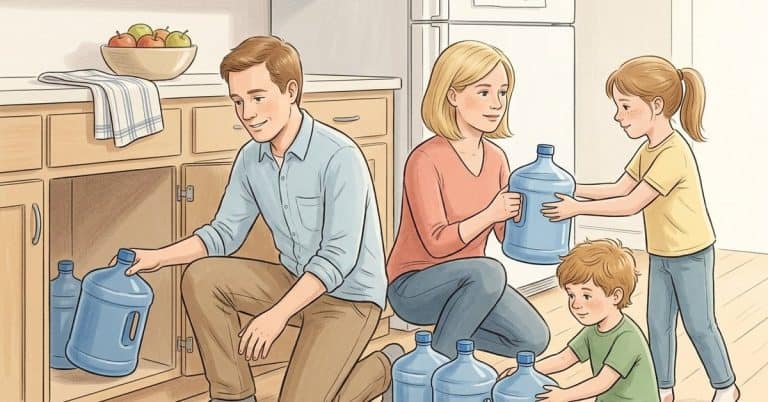
Households with kids will find the practical side — routines, rotation, and getting children involved — in water storage for families with kids.
Step 5
Turning Gallons Into Real Containers
Divide your gallon target by a container size you can actually lift, and the shopping list writes itself.
This is where an abstract number becomes a decision. The same 56 gallons can be eight 7-gallon jugs, sixteen 3.5-gallon stackable containers, one 55-gallon barrel, or a mix. What separates those options is not capacity but handling: what each piece weighs when full, and whether you can move and refill it on rotation day.
| Format | Full weight | 1 person (14 gal) | Couple (28 gal) | Family of 4 (56 gal) |
|---|---|---|---|---|
| Case of bottled water (~3.2 gal) | ~26 lb | 5 cases | 9 cases | 18 cases |
| Stackable container (3.5 gal) | ~29 lb | 4 | 8 | 16 |
| Jug with spigot (7 gal) | ~58 lb | 2 | 4 | 8 |
| Barrel (55 gal) | ~459 lb | — | — | 1 (plus a pump) |
Pick the size you can still handle on rotation day
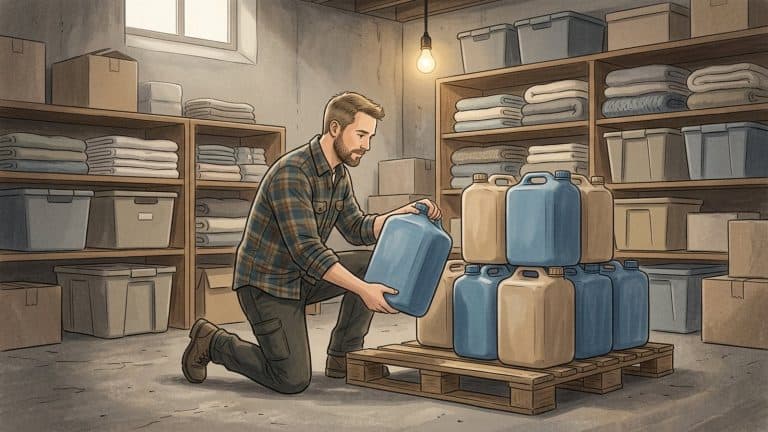
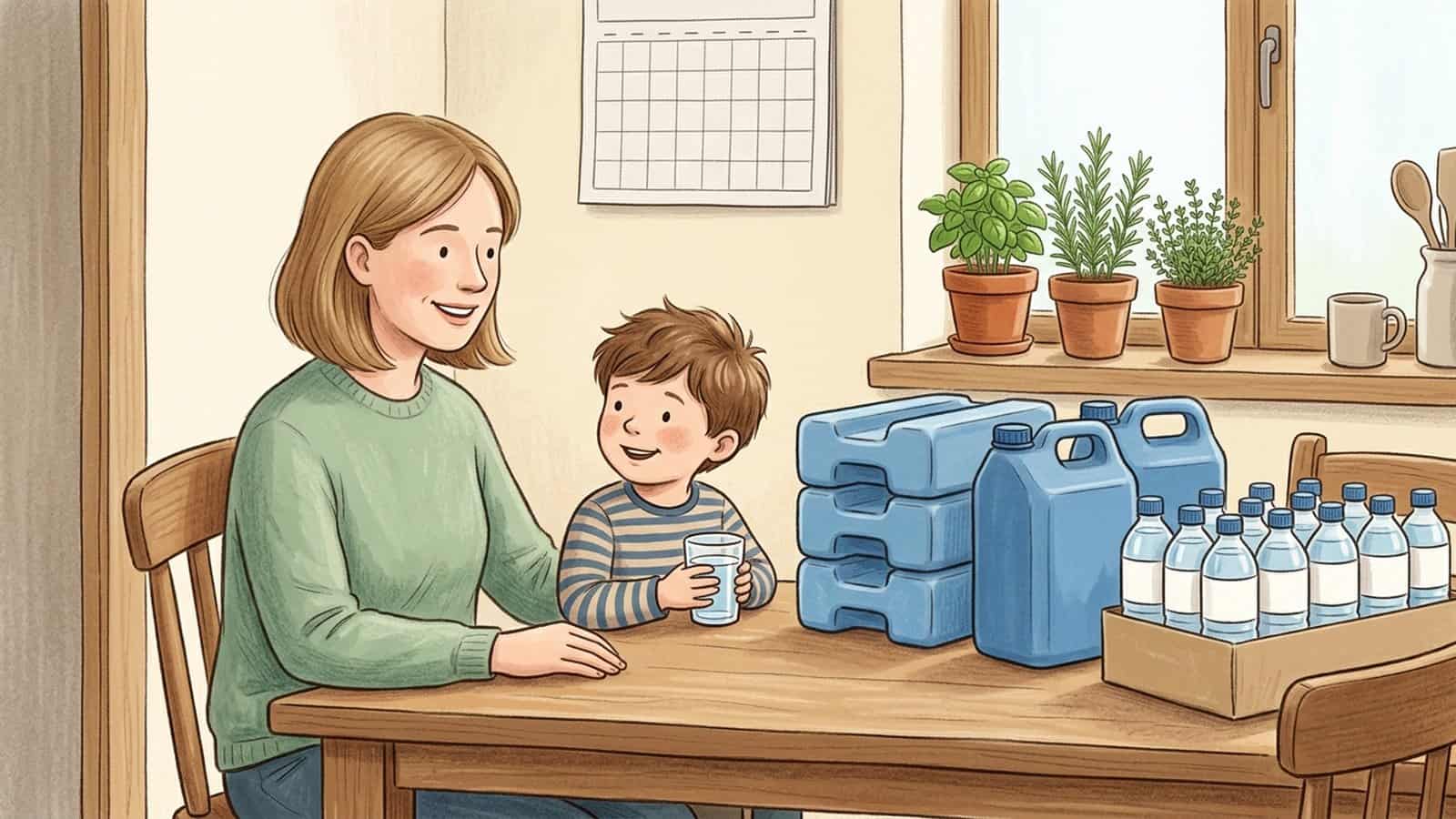
A 7-gallon jug is the efficient middle for most families — but at about 58 lb full it is not right for anyone who cannot safely lift that. 3.5-gallon stackable containers are the most flexible for renters and small spaces at roughly 29 lb each. A 55-gallon barrel is the cheapest per gallon and nearly covers a family of four on its own, but at about 459 lb full it never moves once filled, needs a pump, and is not for apartments or anyone likely to move house.
Compare container options by fitStep 6
Split the Total Between Home and Go-Bag
Your total should not all live in one place — keep the bulk at home and a small portable share in a go-bag or vehicle.
Most emergencies keep you at home, which is why bulk storage carries the plan. But some ask you to leave quickly, and a 55-gallon barrel is useless in that scenario. Setting aside a small, carry-friendly portion — pouches or small bottles in a go-bag and a few in the car — covers the case bulk storage cannot. That portable share counts toward your total; it does not replace it.
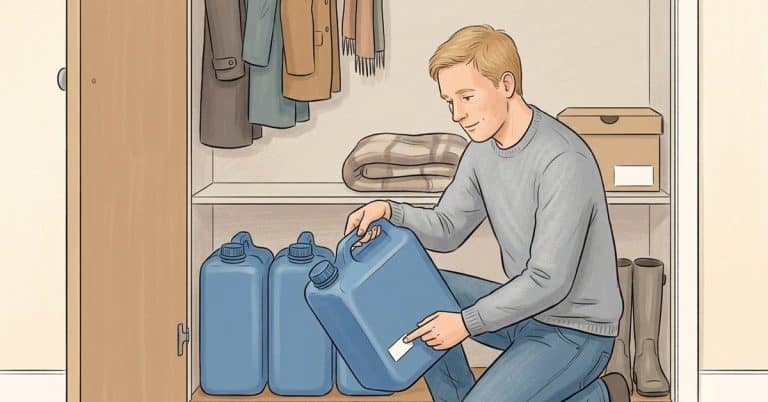
Spreading containers across two or three spots has a second benefit: one leak, one blocked room, or one inaccessible basement never takes out the whole reserve. Renters and small-space households will find layouts that work in water storage for apartments and small spaces, and compact options are covered in emergency water pouches for grab-and-go kits.
After the math
What to Do Once You Know Your Number
A target only helps once the water is stored safely and rotated on a schedule you will actually keep.
Your number is the starting point. The complete emergency water storage guide ties the whole plan together, and these pages take the next steps.
Safe containers, cool locations, and a simple rotation habit.
DurationHow long does stored water last?Dates, storage conditions, and when to replace.
PreventionStorage mistakes to avoidThe container, location, and rotation errors people repeat.
ToolEmergency water calculatorGet a personalized target in about a minute.
MaintenanceRotation schedule and checklistKeep the supply fresh without thinking about it.
Large format55-gallon barrel kitsWhen the biggest option is and isn't the right call.
FAQ
Frequently Asked Questions About How Much Water to Store
The quantity questions households ask most. During a local water emergency, follow direction from public-health officials and your water utility.
Store at least 1 gallon of water per person per day. Ready.gov and CDC both use that figure, and it covers drinking plus basic sanitation rather than drinking alone.
A family of four needs about 12 gallons for 3 days and 56 gallons for 2 weeks. A 30-day supply would be roughly 120 gallons, though that is an optional stretch goal rather than an official recommendation.
Yes. Ready.gov describes the gallon per person per day as covering drinking and sanitation, which includes basic hygiene and food preparation. It is not a gallon of drinking water on top of everything else.
One gallon is a floor, not a ceiling. Ready.gov notes that children, nursing mothers, and sick people may need more, and that water needs can double in very hot temperatures. Store more when space, budget, and safe lifting allow.
Plan above the baseline rather than at it. Ready.gov specifically notes that children, nursing mothers, and sick people may need more water. For infant feeding or a medical condition, follow guidance from your pediatrician, doctor, or local health department rather than a general figure.
Pets add to your household total and should be planned in rather than treated as an afterthought. Needs vary widely by species, size, and climate, so use your veterinarian's guidance for your animals and see our dedicated emergency water for pets guide.
Practically, yes. A two-week supply for four people weighs roughly 467 pounds, so the limits are floor loading, safe lifting, and the space you actually have. A plan you cannot lift or rotate is not a working plan.
Start at the 3-day minimum and build up in stages. Smaller containers split across closets, under beds, and cupboards store the same total as one large barrel while staying liftable, which matters most for renters and small households.
Sources used
Official guidance behind these numbers
Every per-person figure on this page comes from current federal or municipal guidance; the totals and weights are arithmetic applied to it.
- Ready.gov: Water — at least one gallon per person per day for drinking and sanitation; more for children, nursing mothers, and sick people; needs can double in very hot temperatures.
- CDC: How to Create and Store an Emergency Water Supply — at least 1 gallon per person per day for 3 days, and a two-week supply if possible.
- Jordan Valley Water Conservancy District — one gallon per person per day, and about two weeks’ worth, or 14 gallons, per person.
- City of Seattle: Emergency Water Storage — enough water for at least 3 days per family member, refreshed every 6 months.
Totals, container counts, and weights are calculated at 8.34 lb per gallon and are presented as planning arithmetic, not agency guidance. Reviewed August 2026.