Emergency water storage
How to Store Water Long Term (Step-by-Step Home Guide)
Water itself does not expire. Long-term storage really comes down to three habits: clean, food-grade containers, a cool and dark place to keep them, and a simple rotation schedule you will actually follow.
Quick answer: Store at least 1 gallon of water per person per day for a minimum of 3 days, and aim for a 2-week supply if you can. Use food-grade containers, keep them between 50–70°F out of direct sunlight, and replace water you bottle yourself about every 6 months.
What you’ll learn
Build a water supply that fits ordinary life
A practical long-term water plan uses safe containers, a protected location, and an easy routine for checking and replacing home-filled water.
- Which containers are safe for stored drinking water — and which are not
- How to clean, fill, label, and rotate water without overthinking it
- Which rooms reduce heat, light, moisture, and chemical risk
- How to size a plan for apartments, families, and lighter lifting
Most people worry that stored water will somehow “go bad.” The real risks are simpler and more manageable: contamination from a dirty container, heat and light that make water taste stale, and neglect that leaves you unsure how old your supply is. Handle those three things and you have a reliable emergency water supply that lasts. This guide focuses on how to store water safely — see how much emergency water you need for the quantity math, how long stored water stays safe for shelf life, or skip ahead with the emergency water calculator.
Step 1
Long-Term Water Storage Basics
Safe long-term storage starts with a safe water source, clean food-grade containers, and a realistic rotation schedule.
Get those three right and everything else is detail. Ready.gov recommends storing at least one gallon of water per person per day, and CDC frames the same amount as a 3-day minimum while encouraging a two-week supply where space allows. For a family of four, that is 12 gallons at the minimum and 56 gallons for a two-week target.
There are two easy ways to build that supply. The first is commercially bottled water: buy it sealed, keep it in its original container, and store it somewhere cool and dark. The second is water you bottle yourself from a safe tap, stored in clean, food-grade containers. Both work. The main difference is maintenance: self-filled water should be rotated about every six months, while sealed store-bought water lasts longer and simply follows the date printed on the package.
One reassuring point worth stating plainly: water does not spoil the way food does. The U.S. Food and Drug Administration has said bottled water does not require an expiration date, and printed dates are best treated as quality markers rather than hard safety cutoffs. Even so, rotating your supply is good practice because it keeps the taste fresh and forces you to inspect your containers on a schedule.
Keep the planning jobs separate. This page covers safe setup. The next decision is how much emergency water you need; then review how long stored water stays safe before deciding whether your system needs more containers or a different rotation routine.
Step 2
Choose Safe Containers for Long-Term Storage
For long-term storage, use food-grade containers made for drinking water — not random jugs, and never anything that held chemicals.
CDC recommends FDA-approved, food-grade water storage containers with a tight-sealing top, made of durable, unbreakable material rather than glass. Just as important is what to avoid: CDC is explicit that you should never reuse a container that previously held toxic chemicals such as bleach or pesticides.
Many preparedness guides also steer people away from reusing old milk jugs and juice bottles. The reasons are practical: milk and juice leave sugars and proteins that are hard to rinse out completely and can support bacterial growth, and thin milk-jug plastic tends to break down and leak over months of storage. Thoroughly cleaned two-liter soda bottles are a widely used budget option because their plastic is sturdier and designed for beverages. When in doubt, a purpose-made food-grade container removes the guesswork.
| Container type | Typical capacity | Best use | Strengths | Watch-outs |
|---|---|---|---|---|
| Sealed store-bought bottled water | 0.5 L – 1 gal | Grab-and-go & short term | No prep, portable, dated by maker | Bulky per gallon; follow the package date |
| Food-grade jug w/ spigot | 5–7 gal | Long term, closets & basements | Reusable, easy dispensing | About 58 lb full — heavy to move |
| Stackable water “bricks” | 3–3.5 gal | Long term, tight spaces | Stack & split across rooms | More lids to fill and check |
| Cleaned 2-liter soda bottles | 2 L | Budget long term | Free, sturdy, easy to rotate | Must be cleaned & sanitized well |
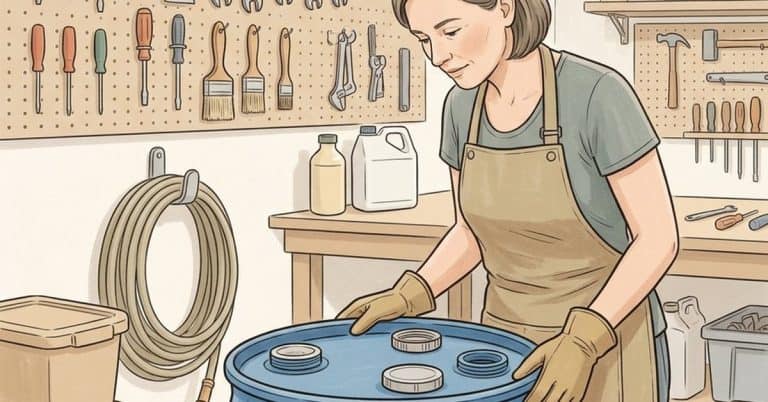
| 55-gallon barrel | 55 gal | Homes with the space | Big capacity, low cost per gallon | ~458 lb full; needs a pump & a plan |
Bars are to scale against a 55-gallon barrel. This is the single fact that decides most container choices.
Calculated, not quoted. Capacity times 8.329 pounds per U.S. gallon at 70°F (USGS), rounded. Typical category capacities, not any manufacturer’s stated figures, and excluding the empty container.
Choose a mix, not one oversized solution
Once you know the rules above, picking hardware is mostly about weight and space. A 7-gallon jug with a spigot is a good default for closets and basements — but it is not ideal for anyone who cannot safely lift about 58 lb. 3.5-gallon stackable bricks are the easiest to split across small rooms at roughly 29 lb each. A 55-gallon barrel gives the lowest cost per gallon for homeowners with basement or garage space, but it is not for apartments, frequent movers, or anyone without a pump and a permanent spot.
We keep specific product picks, prices, and current availability in the dedicated guide so this page stays evergreen.
See container options that fit your planStep 3
How to Clean and Fill Containers Before Storing Water
Before you fill a container for long-term storage, clean and sanitize it, then fill it with safe tap water.
The process is short. Ready.gov describes washing the container with dishwashing soap and water, rinsing it well, then sanitizing it with a solution of one teaspoon of unscented liquid household chlorine bleach per quart of water, and letting it air-dry before filling. Once the container is clean, fill it to the top with cold water from a safe public tap and seal it.
Wash and rinse
Wash the food-grade container and its lid with dish soap and warm water, then rinse until no soap remains.
Sanitize the interior
Use the Ready.gov bleach-and-water solution above, making sure it contacts all inner surfaces, then let the container air-dry.
Fill and cap
Fill to the top with cold water from a safe public tap and tighten the lid. Leave a little headspace if the container may freeze.
Label the date
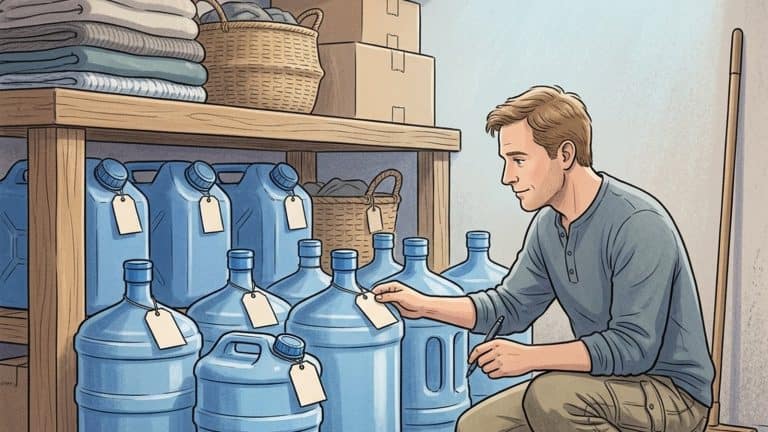
Mark it “drinking water” with the fill date. A visible date is the simplest rotation tool you have.
If your tap water comes from a treated municipal system, you generally do not need to add anything to the water itself. Treating the water — as opposed to sanitizing the empty container — is only necessary when the source is unsafe or uncertain.
Step 4
Where to Store Water in Your Home
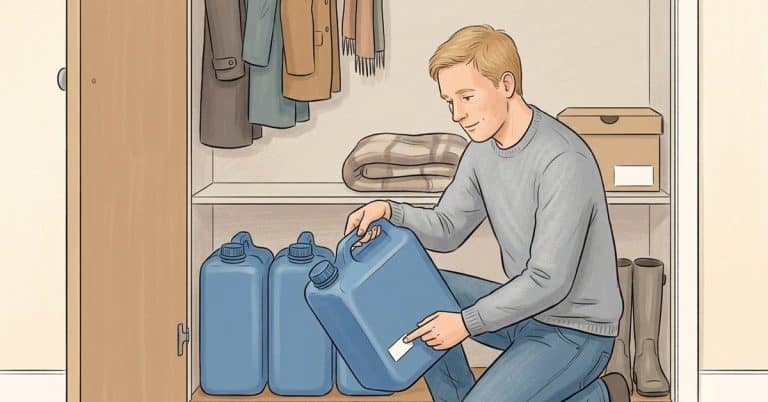
Store water in a cool, dark place away from chemicals — ideally 50–70°F, off bare concrete, and out of direct sunlight.
CDC’s guidance is specific: keep containers at roughly 50–70°F, out of direct sunlight, and away from toxic substances such as gasoline and pesticides. Interior closets, pantries, and conditioned basements usually beat hot garages and sunny rooms, where heat and light shorten how long the water tastes fresh.
Spreading your supply across two locations means one leak or one blocked room never wipes out your whole reserve. Renters and small-space households can find tailored ideas in our guide to storing water in an apartment or small space, and either way it is worth skimming the common emergency water storage mistakes to avoid.
Step 5
Rotation and Simple Treatment Rules
Rotation keeps your supply reliable and fresh-tasting, especially for water you bottle yourself.
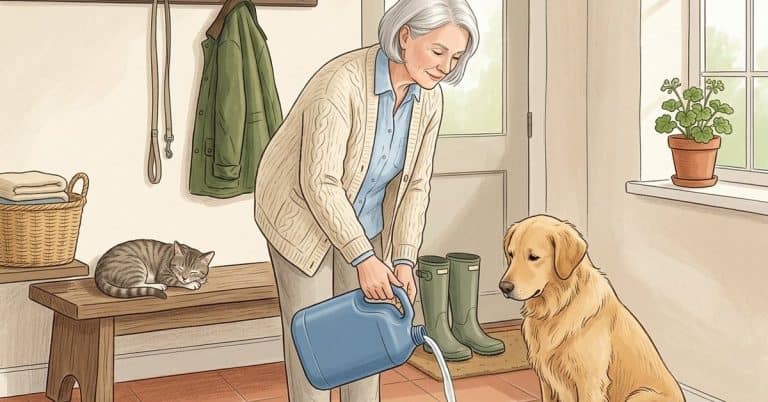
CDC advises replacing self-filled water about every six months. Tie rotation to the twice-yearly daylight-saving weekends, the same way you might change smoke-detector batteries. Sealed store-bought water lasts longer; just follow the date on the package and keep it cool and dark. When you rotate, do not waste the old water — use it for plants, cleaning, or pets, then refill and re-date the container. For a printable routine, use the water storage rotation schedule checklist.
When water needs treatment. If your stored water runs out and you must use water from an unsafe or uncertain source, treat it before drinking. Follow the current EPA emergency disinfection guidance and any instructions from your local authorities, since the correct amounts depend on the product and conditions. One important limit: boiling or disinfection handles germs, but it does not remove chemicals, fuels, salts, or heavy metals. If water may be contaminated by those, do not assume treatment makes it safe.
Detailed disinfection steps belong in our upcoming water treatment guide, not here — treatment is a backup skill, and this page is about storing clean water well.
Is your storage plan ready to maintain?
A quick confidence check before you call the job done. Nothing here is saved or sent anywhere.
0 of 6 steps checked
Make it fit
Example Long-Term Storage Setups
The best storage plan is the one that actually fits your space, your strength, and your household size.
Water is heavy: one gallon weighs about 8.34 pounds. Use that reality to choose container sizes before you bring a large supply home. These examples use the 1-gallon-per-person-per-day baseline; adjust upward for hot climates, illness, pregnancy, children, or pets.
Build a mix you can actually handle
Enter what you own or are considering. The panel works out what the mix holds, how long it lasts, and what the heaviest item weighs full.
How this is worked out. Gallons are the counts times each format’s typical capacity. Days are gallons divided by people, rounded down, from the CDC and Ready.gov allowance of at least one gallon per person per day for drinking and sanitation. Weight is gallons times 8.329 pounds per U.S. gallon at 70°F (USGS), water only. Arithmetic on published figures, not a recommendation.
Treat the result as a floor. It adds nothing for pets, hot weather, infants, illness or hard physical work. Ready.gov says needs can double in very hot temperatures and that some groups need more, but publishes no multiplier to apply, and no per-animal figure at all.
28 gal
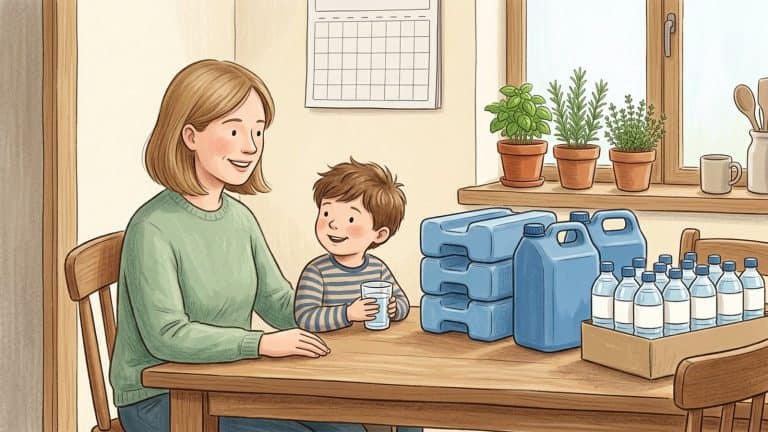
Two people aiming for two weeks need roughly 28 gallons. Sealed bottled-water cases under the bed plus a few 3.5-gallon stackable bricks in a closet keep every single item light and movable.
- Bricks are about 29 lb each when full
- See the small-space storage guide
56 gal
Four people targeting two weeks need about 56 gallons. One 55-gallon barrel in the basement covers most of it, and a few 7-gallon jugs add grab-and-go flexibility for shorter outages.
- 56 gallons weighs roughly 467 lb in total
- See storage for families with kids and for pets
14 gal
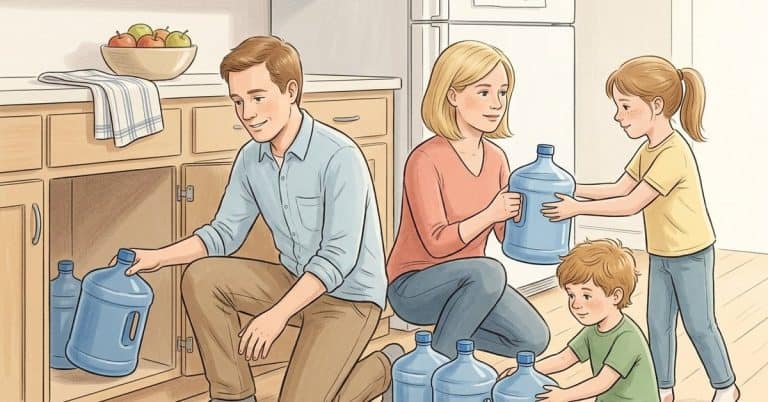
One person for two weeks needs about 14 gallons. Several smaller, lighter containers are far easier to lift, carry, and rotate than one big jug, and tuck onto a low closet shelf.
- Choose containers you can move safely when full
- Add water pouches to a grab-and-go kit separately
Build the full plan
How Storage Connects to Quantity, Duration, and Containers
Once you know how to store water safely, the next step is deciding how much to keep and which containers fit your home.
Use this page as the setup layer, then work through the questions that turn general advice into a working home system. The complete emergency water storage guide ties the whole plan together, and the emergency water calculator sets your target in about a minute.
Calculate a starting supply for people, pets, climate, and duration.
DurationHow long does stored water last?Understand dates, storage conditions, and practical replacement cues.
PreventionWhich storage mistakes should you avoid?Review the common container, location, and rotation errors.
Container fitWhich container type fits your home?Compare portable, stackable, and large-capacity formats.
MaintenanceKeep your supply freshUse a printable rotation schedule and inspection checklist.
Large formatIs a 55-gallon barrel right for you?Weigh capacity against weight, space, and pump requirements.
FAQ
Frequently Asked Questions About Long-Term Water Storage
These answers cover the storage questions households ask most often. During a local water emergency, follow direction from public-health officials and your water utility.
Water you bottle yourself from a safe tap should be replaced about every 6 months, per CDC guidance. The water does not expire, but rotating it keeps it fresh-tasting and gives you a chance to check containers for leaks or problems.
If your tap water already comes from a safe public system, you generally do not need to add anything before storing it in clean, food-grade containers. Disinfection is only for water from an unsafe or uncertain source, and in that case you should follow the current EPA emergency disinfection guidance and any instructions from your local authorities.
Use FDA-approved, food-grade containers made for drinking water, with a tight-sealing lid and made of durable, unbreakable material rather than glass. Never reuse a container that held toxic chemicals such as bleach or pesticides.
Store water in a cool, dark place between about 50 and 70 degrees Fahrenheit, out of direct sunlight, and away from gasoline, pesticides, and other chemicals. Interior closets and basements usually work better than hot garages or sunny rooms.
Replace self-filled water about every 6 months. For store-bought sealed bottled water, follow the date on the package. Tying rotation to the twice-yearly daylight-saving weekends is an easy way to remember.
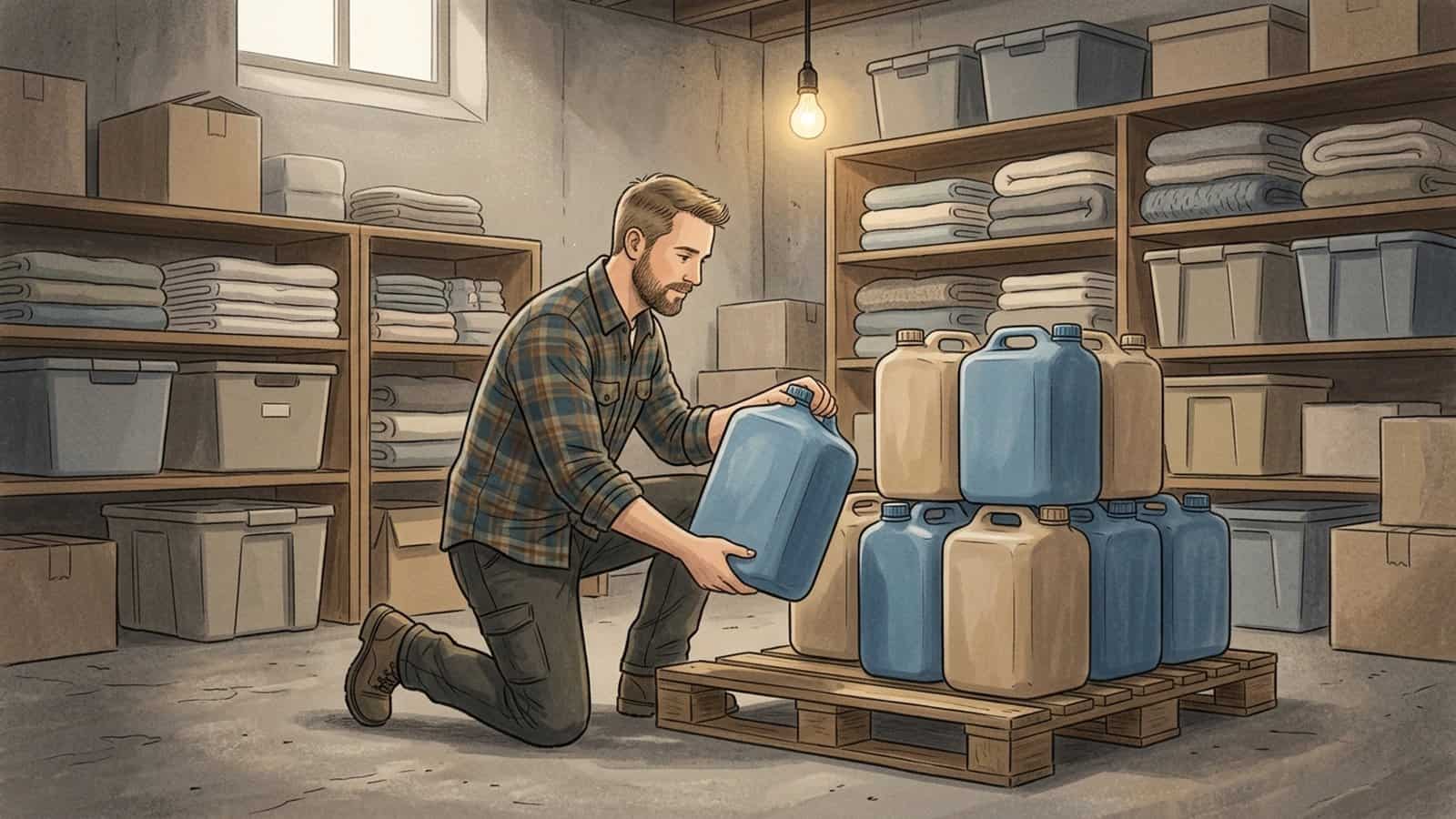
It is better to raise containers off a bare concrete floor on wood boards or a pallet, because concrete can transfer temperature swings and moisture. A hot garage is not ideal because heat and sunlight shorten how long the water tastes fresh; a cooler interior spot is preferable.
The U.S. Food and Drug Administration has stated that bottled water does not require an expiration date, and printed dates are best used as quality markers rather than hard safety cutoffs. Even so, CDC advises observing the date on store-bought water and storing it sealed in a cool, dark place.
Frozen water is still safe once thawed, as long as the container stayed sealed and clean. Water expands by roughly 9 percent when it freezes, so leave some empty headspace in each container so it does not crack.
Sources used
Official guidance behind this page
The storage, container, location, and rotation steps on this page are grounded in current CDC, Ready.gov, and EPA public guidance.
- CDC: How to Create and Store an Emergency Water Supply — quantity baseline, container selection, storage temperature, and the six-month replacement schedule.
- Ready.gov: Water — per-person planning, container sanitizing steps, and factors that increase water needs.
- EPA: Emergency Disinfection of Drinking Water — what to do for water of uncertain quality, and the limits of treatment.
Bottled-water shelf-life position attributed to the U.S. Food & Drug Administration. Reviewed August 2026.