
Buying Guide
Emergency Water Tanks for the Home
An emergency water tank puts a household’s supply in one place, with a tap on the front, and close to 500 pounds on a few square feet of floor. Here is how to size and place one.
The comparison
Emergency water tank formats compared
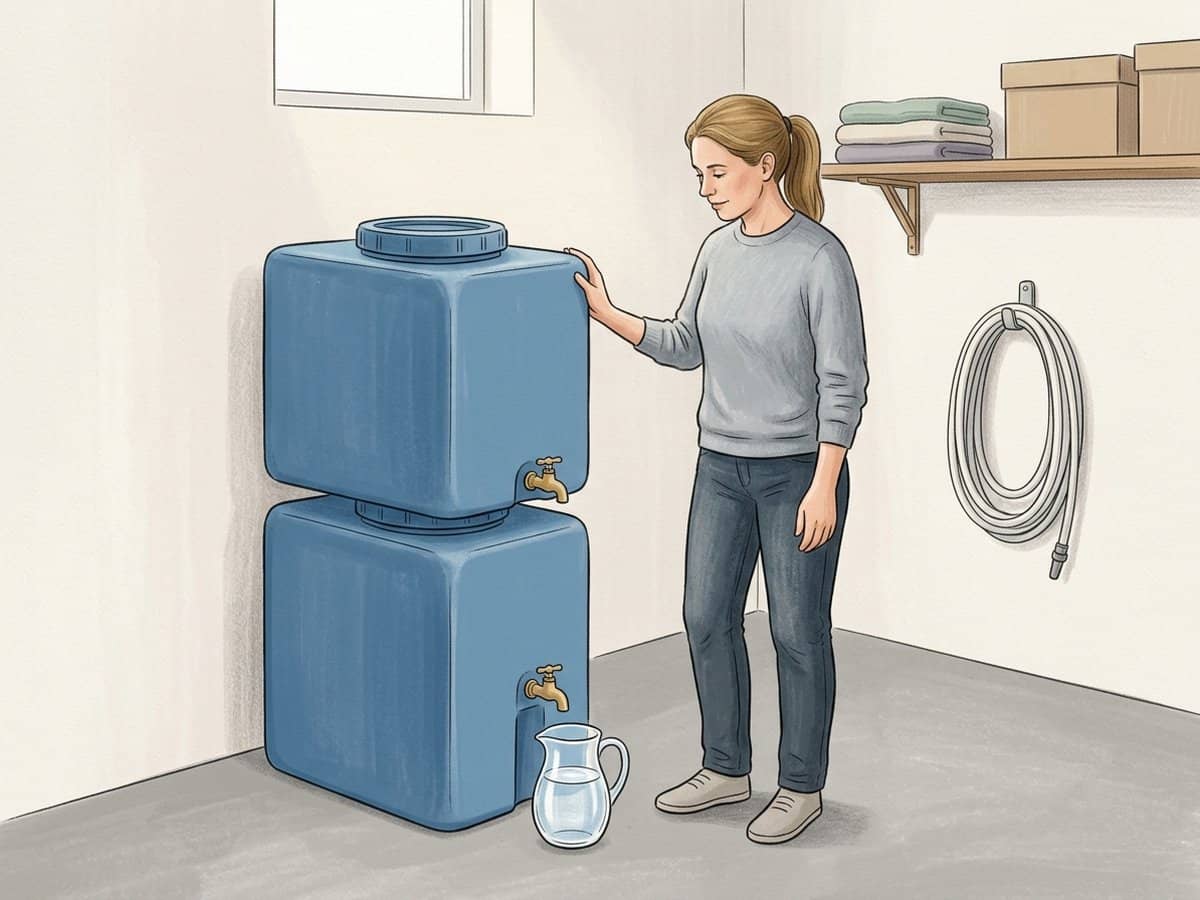
An emergency water tank is a large, fixed container, usually 55 gallons or more, that stays where it is filled and dispenses through a built-in spigot instead of being lifted and poured.
The trade for a tap instead of a lift is weight: at 8.329 pounds per U.S. gallon, the U.S. Geological Survey figure for water at 70°F, every 55 gallons weighs about 458 pounds (calculated).
| Format | Example size | Water weight (calculated) | Getting water out | Best job |
|---|---|---|---|---|
| Refillable jug | 5 gallons | About 41.6 lb | Lift and pour | A supply you can split up or take with you |
| Drum with bung caps | 55 gallons | About 458 lb | A pump or siphon, bought separately | A fixed supply at the lowest container count |
| Stackable tank with spigot | 55 gallons | About 458 lb | A built-in spigot | A fixed supply where floor space is short |
| Large upright tank | 300 gallons | About 2,499 lb | Check the maker’s stated fittings | A multi-week household supply on a ground-level slab |
How this table was built. It compares formats, so sizes are examples rather than product claims, and each weight is gallons × 8.329. The 300-gallon row reflects a size the tank maker below says it sells; this page did not check that tank’s specifications, so it prints none. Nothing was tested.
Try it
How many emergency water tanks a household needs, and what they weigh
The number of emergency water tanks a household needs is people times days times 1 gallon, divided by the tank’s capacity and rounded up, and the floor carries every pound of it.
The CDC and Ready.gov set the storage allowance at a minimum of 1 gallon per person per day, for drinking and sanitation, for at least 3 days, and the CDC suggests a 2-week supply if possible. For four people that is 56 gallons: one gallon more than a 55-gallon tank holds.
Tank count and floor load
For 55-gallon tanks. Every figure is arithmetic; edit the footprint if your tank or platform differs.
How this is worked out. Tanks is people × days ÷ 55, rounded up. Water weight is tanks × 55 × 8.329 lb (USGS); the total adds the maker’s stated 22-lb empty weight per tank. Floor area is the number of stacks × the footprint; the default 4.19 sq ft is the stated 27.75 × 21.75 inches. Load is total weight ÷ floor area.
What it will not do. It gives no floor rating; that is structural engineering, not arithmetic. On an upper floor, a deck or any suspended floor, ask the building owner or a structural engineer before filling. The maker states no maximum stack height, so “2 high” is the tool’s limit, not a recommendation. It adds nothing for heat, infants, illness or pets.
Two tanks for four people hold 110 gallons, about 960 pounds with the tanks, at about 115 pounds per square foot (calculated); with the maker’s stated 490 pounds per tank, about 117. Stacking halves the floor area and doubles the load. A wider platform lowers the per-foot figure, not the total.
What decides it
Where an emergency water tank can go
An emergency water tank belongs on a ground-level floor in a spot that stays between 50°F and 70°F, out of direct sunlight and away from fuel and chemicals.
Where a tank lives
- WrongOn a wood upper floor, in the sun.
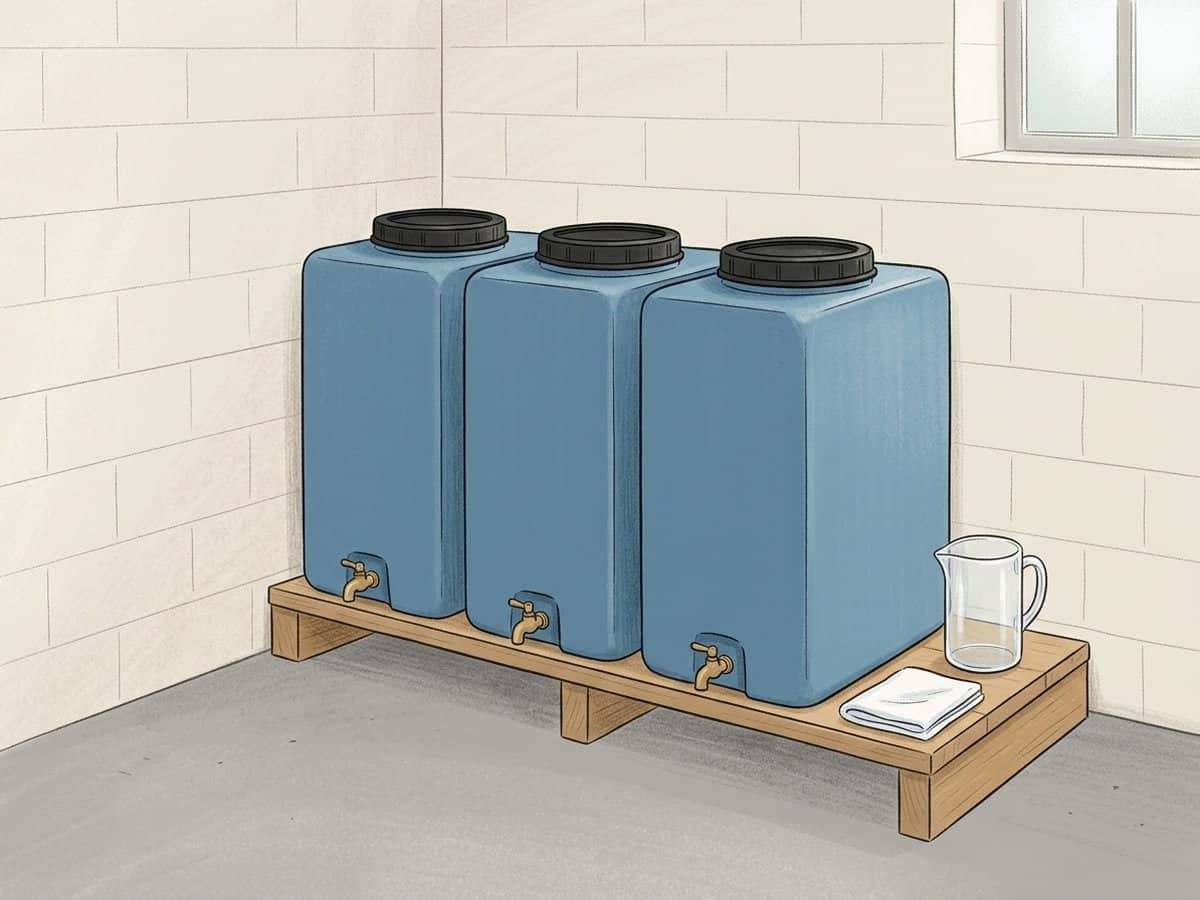
- RightOn a basement slab, in shade, spigot clear.
- Pick a cool, dark spot. The CDC says to keep stored water between 50°F and 70°F, away from direct sunlight and toxic substances such as gasoline and pesticides. The tank’s maker recommends “a cool, shaded area such as a garage, basement, utility room, or shed”; a garage or shed can run far hotter than 70°F in summer, so check yours.
- Keep it out of the sun. The maker’s FAQ calls its tanks UV-resistant, yet its warranty excludes “Tank damage from sun exposure”. Plan by the exclusion.
- Put it on a ground-level floor. One full tank is about 480 pounds (calculated). A basement or garage slab carries that load on the ground rather than on joists. For any upper floor, ask the building owner or a structural engineer first.
- Place it empty, then fill it. A full tank does not move. Raise it enough that a pitcher fits under the spigot, then fill it from your usual tap. If your utility or local officials give treatment instructions, follow theirs; this page gives no ratios, no measures and no timings.
- Label, date and rotate. The CDC says to label containers “drinking water” with the storage date and to replace stored water every 6 months, and Ready.gov says the same for water not commercially bottled. The maker’s FAQ says stored water “can last up to 12 months”; this page follows the CDC. The rotation schedule sets the reminders.
- Dispense cleanly. The CDC says to use a clean scoop or device each time and not to touch the water or the inside of the container with your hands. A spigot helps: fill a clean pitcher and leave the lid closed.
The product
The emergency water tank checked at its maker
One emergency water tank on this page was checked against its maker’s own product, FAQ and warranty pages in September 2026, and the card prints only what that maker states or what arithmetic shows.
55 gallons, with a spigot
Emergency Water Tanks 55 Gallon Stackable Tank
- Capacity: “55 Gallons” Stated
- Size: “27.75 L x 21.75 W x 29.5 H” Stated
- Construction: “rotationally-molded plastic”; “premium, lead-free materials” Stated
- Food contact: the FAQ says all its tanks “are made from BPA-free, food-grade materials” Stated
- Outlet and lid: “1 x 3/4 GHT Lead Free Brass Spigot”; “5″ Threaded Lid with Vent” Stated
- Empty weight: “22 Lbs” Stated
- Full weight: “490 Lbs” Stated; about 480 lb Calculated
- Warranty: 1 year standard, 5 years if registered within 30 days; excludes “Tank damage from sun exposure” Stated
- FDA or NSF certification: Not stated by the manufacturer. Not stated
- Maximum stack height: Not stated by the manufacturer. Not stated
View the 55-gallon emergency water tank on Amazon
Affiliate link. This site does not link the water preserver the listing offers alongside it.
What the numbers mean
The same tank, in household terms
- Days for four people: 55 ÷ 4 is about 13.75 days at 1 gallon per person per day Calculated. The maker says “almost 2 weeks”, which agrees.
- Floor area: about 4.19 sq ft Calculated
- Floor load, one tank: about 115 lb per sq ft, or 117 with the maker’s 490 lb Calculated
- Storage period: the maker’s FAQ says up to 12 months; the CDC says replace every 6. This page follows the CDC.
- Pump: the maker says “no pump required” because of the built-in spigot Stated
If you already own a drum instead, its dispensing tools are covered in the guide to 55 gallon drum pumps.
How this card was built. Figures come from the maker’s product page, FAQ and warranty page. The food-grade statement sits in the FAQ, not the product specifications, and names no FDA or NSF certification. Where the maker’s full weight and the arithmetic differ, both are printed; plan with the heavier. Cost per usable gallon is price ÷ 55.
The exclusions
Who an emergency water tank is not for
An emergency water tank is the wrong choice for renters on upper floors, for anyone who moves often, and for anyone who may need to leave home with their water.
- Not for you if you rent an upper-floor unit. About 480 pounds per tank on a suspended floor is for the building owner to approve, not for arithmetic to settle.
- Not for you if you move often. A tank must be drained to move.
- Not for you if you have no ground-level spot that stays between 50°F and 70°F and out of the sun.
- Not for you if your water may need to travel with you. Carry-size containers go; a tank stays.
- Not for you if your need is small. Two people need 6 gallons for 3 days, a lot less than 55 gallons to rotate every 6 months.
For smaller formats, compare the best emergency water storage containers or stackable water storage containers. For a drum-based setup, see 55 gallon water barrel kits. The whole plan starts in the emergency water storage guide.
Questions
Common questions about emergency water tanks
Short answers to what people ask before buying a water tank.
The water alone is about 458 pounds: 55 gallons at 8.329 pounds per gallon, the USGS figure at 70°F. The tank on this page adds a stated 22 pounds, about 480 in all; its maker states 490. Plan with the heavier figure.
The CDC says to replace water you store yourself every 6 months, and Ready.gov agrees. One tank maker’s FAQ says up to 12 months; this page follows the CDC. Use the guide to how long water can be stored for the detail.
Somewhere between 50°F and 70°F, out of direct sunlight and away from gasoline and pesticides, which is the CDC’s storage guidance. Because a full 55-gallon tank weighs close to 500 pounds, a ground-level slab such as a basement floor is the practical choice.
Ask the building owner or a structural engineer first. This page can show the arithmetic, about 115 pounds per square foot under one full 55-gallon tank, but not whether a particular floor can carry it.
It depends on the maker’s statement. The maker of the tank on this page says in its FAQ that its tanks are made from BPA-free, food-grade materials; it states no FDA or NSF certification. The CDC recommends FDA-approved food-grade containers.
For 3 days, four people need 12 gallons, so one 55-gallon tank is plenty. For the CDC’s suggested 2 weeks they need 56 gallons, one more than a single tank holds, so two tanks or one tank plus a jug.
Sources
Where these facts come from
Agency figures and manufacturer statements, each checked in September 2026.
- Centers for Disease Control and Prevention, “How to Create and Store an Emergency Water Supply” (reviewed June 27, 2025). cdc.gov — at least 1 gallon per person per day for 3 days; a 2-week supply if possible; FDA-approved food-grade containers; label and date; replace every 6 months; 50°F–70°F, out of sunlight, away from gasoline and pesticides; use a clean scoop or device and do not touch the water. Checked September 2026.
- Ready.gov, “Water.” ready.gov — at least 1 gallon per person per day for drinking and sanitation; replace water that was not commercially bottled every six months. Checked September 2026.
- U.S. Geological Survey, “Water Density.” usgs.gov — 8.329 pounds per U.S. gallon at 70°F. Checked September 2026.
- Emergency Water Tanks (a division of Hive Plastics), “55 Gallon Stackable Emergency Water Storage Tank.” emergencywatertanks.com — 55 gallons; 27.75 × 21.75 × 29.5 in; 22 lbs empty, 490 lbs full; BPA free; 5″ threaded lid with vent; 3/4 GHT lead-free brass spigot; rotationally-molded plastic; lead-free materials; no pump required; “almost 2 weeks” for a family of 4. Checked September 2026.
- Emergency Water Tanks, “Frequently Asked Questions.” emergencywatertanks.com — made from BPA-free, food-grade materials; store in a cool, shaded area such as a garage, basement, utility room, or shed; UV-resistant; stored water can last up to 12 months if sealed, cool and away from sunlight; a 300-gallon tank. Checked September 2026.
- Emergency Water Tanks, “Warranty.” emergencywatertanks.com — 1-year standard limited warranty; 5-year with registration within 30 days; excludes tank damage from sun exposure. Checked September 2026.