Buying Guide
55 Gallon Drum Pumps for Drinking-Water Barrels
A full 55-gallon drum holds about 458 pounds of water and will not tip. Every glass you pour comes through a pump or spigot, so that small part decides whether stored water stays clean.
The comparison
55 gallon drum pumps compared by type
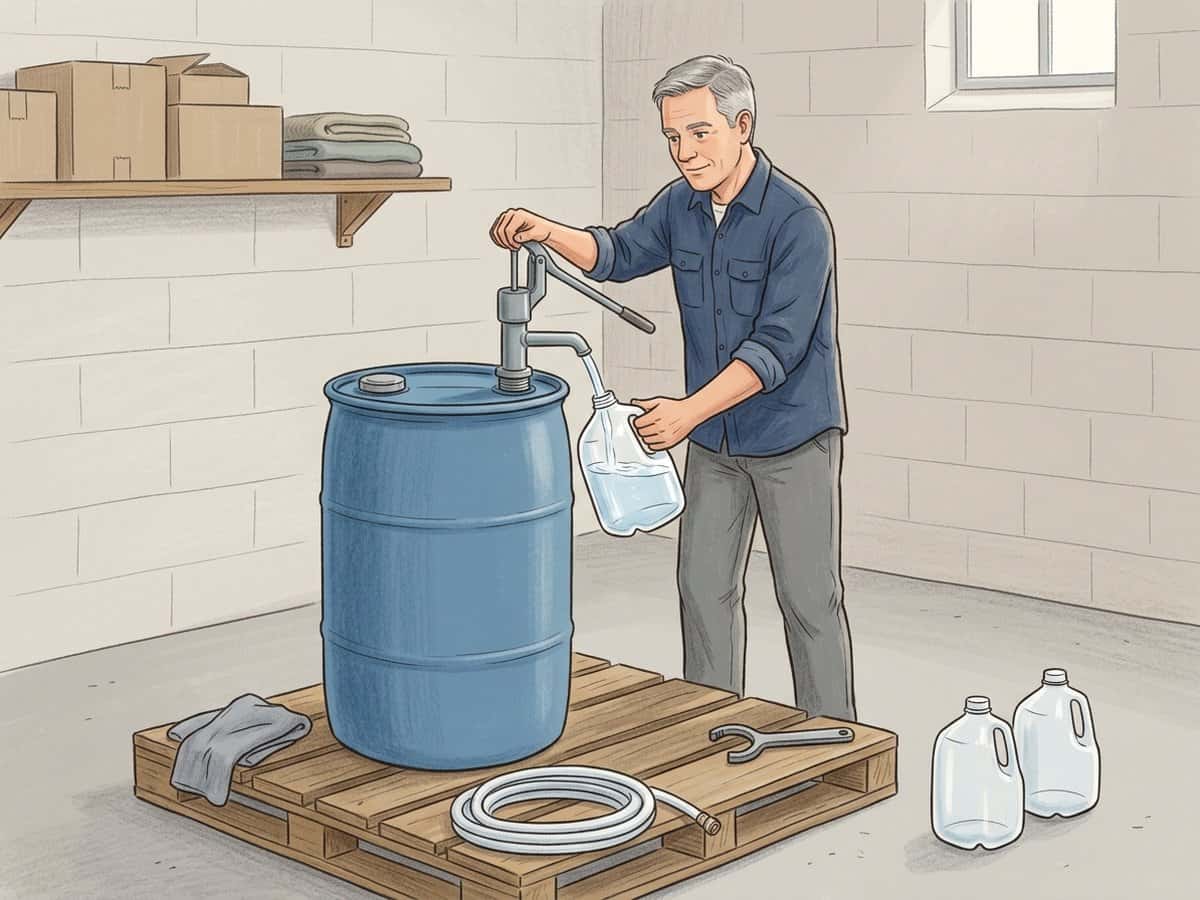
55 gallon drum pumps come in three hand-powered types, siphon, lever and rotary, and a spigot threaded into the drum is the fourth way to get water out without tipping it.
A drum is a closed barrel with two small threaded openings in its top, called bungs. At 8.329 pounds per U.S. gallon, the U.S. Geological Survey figure for water at 70°F, 55 gallons weighs about 458 pounds before the drum itself (calculated). You need a dispenser; the question is which kind.
| Type | How it works | Where it fits | Best job | Weak spot |
|---|---|---|---|---|
| Siphon pump | A squeeze bulb or shaker valve starts the flow; gravity does the rest | A hose through an open bung | Filling jugs from a drum on a pallet | Stops unless the outlet sits below the water in the drum |
| Lever hand pump | Each handle stroke lifts water up a tube | Threads into a bung | Daily draws of a gallon or two | Wetted parts are hidden inside the tube |
| Rotary hand pump | A crank turns a vane that draws water steadily | Threads into a bung | Filling larger containers | Many are sold for oil and fuel |
| Drum spigot | A tap pours when it sits below the water line | A bung, with the drum on its side on a rack | Hands-free pouring | The rack carries the whole full drum |
How this table was built. It compares how each type works, so it names no brand and prints no maker’s figure. The one number here is arithmetic: 55 × 8.329 = 458.1 pounds. Nothing was tested.
Four ways out of a drum
- Siphonsqueeze to start
- Leverone stroke at a time
- Rotarya crank, steady flow
- Spigotdrum on a rack
What decides it
What makes a drum pump safe for drinking water
A drum pump is fit for drinking water when its maker says so in writing, every metal part that touches the water is stated lead-free, it fits your drum’s bung, and it has never pumped anything else.
Drum pump listings mix drinking-water pumps with pumps for fuel, oil and drainage. Run these five checks on each one.
- The maker states drinking-water use. Look for drinking water, potable or food-grade on the maker’s own page, not only in a listing title. The CDC recommends FDA-approved food-grade containers and rules out containers that previously held toxic chemicals such as bleach or pesticides. This page applies the same reasoning to anything the water passes through.
- Metal parts are stated lead-free. Section 1417 of the Safe Drinking Water Act makes “lead free” a legal limit on lead in the wetted surfaces of pipes and fittings, but the EPA exempts devices “used exclusively for non-potable services such as manufacturing, industrial processing, irrigation, outdoor watering”. A rain-barrel spigot need not meet it. The EPA names brass or chrome-plated brass faucets as the most common lead problem and sets the health goal for lead in drinking water at zero.
- It fits your drum’s bung. U.S. Plastic Corp.’s listing for the common Greif GP-55 drum states “a 2″ NPS bung & 2″ buttress bung”: one size, two different threads. Match the thread, or buy the adapter the pump’s maker names. The same listing gives a 34.9-inch drum height, so check the pump tube reaches near the bottom of yours.
- It stays clean and dedicated. The CDC says to use a clean scoop or device each time you remove water and not to touch the water or the container’s inside with your hands. Keep the pump for drinking water only and clean it as its maker instructs. This page gives no ratios, no measures and no timings for cleaning chemicals.
- It starts without your mouth. A siphon that primes by squeezing a bulb or shaking a valve keeps mouths and hands out of the water, in line with the CDC’s rule.
One pump, one job
- WrongA pump moved from an oil drum to the water.
- RightA pump kept for water only, bagged beside its drum.
Try it
Your dispensing plan for a 55 gallon drum
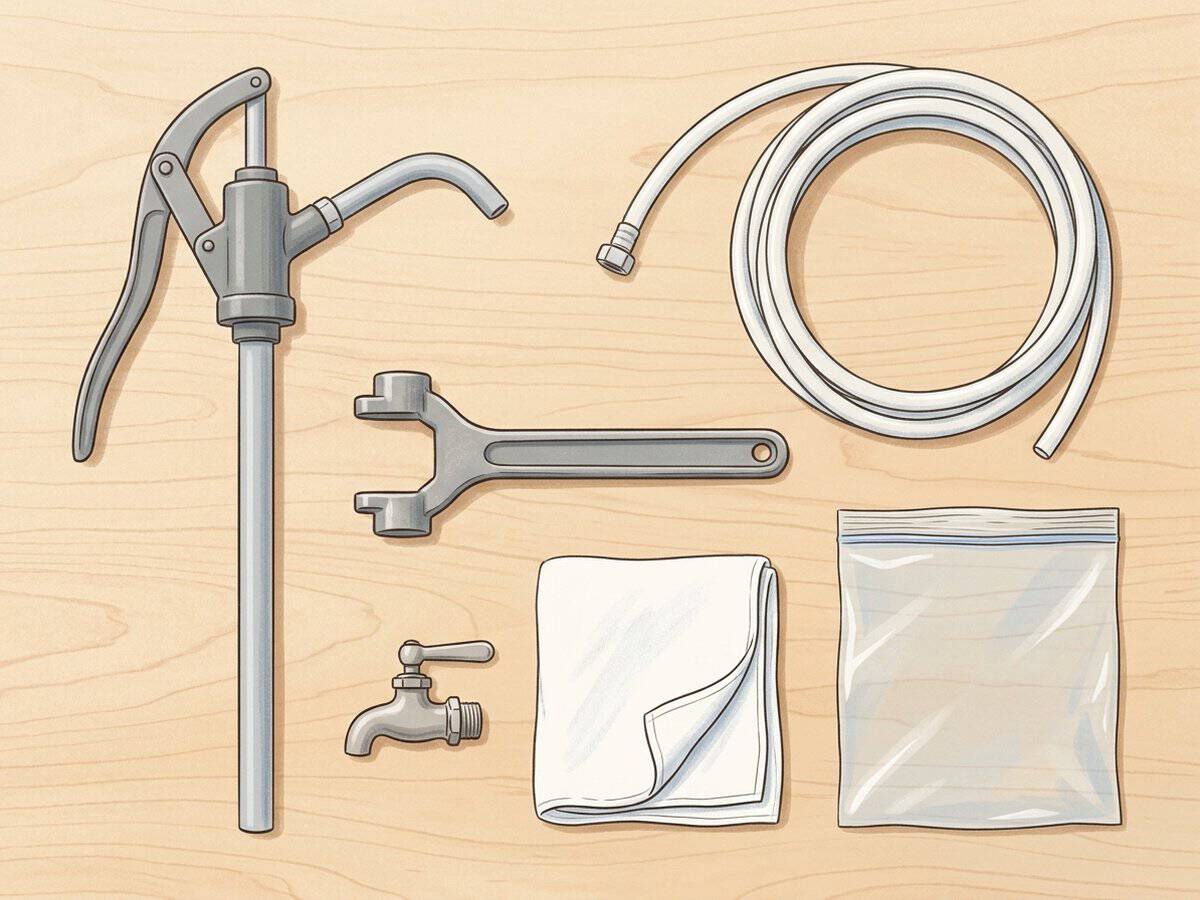
A dispensing plan for a 55-gallon drum starts from the gallons you draw each day, which sets how much you pump, how long the drums last, and when the water is due to be replaced.
The CDC and Ready.gov set the storage allowance at a minimum of 1 gallon per person per day, for drinking and sanitation, and the CDC suggests a 2-week supply if possible. Four people draw about 4 gallons a day.
Dispensing plan
Every figure is arithmetic from your inputs, 55 gallons per drum and 8.329 pounds per gallon.
How this is worked out. Pounds to carry is gallons × 8.329 (USGS). Days is drums × 55 ÷ gallons per day, rounded down. Each drum holds 55 × 8.329 = 458.1 pounds of water. Replace-by is the fill month plus 6, the CDC rule for water you store yourself.
What it will not do. It adds nothing for heat, infants, illness or pets. Ready.gov says some people need more and needs can double in very hot temperatures, without a per-person figure; raise the daily gallons yourself.
One drum gives four people 13 full days, a day short of the CDC’s 2-week suggestion of 56 gallons (calculated). Those 4 gallons are also about 33 pounds carried every day, so a pump that fills a jug without spills matters more than a fast one.
Where to buy
Where to buy 55 gallon drum pumps, spigots and drum tools
The buying links for 55 gallon drum pumps and spigots below open Amazon searches, not checked products, so the five checks above decide which listing to keep.
Drum pumps
A drum pump for drinking water is one whose maker states drinking-water, potable or food-grade use. Skip listings for fuel, oil, chemicals or drainage.
Barrel spigots
A barrel spigot for drinking water is one whose maker states it is lead-free and for drinking water. Rain-barrel spigots fall under the EPA exemption for outdoor watering.
Browse barrel spigots on Amazon
Bung wrench
A bung wrench unscrews a drum’s bung caps; a closed drum cannot be opened without one. Check it fits your caps, and keep it beside the drum.
Browse bung wrenches on Amazon
Drum dolly
A drum dolly is a wheeled base for rolling an empty drum into place and out again for cleaning. The link goes to one listing, the ELAFROS 30/55-gallon plastic drum dolly. This page found no maker page for ELAFROS, so it prints none of the listing’s figures. Check that any dolly’s stated load rating exceeds about 458 pounds of water plus the drum (calculated), and fill the drum after it is on the dolly.
View the ELAFROS drum dolly on Amazon
How these links were chosen. Three are searches, because no drinking-water pump or spigot has yet been checked at its maker; no specification is printed for them. Two products were left out: a utility siphon pump sold for drainage and meter pits, with no drinking-water statement, and a brass rain-barrel spigot with no lead-free statement. For cost per usable gallon, add the pump price to the drum’s and divide by 55.
The exclusions
Who 55 gallon drum pumps are not for
55 gallon drum pumps are the wrong purchase for anyone who does not have, or should not have, a 55-gallon drum.
- Not for you if your water is in jugs or bottles you can lift and pour.
- Not for you if you have no drum yet and want fewer tools. A tank with a built-in, lead-free spigot needs no pump; see 55 gallon water barrel kits and the coming guide to emergency water tanks.
- Not for you if you cannot confirm what your drum held before. The CDC rules out containers that held toxic chemicals; used 55 gallon barrels for water storage explains how to check.
- Not for you if you live on an upper floor. About 458 pounds of water on a few square feet is a question for your building manager first.
- Not for you if you may need to leave home with your water. A drum stays put; carry-size containers go with you.
For the whole plan, see the emergency water storage guide; for reminders, the water storage rotation schedule.
Questions
Common questions about 55 gallon drum pumps
Short answers to what people ask before buying a drum pump.
Use a hand pump or siphon through one of the drum’s bungs, or a spigot with the drum lying on a rack. A full drum is too heavy to tip. The CDC says to use a clean device each time and keep hands out of the water.
It varies, so check yours. The common Greif GP-55 plastic drum is listed with a 2-inch NPS bung and a 2-inch buttress bung: one size, two threads. A pump or spigot must match the thread it goes into.
No. The CDC rules out containers that previously held toxic chemicals, and this page applies the same reasoning to pumps. Buy one whose maker states drinking-water or food-grade use, and keep it for water only.
Only if the maker states they are lead-free. The EPA says the most common lead problem is with brass or chrome-plated brass faucets, and devices sold only for outdoor watering or irrigation are exempt from the lead-free rule. Choose a spigot stated as lead-free and for drinking water.
The water alone weighs about 458 pounds: 55 gallons at 8.329 pounds per gallon, the USGS figure at 70°F. The drum adds its own weight.
The CDC says to replace water you store yourself every 6 months, and Ready.gov says the same for water that has not been commercially bottled. Neither sets a longer period for drums.
Sources
Where these facts come from
Agency guidance, one drum listing and one physical constant, each checked in September 2026.
- Centers for Disease Control and Prevention, “How to Create and Store an Emergency Water Supply” (reviewed June 27, 2025). cdc.gov — at least 1 gallon per person per day for 3 days; a 2-week supply if possible; FDA-approved food-grade containers; no containers that held toxic chemicals; use a clean scoop or device each time and do not touch the water; label and date; replace every 6 months. Checked September 2026.
- Ready.gov, “Water.” ready.gov — at least 1 gallon per person per day for drinking and sanitation; some people need more; needs can double in very hot temperatures; replace water that was not commercially bottled every six months. Checked September 2026.
- U.S. Environmental Protection Agency, “Use of Lead Free Pipes, Fittings, Fixtures, Solder, and Flux for Drinking Water” (updated May 19, 2026). epa.gov — the section 1417 definition of lead free; the exemption for devices used exclusively for non-potable services such as irrigation and outdoor watering. Checked September 2026.
- U.S. Environmental Protection Agency, “Basic Information about Lead in Drinking Water” (updated June 18, 2026). epa.gov — brass or chrome-plated brass faucets are the most common problem; the health goal for lead is zero. Checked September 2026.
- U.S. Plastic Corp., “Greif GP-55 Closed Head Poly Drums” (distributor listing). usplastic.com — a 2″ NPS bung and a 2″ buttress bung; 34.9″ height. Checked September 2026.
- U.S. Geological Survey, “Water Density.” usgs.gov — 8.329 pounds per U.S. gallon at 70°F. Checked September 2026.