Emergency Water Storage
Emergency Water Storage for Apartments and Small Spaces
A two-week supply for two people is 28 gallons and about 233 pounds of water. That sounds impossible in a small apartment until you see how little floor it takes.
Emergency water storage for apartments follows the same rules as any home: at least 1 gallon per person per day for 3 days, and a 2-week supply if possible (CDC), kept at 50°F–70°F, out of direct sunlight and away from chemicals. In a small space, spread it across closet floors, under beds and pantry corners in containers you can carry, and remember that water weighs about 8.329 pounds per gallon (USGS).
What you’ll learn
The short version
Emergency water storage in an apartment uses the same published rules as a house; only the placement and container sizes change.
- Store at least 1 gallon per person per day for 3 days, and 2 weeks if possible (CDC).
- Closet floors and under-bed space are the usual winners: cool, dark and away from chemicals.
- Spread the water out in several containers rather than one heavy one.
- Every gallon is about 8.3 pounds (USGS); ask your landlord or building manager about floor limits.
- Sealed store-bought water follows its printed date; water you fill yourself is replaced every 6 months (CDC).
Step 1
How much water an apartment needs
An apartment needs the same emergency water per person as any other home: at least 1 gallon per person per day, for at least 3 days.
The CDC sets the baseline at 1 gallon of water per person, per day, for 3 days, and suggests a 2-week supply if possible. Ready.gov uses the same gallon and says it covers drinking and sanitation. Square footage changes where the water goes, not how much a person needs.
| Household | 3 days | 2 weeks | 2-week weight (calculated) |
|---|---|---|---|
| 1 person | 3 gal | 14 gal | About 117 lb |
| 2 people | 6 gal | 28 gal | About 233 lb |
| 3 people | 9 gal | 42 gal | About 350 lb |
| 4 people | 12 gal | 56 gal | About 466 lb |
Ready.gov adds that water needs can double in very hot temperatures, and that children, nursing mothers and sick people may need more. A top-floor unit without air conditioning in a heat wave can be that case. If 2 weeks will not fit yet, start with the 3-day minimum. The emergency water calculator handles the multiplication for any household.
Step 2
Where water fits in a small apartment
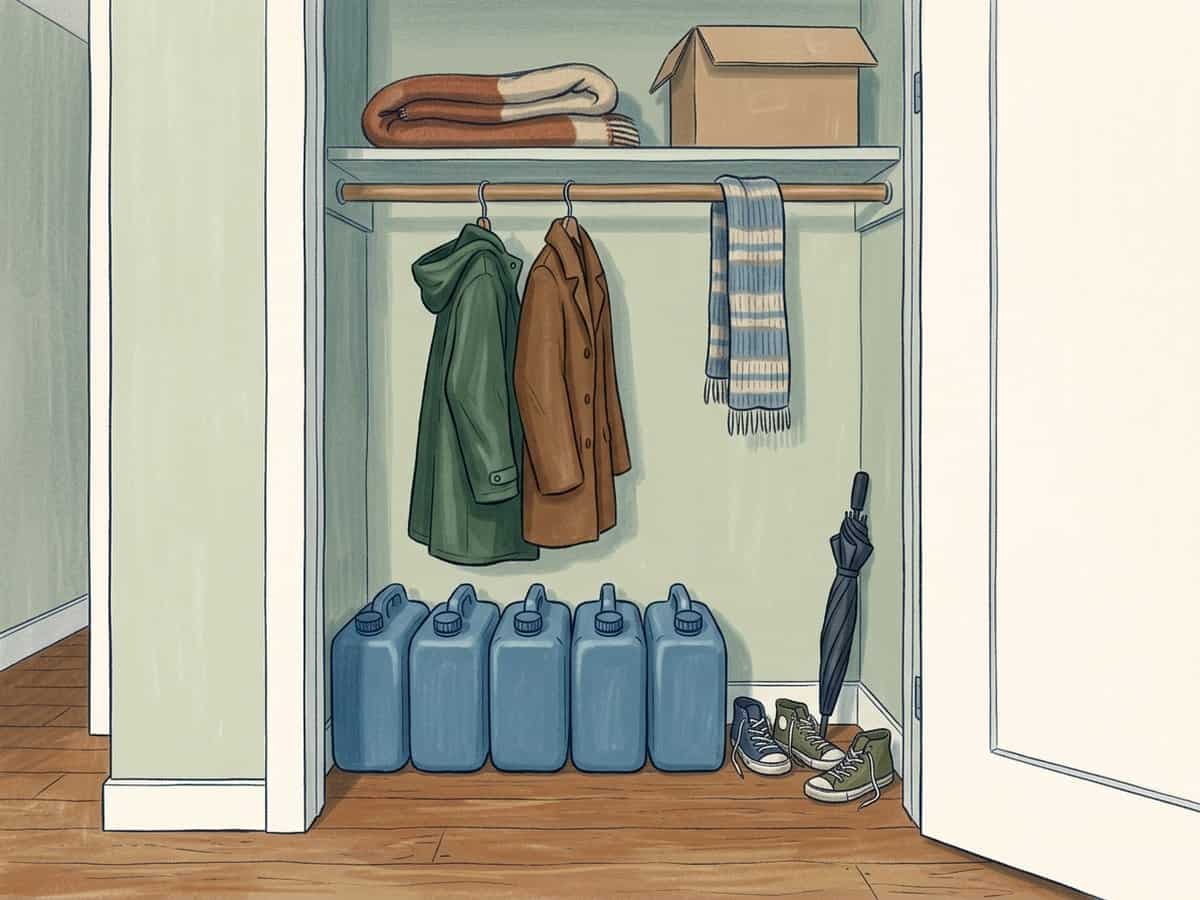
Water fits in a small apartment in the places that meet the CDC’s three storage rules: closet floors, under beds and pantry corners, rather than anywhere that gets sun or holds chemicals.
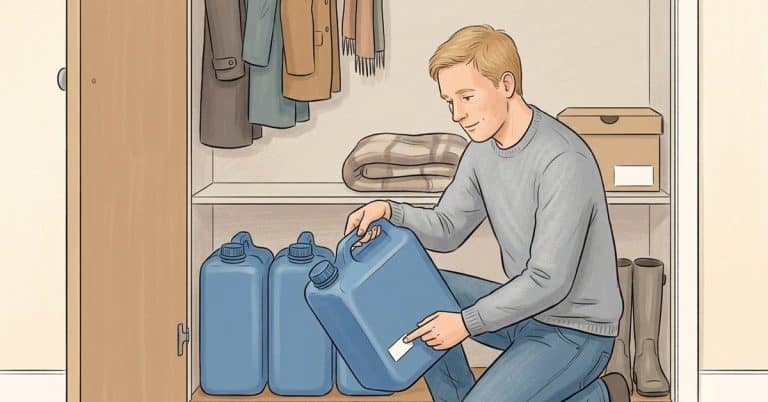
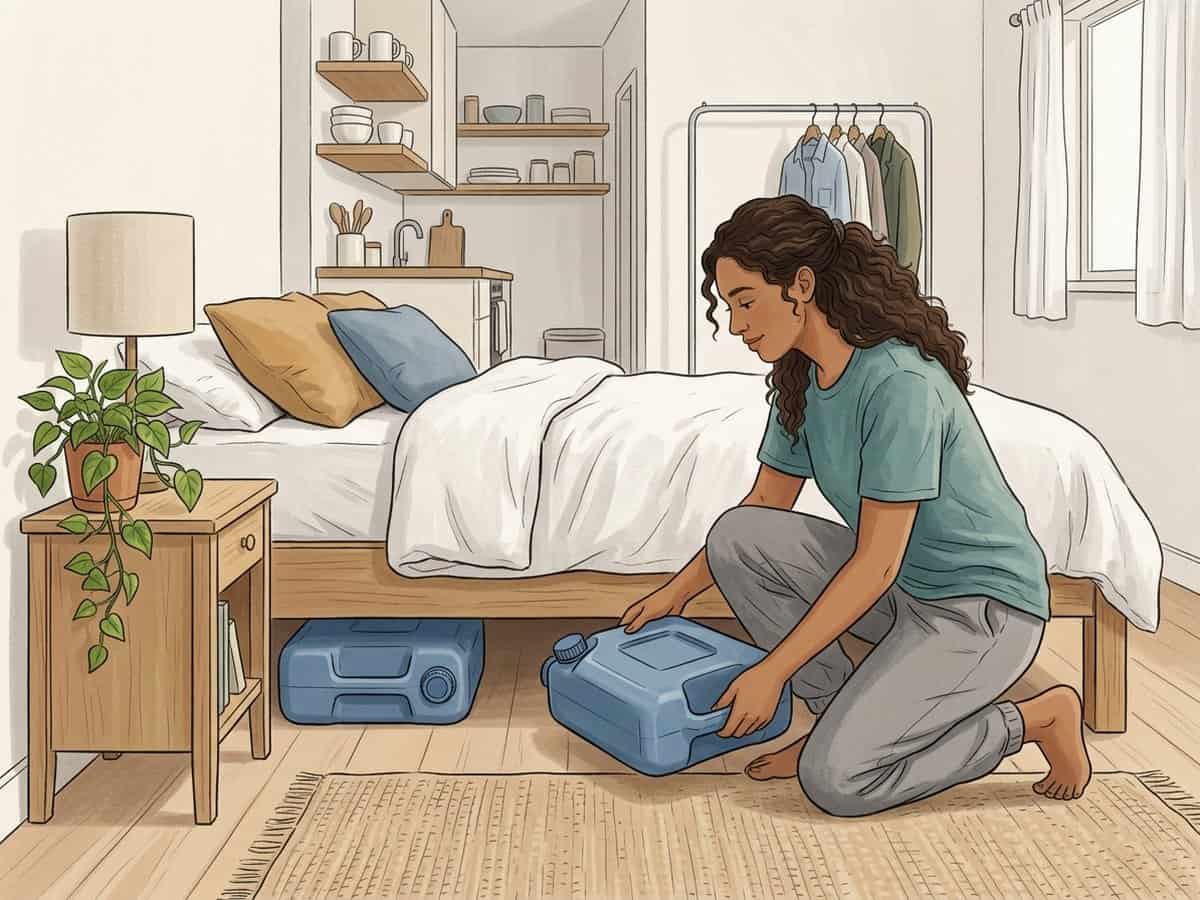
The CDC says to keep stored water in a cool place, between 50°F and 70°F, away from direct sunlight, and away from toxic substances such as gasoline or pesticides. Two Pacific Northwest water utilities publish apartment-specific ideas that fit those rules. The Regional Water Providers Consortium suggests the back of a closet or under a bed, and EWEB (the Eugene Water & Electric Board) adds under kitchen and bathroom sinks, and advises spreading water through the home rather than keeping it all in one spot.
Where water goes in a studio
- Good spotCloset floor, under the bed and a pantry corner: cool, dark and away from chemicals.
- Only with careUnder the sink works only once cleaning products move somewhere else.
- Poor spotAnywhere a window puts direct sun on the containers.
The under-sink idea has a catch: that cupboard usually holds cleaning products, and the CDC’s toxic-substances rule applies there too, so move the chemicals out first. A balcony fails the CDC’s sunlight and temperature rules.
Step 3
Containers that suit small spaces
The containers that suit small spaces are slim, rectangular and light enough to carry, because they fill dead space and can be split across several spots.
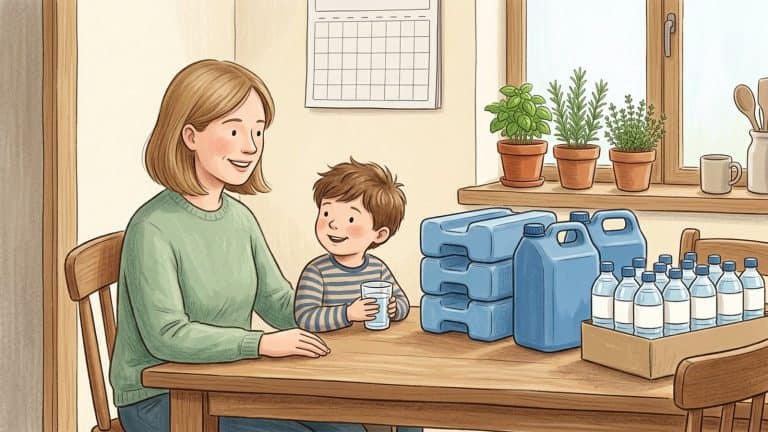
The CDC’s container rules come first: FDA-approved food-grade, a tightly closing top, durable unbreakable materials rather than glass, and never a container that held toxic chemicals. Within those rules, shape matters most. Both utilities point the same way: EWEB says brick-style stacking containers work well in tight spaces and that jerry cans are narrow enough to slide into a cupboard or closet, and the Regional Water Providers Consortium says bottled water or slim containers fit nicely in small spaces.
| Format | Typical capacity | Water weight when full (calculated) | Small-space fit |
|---|---|---|---|
| Sealed bottles or 1-gallon jugs | Under 1 gal each | About 8.3 lb per gallon | Fills gaps anywhere; easiest to rotate |
| Brick-style stackable (WaterBrick Standard) | 3.5 gal, stated | 29.2 lb water; 31.7 lb with the stated 2.52 lb empty weight; the maker states 27 lb filled | Maker states 9 × 18 × 6 in, low enough for under-bed space |
| 5-gallon jug | 5 gal | About 41.6 lb | Fits closet floors; heavy on stairs |
| 55-gallon barrel | 55 gal | About 458 lb | Rarely suits an apartment; ask the building first |
Methodology. The WaterBrick figures are quoted from the maker’s specification page. Where its stated filled weight and the arithmetic disagree, plan with the heavier figure. The other rows are format ranges, not product claims.
For side-by-side comparisons from manufacturer documentation, see the stackable water storage containers guide and the broader water storage container guide. For a go-bag rather than a closet, emergency water pouches are the smallest format of all, though far too small to be a whole household supply.
Step 4
Stairs, elevators and lifting
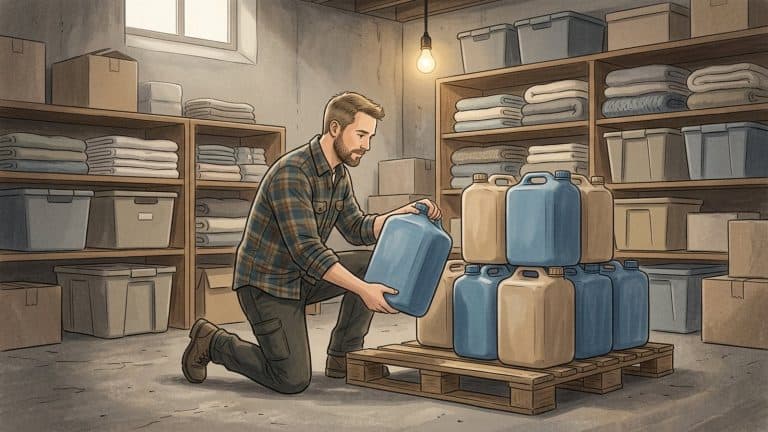
Stairs change the container choice in an apartment, because every gallon has to be carried up once and may need to be carried down again.
At 8.329 pounds per gallon (USGS), a 5-gallon jug is about 41.6 pounds of water and a 3.5-gallon brick about 29.2 pounds (both calculated, container weight extra). A two-person, 2-week supply is 233 pounds in total. Carried up three flights in 5-gallon jugs, that is six trips with more than 40 pounds each time; in 1-gallon jugs it is many lighter trips.
Size to the lightest carrier. Pick containers the person most likely to be home can lift and pour without help.
Plan for no elevator. In a power outage, a building’s elevator may be out of service. Water that is already upstairs is the water you have.
Keep something portable. If you may need to leave, a few small containers travel; a full 5-gallon jug does not travel far.
Step 5
Work out how much space your water takes
The space emergency water takes in an apartment is simple arithmetic: gallons, divided into containers, multiplied by each container’s footprint.
Apartment water space calculator
Choose people, days and a container, then enter its base in inches. Everything below is calculated.
Footprint: the WaterBrick Standard’s stated 9 × 18 in base. For another container, measure its base and enter it.
How this is worked out. Gallons is people × days × 1 (CDC). Containers is gallons ÷ container size, rounded up. Floor area is containers × length × width ÷ 144, laid in one layer. Weight is containers × size × 8.329 pounds (USGS), water only. Floor load is weight ÷ floor area. All of it is arithmetic.
What it will not tell you. Whether your floor can take the load: this page publishes no floor rating, so ask your landlord or building manager. It has no maker-stated footprint for 1- or 5-gallon jugs, so it uses your measurement instead of guessing, and it adds nothing for heat, illness or pets.
The default answer is worth a second look. A two-person, 2-week supply in 3.5-gallon bricks covers about 9 square feet laid flat, a patch about 3 feet by 3 feet (calculated).
Step 6
Weight and your apartment floor
The weight of stored water on an apartment floor is a question for your landlord or building manager, because no public-health agency publishes a floor rating for homes.
This page can give you the arithmetic. Each gallon adds about 8.3 pounds (USGS), and concentrating it raises the load per square foot: the calculator's default puts about 26 pounds on each square foot under the containers, and stacking the same bricks two high doubles that (both calculated). Neither figure says whether a particular floor is fine; only the people responsible for the building can, so ask before adding a barrel or a tall stack.
The practical rule is to spread the weight: several containers in different spots, rows along walls rather than towers mid-room, which also matches EWEB's advice to distribute water around the home.
Step 7
Leases, landlords and shared spaces
Lease terms on storage differ from building to building, so the safe move for renters is to read the lease and ask before storing anything large or outside the unit.
Small containers inside your own closets rarely raise questions. Larger containers, storage cages, hallways and balconies are different: a building rule may limit them, and a leak can reach the unit below. Questions worth asking:
- Are there limits on what I can store on a balcony, in a storage cage or in a hallway?
- Is there a weight limit for the floor, or for anything heavier than furniture?
- Who should I call if a container leaks?
Check containers for leaks when you rotate them, as EWEB advises. A slow drip under a bed can go unnoticed for weeks.
Step 8
Sealed bottled water or home-filled containers
Sealed bottled water and home-filled containers both work in an apartment, but they run on different rotation rules.
The CDC calls unopened, commercially bottled water the safest and most reliable source of water in an emergency, and says to observe the expiration date on store-bought water. Ready.gov says to keep it sealed in its original container in a cool, dark place. Bottles also pack into odd gaps.
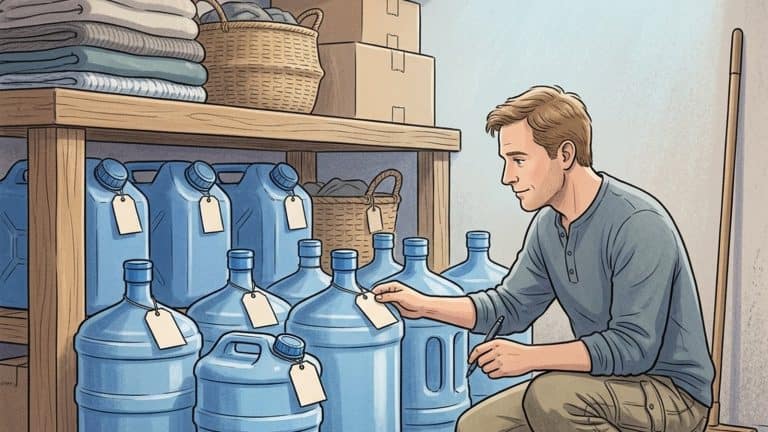
Water you fill yourself is cheaper per gallon but needs more care. The CDC says to label each container “drinking water” with the storage date and to replace it every 6 months; Ready.gov gives the same 6-month rule. Hidden under beds and behind coats, containers need those labels more. The water storage rotation schedule sets the reminders, and how long emergency water can be stored explains both rules.
Whichever you choose, take water out cleanly. The CDC says to use a clean scoop each time and never to touch the water or the inside of the container with your hands. For the full list of common slips, see emergency water storage mistakes to avoid.
Step 9
Children and pets in a small apartment
Children and pets raise an apartment's water needs, and the agencies say so without publishing a separate amount for either.
Ready.gov notes that children, nursing mothers and sick people may need more water, and the CDC suggests storing more for pregnant women, people who are sick, pets and hot climates. Neither page gives a figure per child or per animal, so this page does not invent one. Add a margin on top of the household total, and keep containers where small children cannot tip them.
Families will find more detail in emergency water storage for families with kids, and pet owners in emergency water storage for pets. For the whole plan in one place, start from the complete emergency water storage guide.
Questions
Common questions about apartment water storage
These are the questions renters and small-space households ask most often about storing emergency water.
Store at least one gallon per person per day for three days, and two weeks if possible, as the CDC advises. Keep it somewhere cool, between 50°F and 70°F, out of direct sunlight and away from chemicals, such as a closet floor or under a bed, and spread it across several containers you can carry.
Utility guidance suggests the back of a closet, under a bed, and under kitchen and bathroom sinks. Under-sink space works only if cleaning products are moved out, because the CDC says to keep stored water away from toxic substances. Avoid balconies and sunny windows.
At least one gallon per person per day for three days, according to the CDC, with a two-week supply if possible. For two people that is 6 gallons for three days and 28 gallons for two weeks. Ready.gov says needs can double in very hot temperatures.
Yes, if the containers are food-grade and fit. Under a bed is usually cool and dark, which matches the CDC's storage conditions, and the Regional Water Providers Consortium lists it as a small-space option. Label each container with its date so it is not forgotten.
About 8.329 pounds at 70°F, according to the U.S. Geological Survey. A 5-gallon container holds about 41.6 pounds of water and a 55-gallon barrel about 458 pounds, before the container's own weight.
No public-health agency publishes a floor rating for homes, so ask your landlord or building manager, especially before storing a large barrel or a tall stack. Spreading several smaller containers around the apartment keeps the weight on any one spot low.
Sources
Where these figures come from
Every figure on this page is quoted from, or calculated from, one of these sources, checked in September 2026.
- Centers for Disease Control and Prevention, “How to Create and Store an Emergency Water Supply” (reviewed June 27, 2025). cdc.gov — 1 gallon per person per day for 3 days; 2-week supply if possible; store more for pregnant women, sick people, pets and hot climates; unopened commercially bottled water; observe the expiration date; FDA-approved food-grade containers, tight top, not glass, never a container that held toxic chemicals; label with the storage date; 50°F–70°F, away from sunlight and toxic substances; replace every six months; clean scoop, no hands. Checked September 2026.
- Ready.gov, “Water.” ready.gov — at least 1 gallon per person per day for drinking and sanitation; needs can double in very hot temperatures; children, nursing mothers and sick people may need more; sealed bottled water in a cool, dark place; replace non-commercial water every six months. Checked September 2026.
- U.S. Geological Survey, “Water Density.” usgs.gov — 8.329 pounds per U.S. gallon at 70°F, used for every weight on this page. Checked September 2026.
- WaterBrick, “Product Specifications.” waterbrick.org — Standard: 3.5 gallons; 9″ × 18″ × 6″; empty weight 2.52 pounds; filled weight 27 pounds; HDPE. Checked September 2026.
- Regional Water Providers Consortium, “Emergency Water Storage.” regionalh2o.org — back of a closet or under a bed; bottled water or slim containers fit small spaces. A regional utility source. Checked September 2026.
- Eugene Water & Electric Board, “Storing Water in Small Spaces” (January 31, 2020). eweb.org — under the bed, back of the closet, under sinks; spread water through the home; check for leaks; brick-style containers and jerry cans for tight spaces. A regional utility source. Checked September 2026.