Daily Water Needs
How Much Water Do You Need Per Day to Survive?
Two agency numbers answer this question, and they measure different things. One is what your body uses. The other is what you should keep on the shelf.
Ready.gov puts a normally active person at about ¾ of a gallon of fluid a day, from water and other drinks. For an emergency supply, store at least 1 gallon per person per day for drinking and sanitation, for at least 3 days, and aim for 2 weeks if you can (CDC). In very hot weather, needs can double. No U.S. agency publishes a figure for how long a person can last without water, so plan to the supply, not to the edge.
What you’ll learn
The short version
The amount of water you need per day to survive an emergency comfortably is the amount you should store, and that number is larger than what you drink.
- Drinking need: about ¾ gallon of fluid a day for a normally active person (Ready.gov).
- Storage allowance: at least 1 gallon per person per day, for drinking and sanitation (CDC, Ready.gov).
- Duration: at least 3 days; a 2-week supply if possible (CDC).
- Heat can double the need. Children, nursing mothers and sick people may need more (Ready.gov).
- No agency publishes a “days without water” limit. Do not plan around one.
Step 1
Two numbers, two jobs
The water you need per day to survive has two published answers: about ¾ of a gallon of fluid for your body, and 1 gallon per person to store.
Most confusion about this question comes from people quoting one of these numbers as if it were the other. Ready.gov states that a normally active person needs about ¾ of a gallon of fluid daily, from water and other beverages. The same page then tells you to store more than that: “at least one gallon of water per person per day for several days, for drinking and sanitation.”
The CDC’s emergency water page gives the storage figure in the same form: store at least 1 gallon of water per person, per day, for 3 days, and try to store a 2-week supply if possible. It is a planning allowance, not a drinking target.
| Figure | Amount | In ounces and liters (calculated) | Who says so | What it covers |
|---|---|---|---|---|
| Daily fluid need | About ¾ gallon | 96 fl oz · about 2.8 L | Ready.gov | Water and other drinks for a normally active person |
| Storage allowance | At least 1 gallon per person per day | 128 fl oz · about 3.8 L | CDC; Ready.gov | Drinking and sanitation, for at least 3 days |
The gap between the two rows is 32 fluid ounces per person per day (128 minus 96, calculated). Neither agency assigns that difference to a particular use, and this page does not either. What the agencies do say is that the gallon is meant to cover drinking and sanitation together, so the stored gallon should never be read as a gallon of drinking water.
Step 2
What “survive” really means here
The published water figures describe what keeps a person healthy through an emergency, not the least amount a person can live on.
People searching for how much water they need per day to survive often expect a minimum, a number below which life is at risk. The agencies do not publish one. Neither the CDC’s emergency water page nor Ready.gov’s water page gives a figure for how long a person can go without water, and neither sets a survival floor below the storage allowance.
You will see a “three days without water” rule repeated widely. It does not appear on either agency page cited here, and this site does not print it as guidance. How long a body tolerates going without water depends on heat, exertion, age and health, which is exactly why the agencies publish a generous supply figure rather than a limit.
Do not ration drinking water. Ready.gov is direct about this: “Never ration drinking water unless ordered to do so by authorities.” If supplies are short, drink what you need today and look for more tomorrow. Stretching water by drinking less is the wrong economy.
Step 3
When you need more than the baseline
The 1-gallon storage allowance is a floor, and several common conditions push daily water needs well above it.
Heat. Ready.gov states that in very hot temperatures, water needs can double. A household planning for summer outages in a hot climate should size its supply for that case, not for a mild week.
Children, nursing mothers and people who are sick. Ready.gov notes these groups may need more water. It does not publish a separate figure for each group, so this page does not invent one; plan extra rather than exact.
Age, sex, pregnancy and activity. The CDC’s general drinking guidance says daily water intake recommendations vary by age, sex, pregnancy status, activity level and breastfeeding status. There is no single number that fits every person in a household.
Physical work. Clearing debris, carrying water, or any hard labor after a storm raises fluid loss. That is exactly when a supply sized for normal activity comes up short.
Needs can be higher for infants, children, older adults, pregnancy, illness, pets, hot conditions, and physically demanding activity. If anyone in your household has a medical condition that affects fluid intake, ask a clinician what their needs are before an emergency, not during one.
Step 4
Where a day’s water actually comes from
A person’s total daily water includes water from food, which is why everyday intake figures and emergency drinking figures do not line up exactly.
The National Academies of Sciences, Engineering, and Medicine set adequate intakes for total water in 2004. The National Academies report that women who appear to be adequately hydrated consume an average of about 2.7 liters (91 ounces) of total water a day, and men about 3.7 liters (125 ounces). About 80 percent of that comes from drinking water and other beverages, and the other 20 percent from food.
Daily water figures, in fluid ounces
Bars scaled to one U.S. gallon (128 fl oz). The National Academies figures are total water, which includes food.
Two practical points follow from those figures. First, the everyday intake numbers count the water in food as well as drinks, so they are not a drinking target either. Second, the National Academies note that most healthy people meet their daily hydration needs by letting thirst be their guide. In an emergency the job is not to hit a precise number; it is to make sure water is there when thirst asks for it.
If you want the everyday version of this question, without the emergency framing, the daily intake guide on this site covers it: how much water a person should drink a day.
Step 5
From a day’s need to a stored supply
Turning the daily figure into a supply is simple multiplication: people, times days, times one gallon, with heat doubling the result.
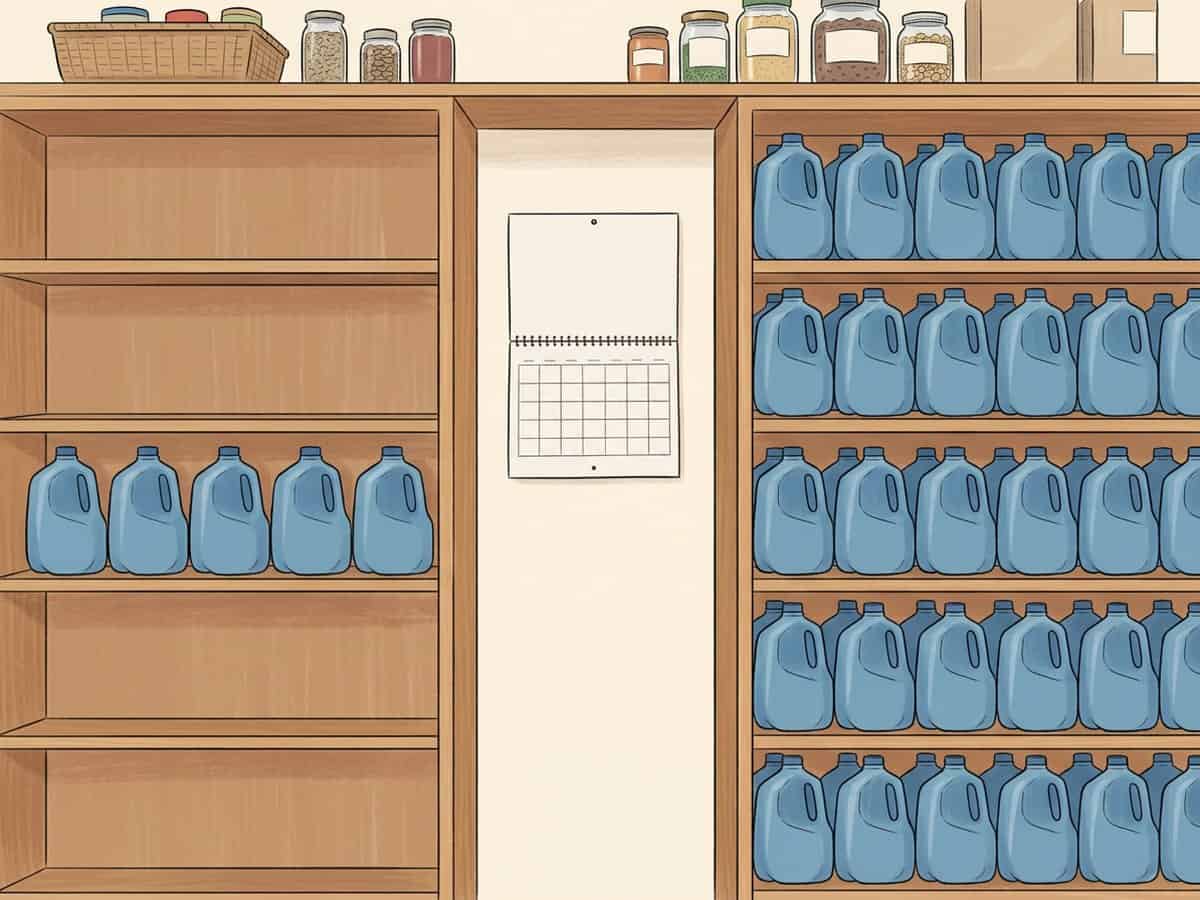
The arithmetic is the same for every household. A single adult storing for the CDC’s 3-day minimum needs 3 gallons. The same adult storing for 2 weeks needs 14. A family of four needs 12 gallons for 3 days and 56 gallons for 14 days. Every one of those figures is calculated from the 1-gallon allowance, and none of them adds anything for heat, illness or pets.
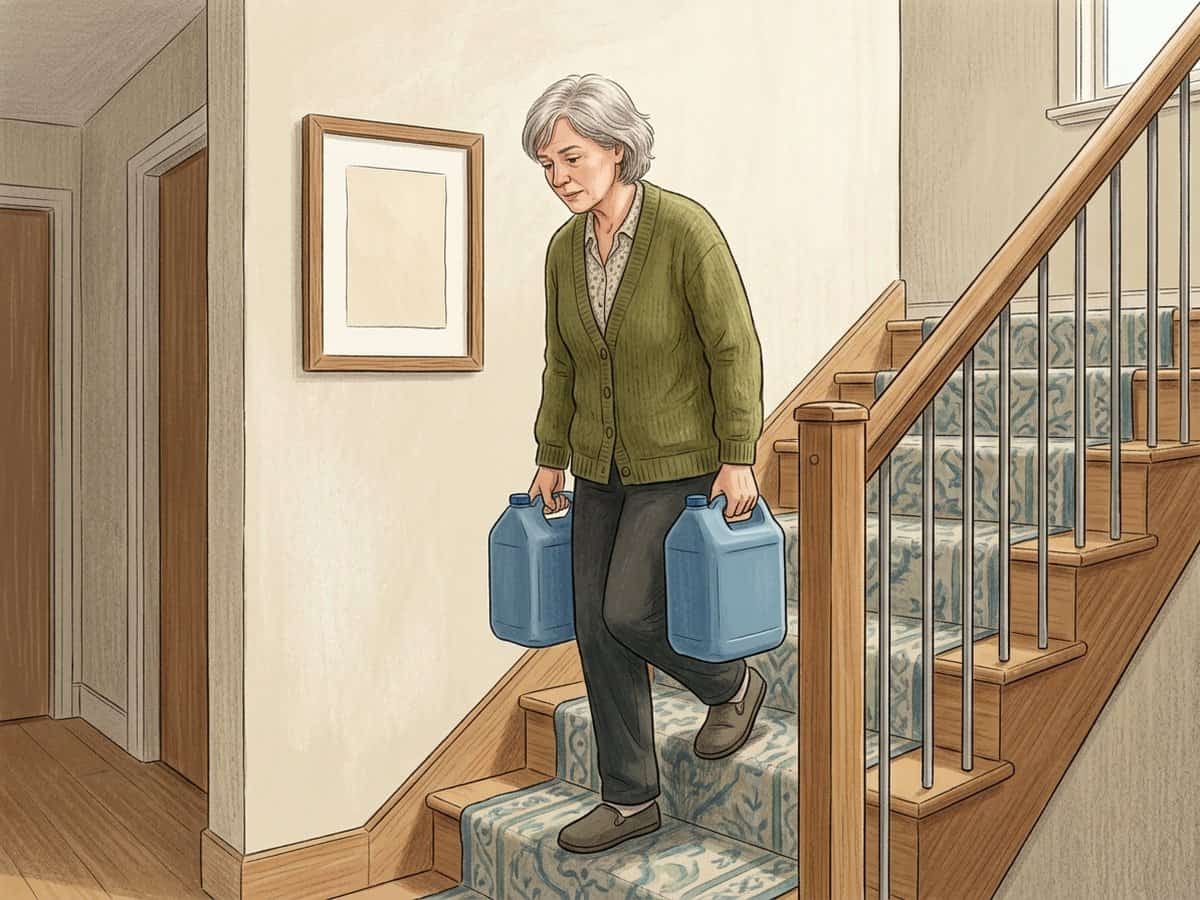
Weight is the part that surprises people. Water weighs about 8.329 pounds per U.S. gallon at 70°F, according to the U.S. Geological Survey. So a single adult’s 3-day supply is about 25 pounds of water, and a family of four’s 2-week supply is about 466 pounds (both calculated, container weight not included). That weight decides where the supply can safely live and how it gets moved.
How many days does your water cover?
Enter the people in your household and the gallons you have stored. The panel uses the published allowance of 1 gallon per person per day.
How this is worked out. Days covered is gallons ÷ people, rounded down to whole days, because the CDC and Ready.gov allowance is 1 gallon per person per day. Ticking very hot weather doubles the daily need, following Ready.gov’s statement that water needs can double in very hot temperatures. The gap is people × 14 − gallons, doubled in heat, and never shown below zero. Weight is gallons × 8.329 pounds (USGS, water at 70°F). All of it is arithmetic, not a judgment about any individual.
What it will not calculate. The panel gives no separate figure for infants, nursing mothers, illness or pets, because Ready.gov says these needs may be higher without publishing an amount. Treat its answer as the least you should have, and add a margin for anyone in those groups.
If the panel shows a gap, the household calculator turns it into a shopping list of containers, and the storage guide covers where to keep them: how much emergency water your household needs and how to store water long term.
Step 6
Three households, three answers
The same daily allowance produces very different supplies depending on who lives in the home and what the weather is doing.
One adult
01
The apartment on its own
3 gallons covers the 3-day minimum and weighs about 25 pounds. Fourteen gallons covers 2 weeks at about 117 pounds, which fits in a closet as a handful of containers rather than one heavy one (calculated).
Family of four
02
The standard plan
12 gallons for 3 days, 56 gallons for 2 weeks. The 2-week supply weighs about 466 pounds before containers, so it belongs on a ground floor or a slab, spread across several containers (calculated).
Heat wave
03
The same family in July
If needs double in very hot weather, the 3-day supply becomes 24 gallons and the 2-week supply 112 gallons. A household in a hot region should size its plan for this case (calculated from Ready.gov's doubling).
None of these figures includes pets. Ready.gov's water page publishes no per-animal amount, so this site does not print one. If you have pets, add water for them on top of the household total.
Step 7
What to do with this today
Knowing how much water you need per day to survive only helps once it becomes a supply you can see and count.
This week
Turn the number into water
0 of 5 steps checked
Unopened commercially bottled water is what the CDC calls the safest and most reliable source of water in an emergency, so buying sealed water is a perfectly good way to start. If you fill containers yourself, the CDC says to replace that water every 6 months. The storage-life guide explains both rules: how long emergency water can be stored.
Questions
Common questions about daily water needs in an emergency
These are the questions people most often ask when they search for how much water they need to survive.
Ready.gov says a normally active person needs about three-fourths of a gallon of fluid a day from water and other drinks. For emergency planning, the CDC and Ready.gov both say to store at least one gallon per person per day for drinking and sanitation, for at least three days. Neither agency publishes a lower survival minimum.
For a normally active adult, Ready.gov gives about three-fourths of a gallon of fluid a day. The National Academies report average total water intakes of about 2.7 liters for women and 3.7 liters for men, including water from food. In heat or during hard work the need rises, and Ready.gov says it can double in very hot temperatures.
Neither the CDC nor Ready.gov publishes a figure for how long a person can go without water, and the often-repeated three-day rule does not appear in their guidance. Tolerance depends on heat, exertion, age and health. The agencies' answer is to store enough that nobody has to find out, and never to ration drinking water unless authorities order it.
Store at least one gallon per person per day for at least three days, and try to store a two-week supply if possible, according to the CDC. That is 3 gallons per person for the minimum and 14 gallons per person for two weeks, before adding anything for heat, illness, young children or pets.
Yes. Both the CDC and Ready.gov describe the one-gallon allowance as covering drinking and sanitation together. That is why the storage figure is larger than the roughly three-fourths of a gallon Ready.gov gives as a person's daily fluid need. Bathing and laundry are not part of the allowance.
No. Ready.gov says never to ration drinking water unless you are ordered to do so by authorities. Drink what you need and look for more water. The better way to make a supply last is to store more of it before an emergency begins.
Keep going
Where to go next
The daily figure is the starting point for a household plan, and these pages carry it the rest of the way.
Sources
Where these figures come from
Every figure on this page is quoted from, or calculated from, one of these sources, checked in September 2026.
- Ready.gov, “Water.” ready.gov — about ¾ gallon of fluid daily for a normally active person; at least 1 gallon per person per day for drinking and sanitation; needs can double in very hot temperatures; children, nursing mothers and sick people may need more; never ration drinking water unless ordered by authorities. Checked September 2026.
- Centers for Disease Control and Prevention, “How to Create and Store an Emergency Water Supply” (reviewed June 27, 2025). cdc.gov — 1 gallon per person per day for 3 days; 2-week supply if possible; unopened commercially bottled water; 50°F–70°F storage; replace home-filled water every 6 months. Checked September 2026.
- Centers for Disease Control and Prevention, “About Water and Healthier Drinks” (reviewed March 5, 2026). cdc.gov — daily water intake recommendations vary by age, sex, pregnancy status, activity level and breastfeeding status. Checked September 2026.
- National Academies of Sciences, Engineering, and Medicine, news release on dietary reference intakes for water (February 11, 2004). nationalacademies.org — about 2.7 L (91 oz) total water for women and 3.7 L (125 oz) for men; about 80 percent from beverages; thirst as a guide. Checked September 2026.
- U.S. Geological Survey, “Water Density.” usgs.gov — 8.329 pounds per U.S. gallon at 70°F, used for every weight on this page. Checked September 2026.